Suramya's Blog : Welcome to my crazy life…

September 2, 2026

Hinduism – Symbolism of Om (ॐ)

Filed under: Article Releases,My Thoughts — Suramya @ 3:43 PM

Hinduism is one of the oldest religions in the world and is practiced by over 1.2 Billion people worldwide. It is known as the eternal Dharma. As all religions there are multiple symbols in Hinduism that have special meanings. I realized that there is a lot of knowledge that is known to our parents and grandparents but is not common knowledge in our generation and the next so I have decided to do writeup’s on some of the things and this is the first article in a series. Got this proofread by mom so should be accurate but am happy to discuss this with others as long as it is a respectful discourse.

In this first post I am going to talk about one of the major symbols in Hinduism Om and its meaning.

Om(ॐ)

Om is one of the most sacred syllable in Hinduism and is spoken before, during and after any Hindu prayer. It is also used extensively in Jainism and Budhism. In it’s essence it represents the primordial sound of the universe and is a sonic representation of the divine. It is from this first sound (vibration) all other vibrations are able to manifest.

Meaning of the Symbol

The Origins of Om can be traced back to the Vedas’. In Aitareya Brahmana of Rig Veda, section 5.32 states that the three components of Om (a + u + m) represent the three stages of cosmic creation.

a: Represents Brahma who created the universe or Creation.
u: Represents Vishnu who is the preserver
m: Represents Shiva, the destroyer.

The combination of these syllables reflects the cyclical nature of existence and the eternal cosmic dance of creation, preservation, and dissolution.

The visual representation of Om also has meaning and each curve, crescent and dot in fact corresponds to a specific state of reality. Using the numbers in the image below as reference we will expand on the meaning of each dot and curve in the symbol.
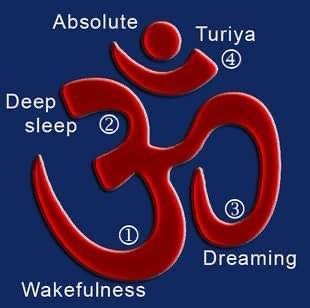
The Symbol Om

The large lower curve (1) marks the normal waking state (jāgrat). In this condition, the mind identifies with the physical body and perceives the world through the senses. 

The upper curve (2) indicates the unconscious state, or that of deep sleep (sushupti). This is a state of total unawareness, in which you are in a deep dreamless sleep, and you are withdrawn from both physical and mental activities. 

The middle curve (3) denotes the dream state (swapna). The dream state is in between the deep sleep and waking state, where a person explores the subconscious. Your consciousness is turned inwards, as your fears, hopes, and desires manifest themselves in an imaginary world. 

The dot is a symbol of enlightenment (4) (turiyā). In this state, a person becomes harmonized with the Absolute, recognizing that all of creation is made up of spirit and is united through that commonality. This state is beyond the mundane senses, and can only be achieved by associating with spiritual energy. 

The crescent represents maya (4), which separates the three curves from the dot. Maya is the illusion that binds an individual soul to the material world. By chanting Om, one can transcend the three curves of material consciousness, and attain the dot of enlightenment. 

Usage of Om and the Science behind it

Om represents the universal sound or the sound of the universe thus chanting Om aligns your being with the universal sound and that alignment helps promote peace, harmony and balance in the person chanting.

Interestingly science is rediscovering this and recently conducted studies found that a brief 5 min chanting of OM enhances parasympathetic nervous system activity, promotes relaxation, and provide calmness. [Source: Immediate Effects of OM Chanting on Heart Rate Variability Measures Compared Between Experienced and Inexperienced Yoga Practitioners]

Since Om symbolizes the beginning, and the end, all Hindu prayers start, and end with Om. In addition Om is is found at the beginning & the end of every chapter in the Vedas and all written prayers also start and end with Om.

Universal Access of Om

Because it encompasses the entirety of creation and the cycle of life, the usage of Om is not limited to Hinduism.

In Buddhism chanting of Om is considered a potent mantra with great spiritual significance. Buddhists chant Om during meditation and believe it to resonate with the rhythm of the cosmos, harmonizing the mind and body and guiding practitioners toward enlightenment (Nirvana).

In Jainism, Om (or Aum) is considered Navakar Mantra, i.e. the religion’s primary prayer. It honors the Pancha-Paramesthi (the five supreme beings) and serves as a powerful sonic and visual focal point for meditation. 

The symbol is formed by the initials of these five venerated figures, combined as A-A-A-U-M: 
• A stands for Arihant (a liberated soul who has conquered all inner passions).
• A stands for Ashariri / Siddha (a liberated, bodiless soul).
• A stands for Acharya (the head of the Jain monastic order).
• U stands for Upadhyaya (an ascetic teacher).
• M stands for Muni / Sadhu (monks or nuns following the five great vows).

Representation in various scripts (Source)

Northern Brahmic
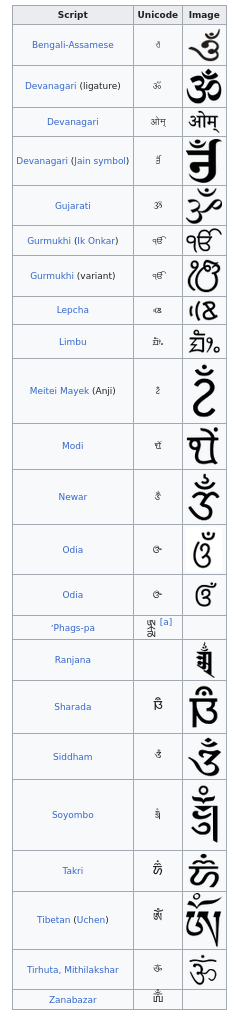
Southern Brahmic
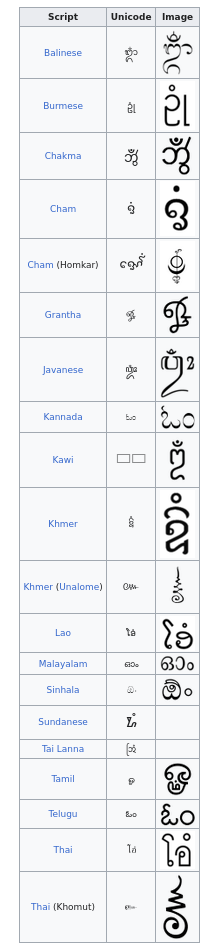
Non-Brahmic

Conclusion

Om stands as a timeless and universal symbol, embodying the essence of cosmic reality and the eternal quest for spiritual connection. Its power to transcend religious boundaries and resonate with seekers worldwide is a testament to its profound and transformative nature.

Om/Aum remains an enduring expression of unity, consciousness, and the eternal journey towards enlightenment.

August 29, 2026

Don’t be oversmart and set your phone for auto-wiping

Filed under: My Thoughts — Suramya @ 7:18 PM

Border crossings can be a bit scary with Immigration etc. Another thing that some folks worry about is the data on the phone as in most countries the immigration and border security folks have the authority to check your phone/other devices and see the data you are carrying. If you search online you will find various ‘solutions’ to this problem ranging from carry a burner phone (and download the data once you clear immigration) to having a passcode that deliberately wipes the contents of that device if entered instead of the user’s unlock passcode.

One user decided to implement the Auto-wipe functionality on his phone before entering the US and when Border Patrol asked for the passcode he gave the wipe code instead which wiped his phone. As expected the agents didn’t like this and he is now being prosecuted for giving border officials a code that wiped his phone. While it is technically legal to wipe your phone like this, my personal feeling is that it is better not to be over-smart in such situations. Even though he is technically in the clear he still has to deal with the hassle of arrest/prosecution etc and this will be a black mark in his record the next time he applies for a visa.

When I first went to the US back in 99, my dad told me not to be a smartass with security or immigration personnel. What you say as a joke can be taken in the wrong way by the agent and then you are on a backfoot trying to explain that it was just a joke but by then it is too late. So at the counter I answer as briefly as possible while giving the relevant information they asked for without any jokes or high tech stunts like this one. The immigration agents can ask whatever question they feel is relevant and you can’t tell them that it is none of their business (Someone I know recently told the immigration folks in Malaysia that it was none of their business where she was going in the country… I was surprised they let her into the country after that but I guess she got lucky).

If I ever had to carry data that I didn’t want to show at border security I would just ensure I don’t have it on my phone as there are multiple ways you can download it back after you clear security & immigration. So don’t be oversmart and get into trouble.

Source: Schneier.com: American Being Prosecuted for Wiping His Phone Before Handing It Over to Border Officials

– Suramya

July 23, 2026

Researchers successfully create Room-Temperature Quantum Material

Filed under: Quantum Computing,Tech Related — Suramya @ 11:33 PM

Quantum Computing has tremendous potential to change the world of computing forever but there are significant challenges that need to be addressed. One of the challenges is that in order to function as a superconductor the system has to be kept between 0.01 to 0.015 Kelvin or -273.14°C. As you can imagine this is hard to do and obviously impractical for consumer / commercial devices.

We are a step closer to solving this problem as Researchers from Louisiana State University have developed a material that can demonstrate quantum weirdness at room temperature. This material is basically a thin layer of gold on a glass chip and is carved with microscopic patterns that act like artificial atoms which carry Quantum states. The crystal chip can distinguish them and move them from one point to another without requiring cryogenic cooling. Which opens the door to practical quantum technologies.

Crucial to the new material’s room-temperature operation is the way it shifts the focus from electrons and atoms to photons (particles of light). This overcomes the usual atomic-level disruption that heat brings with it. The material is what’s known as a plasmonic metacrystal: ‘Plasmonic’ because the light traveling over it makes ripples of electrons known as plasmons, and ‘metacrystal’ because it’s an artificially created crystal. The tiny slit patterns etched into the material act as artificial atoms (meta-atoms), which dictate how different photon groups pass through (the quantum behavior).

“By engineering the distribution of meta-atoms in the plasmonic metacrystal, we can systematically dictate which quantum statistics are allowed to pass through the structure,” says physicist Riley Dawkins. “So, our crystal essentially acts as a statistical filter on quantum states.” That means as light enters the chip and travels across the gold surface, it’s manipulated by the meta-atoms — and by tweaking the size, shape, and spacing of the slits, different end results can be produced at the quantum level. In practice, this means that certain quantum states of light can be transported with less disruption.

The findings have been published in Nature Journal earlier this month.

Source: Slashdot: LSU Physicists Create First Room-Temperature Quantum Material

– Suramya

July 22, 2026

Screens that can simultaneously work as a Camera are now potentially possible

Filed under: Emerging Tech — Suramya @ 11:55 PM

A camera is a camera and a screen is a screen, till recently they couldn’t be both simultaneously. But last month researchers from ETH Zurich in Switzerland, have created a new type of pixel that can do both at the same time. This hypercharged pixel, called a Fourier pixel, can generate and sense arbitrary light fields and tap into a pixel’s full potential for carrying information by manipulating light’s intensity, oscillation phases, and polarization. Meaning it can display an image and act as a camera at the same time. The paper on the team’s findings was published in Nature.

This technology when matured could pave the way for camera–display devices that both display images and act as a camera. One interesting use case would be full functional invisibility. For years we have seen invisibility cloaks, invisible cars and cloaking tech on the movie/TV screens, but most efforts to recreate them have not been successful so far. With this new technology it might soon be possible to have cloaking tech available for use. (At least on the visual spectrum)

Digital cameras and displays use picture elements (pixels3) that perform a single function: detecting or emitting light intensity. To exploit the full information content of electromagnetic waves, more advanced elements are required. This has driven the development of multifunctional components that, for example, simultaneously detect and emit intensity or extract intensity and spectral information. However, no pixel exists that both senses and generates optical wavefronts with full control over amplitude, phase and polarization, limiting bidirectional control and feedback of sophisticated light fields. Here we present a route to such pixels by demonstrating a versatile platform of miniaturized diffractive elements based on Fourier optics. We use plasmonic surface waves, which propagate coherently and efficiently across metallic surfaces. When these plasmons are launched towards wavy microstructures designed with simple Fourier analysis, arbitrary and background-free optical wavefronts are generated. Conversely, incoming light can be sensed, and its amplitude, phase and polarization can be fully characterized. By combining or superposing several such components, we create multifunctional ‘Fourier pixels’ that provide compact and accurate control over the optical field. Our approach, which we extend to photonic waveguide modes, establishes a scalable, universal architecture for vectorially programmable pixels with applications in adaptive optics, holographic displays, optical communication and quantum information processing.

As with all technologies there is potential for misuse as well because every screen becomes a unobtrusive camera which increases the ability for performing surveillance. Imagine having a TV with this functionality. Then imagine hackers gaining control of the screen to record personal movements. Then imagine an authoritarian government doing the same constantly. This was explored in the novel 1984 by George Orwell.

The telescreen received and transmitted simultaneously. Any sound that Winston made, above the level of a very low whisper, would be picked up by it; moreover, so long as he remained within the field of vision which the metal plaque commanded, he could be seen as well as heard. There was of course no way of knowing whether you were being watched at any given moment.

Source: Schneier on Security: A Video Screen That Is Also a Camera

– Suramya

July 21, 2026

Suramya’s Blog now auto-publishes to BlueSky in addition to Mastodon and Linkedin

Filed under: My Thoughts,Website Updates — Suramya @ 12:39 PM

People who know me know that I am not really active on Social Media, and by Social Media I am referring to the sites like Facebook, Instagram and Twitter. Instead I use Mastodon which is an open source equivalent of Twitter and Pixel which is an Opensource version of Instagram. I don’t use Facebook or Twitter because it doesn’t show me what I want to see, which is updates from friends.

Facebook is basically trying to show you stuff that keeps you on the site for as long as possible and it also tries to push Incel, misogynist, white supremacy and Flat earth conspiracy theories to you. You might think that I am yet another doomsayer who is ‘anti-capitalist’, anti-tech etc but this statement is based on personal experience. I have a Facebook account that I created over a decade ago for testing scripts that would push posts to Facebook automatically. I have never used it for surfing content or liked any account/post etc from it. A few days ago  I was changing the passwords on all my accounts and logged into the site for the first time in a while using this account. What I noticed was that the site was pushing accounts that were either trying to teach you to pick up girls, posts on flat earth, Cockroach Janta Party and then pro-trump posts. It shows you how they are pushing a certain agenda and a majority of the posts seem to be auto generated AI slop.

In any case, as I have posted earlier all posts on this blog are auto published on Mastodon and all comments/likes etc are synced back here automatically. Basically the site is a full fledged node on Mastodon. I use the official plugin called ActivityPub to achieve this and it has worked fantastically so far. The same folks have recently released a plugin called ATmosphere that does the same thing for BlueSky. BlueSky is the unofficial successor/replacement for Twitter and a lot of folks who were active on Twitter migrated to BlueSky when Twitter was taken over by Musk.

I do have a blue sky account but am not super active over there. I keep the account alive because a lot of folks I like to follow are active there. Till recently the only way I could Federate the blog posts to BlueSky was to push the post to Mastodon, where a bridge account posted it to BlueSky and then I would manually republish it. But all that is in the past now. With the new plugin I installed yesterday the Blog posts are auto posted to BlueSky directly under my account there automatically and when people on Bluesky reply, like, or repost what you shared, those reactions show up as comments on the post you made and approved comments left here on this Blog are sent right back to Bluesky as replies under the original post. This way I can remove the manual steps for BlueSky and hopefully this will showcase the stuff I post to a wider audience and get more visitors to the Blog :).

This post will be the first (non-test) post that gets published to BlueSky and Mastodon simultaneously.

– Suramya

July 20, 2026

Skyroot successfully becomes the first private Indian company to launch a payload into orbit on 1st attempt

Filed under: Astronomy / Space,My Thoughts,Science Related — Suramya @ 11:17 PM

In a historic first, on 18th July India’s first private orbital launch named Vikram-I, successfully lifted off from Sriharikota and has successfully placed multiple technology demonstration payloads into orbit. These payloads include two satellites named SCOPE & Grahaa which were injected to a Low Earth Orbit along with others that carry out various in-orbit experiments.

This is a phenomenal achievement by Skyroot Aerospace Private Limited which was founded in 2018 by two ISRO scientists. Skyroot became the first private Indian company to successfully reach the space in first attempt making India the third country in world after USA and China to have rocket launch by private company. The really cool fact about this is that the average age of the company staff is 28. So much for the youth today not doing anything new…

Skyroot Aerospace had earlier conducted a sub-orbital launch of a test rocket, Vikram-S from Sriharikota on November 18, 2022. Subsequently, Vikram-I was developed as a 4-stage rocket with 3 solid stages and a liquid stage, which can launch small satellites to LEO. ISRO& IN-SPACE provided handholding and support to this venture by facilitating this launch. ISRO provided access to the solid motor casting and static test facilities at SDSC, Sriharikota. The first stage solid motor was cast and tested at the facilities in SDSC. The second stage motor was also validated at the static test facility in SDSC.

The liquid engine used in the VIKRAM-I upper stage (RAMAN-I)was also tested at the LPSC test facility. During the pre-launch operations, all support was provided for the vehicle stage preparation, material handling, transport of stages to launch pad, trajectory analysis and vehicle integration on the First Launch Pad (FLP). ISRO’s safety team was ensuring safe operations by the Skyroot team at SDSC on a 24×7 basis.

IN-SPACe, the regulation & promotion agency for space activities in the country, played a major role in establishing a seamless mechanism for Non-Governmental Entities (NGEs) like Skyroot Aerospace to access the facilities of ISRO and provide the necessary technical consultancy, mission readiness reviews and launch clearances. ISRO & IN-SPACe congratulates the team at Skyroot Aerospace for the successful maiden launch of Vikram-I launcher. This launch has paved the way for similar ventures and opens up the gates to global commercial opportunities.

Hats off to the team at Skyroot and looking forward to more such achievements from them in the near future.

Source: ISRO: First private orbital launch lifts off from Sriharikota

– Suramya

July 5, 2026

Cheaters complain about use of hidden prompts to snare AI peer reviews

Filed under: Artificial Intelligence,My Thoughts — Suramya @ 11:49 AM

AI (or rather LLM’s) use is becoming more & more common and one of the issues with it (amongst many) is that when you ask it to summarize/process/or whatever something you have to upload that content to servers that are outside your control, then to make things worse a lot of these services use the data uploaded to further train their models. It is not illegal because they have put it in the user agreement that you allow them to use the data in anyway they want. Once the model is trained on data you have uploaded then it is possible for others to extract this data with a specific prompt. This happened to Samsung back in 2023 where an engineer uploaded internal source code to ChatGPT and another user was able to download it.

So the stakes are quite high when scientists are asked to peer-review papers that can contain significant breakthrough’s. Secondly a good peer review evaluates a paper and a lot of times identify issues that the author needs to address before publishing. Using AI for this can significantly degrade the quality of the review and this was identified as an issue by multiple publications.

The 40th Annual Conference on Neural Information Processing Systems (NeurIPS) has strict rules banning peer reviewers from uploading papers they are reviewing to AI chatbots but they are allowed to use AI chatbots for background research. This is pretty normal nowadays but they went a step further to enforce this policy and catch illicit AI use by deliberately concealing instructions for large language models (LLMs) in papers sent out for peer review. These instructions instruct LLM’s to use specific phrases in the review report allowing the organizers to identify the reviewers who breached policy.

The instructions tell an LLM to use telltale phrases—such as “This work addresses the central challenge” and “The claims of the paper”—in a peer-review report. Some researchers have already been caught trying to sneak secret messages into their papers in a bid to game AI tools into giving them favorable referee reports. Many publishers ban the use of AI in peer review.

Most people are in favor of this action but there are some who have been pretty vocal about not liking this action. They claim that “Designing a trap that presumes bad faith corrodes the relationship the whole system depends on,” and “You do not build a healthy reviewing culture by treating your reviewers as suspects.” I have a feeling that folks in this group are the ones who were previously using LLM’s in their review and are not happy about being caught. Is this a perfect method to catch folks who are cheating? Of-course not, but it is better than what we had earlier.

Some of the justified criticism against this method is coming from reviewers who found the embedded prompts in the paper and assumed that they were put in by the paper authors (there have been multiple cases where authors put in hidden prompts in their papers to give them favorable reviews).

Source: Scientists decry conference’s use of hidden prompts to snare AI peer reviews

– Suramya

June 24, 2026

Candidate rejected by interviewer for wearing a shirt that said “I’m too Hot for a Job”

Filed under: My Thoughts — Suramya @ 11:10 PM

Recently an Amazon executive revealed that she had rejected a candidate who showed up to an interview in a T-Shirt that said “I’m too Hot for a Job”. This caused a lot of noise on social media with folks either supporting her or calling the interviewer out for rejecting the candidate for no good reason. I am in the former camp and would have rejected a candidate if they came for an interview dressed like that.

I personally love quirky T-Shirts and about half of the T-Shirts I have have some saying/joke on them (At one point it was more than 90% of my T-Shirts) but I have never worn them to work, or even to meet people who I know on a professional basis. At one point a few years ago I remember complaining that I wasn’t able to wear any of my T-Shirts because of this, which is when I started getting T-Shirts that were more neutral and less quirky. The reason for that rule is quite simple, there is a time and place for everything and a Job *Interview* is not where you wear such clothes. I have worn a suit to pretty much all my in person interviews and I wear a formal shirt for Virtual video interviews.

People supporting this girl say that if the company dress code allows it then it is hypocritical to punish the person for it during the interview but I look at it differently. Yes the dress-code might allow it but even then I would question the judgement of a person who came into the office in a shirt that says “I’m too hot to for a Job”. I can’t even imagine wearing something like that to work forget a job interview. Maybe in a non-corporate environment something like that would be ok but not at a major company for a white collar job.

You are judged by what you wear and during an interview every gesture & action of yours is being scrutinized and judged. I remember reading about a company who asked their receptionist about each candidate and how they treated her and factored that into the hiring process. Please note that I am not saying that you should only go to interviews wearing a suit. I do that because I am comfortable in it and most of the companies I worked for in the past decade and half have been banks where formality is expected. But even when interviewing at a startup, I would suggest wearing a formal shirt or at least something neutral without any slogans/jokes/weird artwork etc. You have a lot of competition for the position and it would be a shame to loose it because of what you wore.

“This isn’t about dress codes. It’s about understanding context. You don’t wear swimwear to a wedding. You don’t wear a tuxedo to the gym. And maybe, just maybe, you don’t show up to an interview wearing a T-shirt that literally announces you’re too good for the thing you’re interviewing for,” she added.

According to Jain, the issue was not that the candidate chose casual clothing or failed to wear traditional business attire. Rather, it was the message displayed on the T-shirt that she felt sent the wrong signal during a job interview. The slogan, she argued, suggested a lack of seriousness about the opportunity and created an impression that the applicant considered herself above the role she was seeking.

The flip side of this is that the hiring manager/HR should also refrain from overly judging people on what they wear. For example rejecting someone because you didn’t like their brand of shoes or clothes would be wrong. It might not be what you would wear but as long as it is not shabby or offensive I feel it should be ignored. However, depending on the position someone is interviewing for, the right dress could potentially make or break the deal.

I recommend researching the company in advance before the interview so you know what to expect and if you don’t then you are taking a risk. I had a candidate who missed their interview with us because the company security didn’t allow them inside because they were not properly dressed. This was at a bank where we weren’t allowed to wear jeans to work and this guy showed up for the interview in Bermuda shorts, slippers and an artfully torn T-Shirt.

Remember, if you are too formally dressed then you can always take off the tie or the blazer and look more casual. I did that at a Startup meet in France where I was the only one wearing a tie at the event so I took it off and it was good. It it was the other way round where everyone was wearing a tie and I wasn’t then I would have been in trouble.

Long story short, an interview is not somewhere you show up wearing T-Shirts with jokes or torn clothes or Artsy look (unless you are applying for an art position) it is where you are expected to put your best foot forward.

– Suramya

June 21, 2026

Saying there are legit uses of AI is not really an answer to the issues being raised against AI by creatives

Filed under: Artificial Intelligence,My Life — Suramya @ 4:08 AM

There is a reason John Scalzi is one of my favorite authors in the world. He is outspoken about issues that are close to his heart and like most authors he is not a fan of AI. In fact he has a clause in his contracts that all artwork, translation etc on his books will be done by actual humans instead of AI. The creative crowd doesn’t like AI because the models are trained on media & text without licensing and thus without paying the original creator and the content it creates is actually quite bad, Plus the suits (management) want to fire all the creatives so that they can use the scholastic parrot to create stuff without having to pay for it.

John had the perfect comment explaining why the creatives dislike the people who pop up in their feeds when they complain about AI saying that there are legit uses for it:

Alt Text in Blockquotes below the image
John Scalzi on AI

I don’t know how to explain to the people who pop up when creatives complain about “AI” to say there are legit uses for it just how much they sound like someone saying “Well actually fire is used to make bread” when people are talking about an organized arson ring burning down their fucking houses
7:23 AM · Apr 11, 2026

– Suramya

June 20, 2026

Gyan Bharatam Mission: To identify, evaluate, preserve and digitize ancient manuscripts from across India

Filed under: Interesting Sites,My Thoughts — Suramya @ 3:37 AM

India has a lot of knowledge and information hidden in scrolls, manuscripts that are unfortunately poorly documented which makes it hard to locate and preserve this knowledge in an organized way. Earlier this year the Ministry of Culture launched the Gyan Bharatam National Manuscript Survey that aims to identify and document these manuscripts located across India. Once the we have a national ‘Manuscript Presence Map’ that shows where these documents are located, what they are about and in what condition they are in the government can then start prioritizing their preservation and digitization based on content, need and condition of the documents.

These will then be available to future researchers and scholars across the world in digital form similar to how various museums and libraries in the world are making their catalogs available digitally globally.

The Gyan Bharatam National Manuscript Survey will be conducted through a four-stage framework:

  • The first stage focuses on the identification of manuscripts and their locations through submissions on the digital platform, leading to the creation of a national manuscript presence map.
  • The second stage involves physical verification by experts and state authorities.
  • The third stage includes detailed cataloguing and metadata creation, such as identification of language, script, and subject.
  • The final stage focuses on conservation support and high-quality digitisation of manuscripts to enable long-term preservation and research.

I think that this is a great initiative by the government and having all this information in a central database will allow us to cross-reference across various sources and showcase the rich and extensive history of Indian Knowledge to the future generations. This is especially important because for too long we have been put down by various external (and some internal) so called experts who claim that India was nothing before it was colonized. Where as in reality India was one of the most productive and knowledgeable country in the world till it was systematically looted with our knowledge and past whitewashed to the point where it was almost forgotten.

You can download the app or view the site to help contribute to this effort to preserve our history: App Store download link, Play Store download link and Website.

– Suramya

Older Posts »

Powered by WordPress