Suramya's Blog : Welcome to my crazy life…

June 9, 2023

Sound based Quantum Computers are now closer to reality due to breakthrough research

We all know about the ongoing efforts to build a Quantum Computer by encoding information into quantum states of particles of light (photons), however there is a parallel effort ongoing that is trying to build Quantum Computers that are based on Sound instead of light. This effort being led by Andrew Cleland at the University of Chicago, just had a major breakthrough and created a device that is a key component in building a sound based Quantum Computer.

Phonons are the fundamental quantum vibrations within materials, with individual phonons representing the collective motion of many trillions of atoms. The team built a chip that allows them to create single phonons on demand which are about a million times higher pitched than audible sound. They then passed it into a beam splitter which consists of 16 tiny, parallel aluminium strips designed so that any sound that hits them gets reflected and transmitted in equal parts. At supercooled temperatures they found that the Phonon entered a quantum superposition state where the whole particle was simultaneously in the state of being reflected and transmitted.

Cleland says that this is exactly what they hoped would happen because this process is a necessary step for running calculations on quantum computers that rely on particles of light. To make their chip even more like a sound-based quantum computer, the researchers also successfully recreated the way two particles of light are commonly made to “talk to each other” and how their behaviour is controlled during light-based computations.

Here, they simultaneously sent two phonons from opposite directions into the beam splitter and saw their respective superposition states influence each other. In the future, they will use this procedure to implement simple operations that make up computer programs.

Dirk Bouwmeester at the University of California, Santa Barbara, says that for particles of light, procedures like quantum teleportation or creating entanglement hinge on using beam splitters, and now they could be done with particles of sound as well. “It is truly spectacular that the team could replace photons with phonons,” he says.

There are a lot of interesting applications for this technology once it matures, for example it could be used to connect computer components that are hard to connect to each other. Using sound as the carrier instead of light opens up more possibilities. Their research has been published in the Science Journal (DOI: 10.1126/science.adg8715)

Source: NewScientist: Sound-based quantum computers could be built using chip-sized device

– Suramya

June 7, 2023

Proof of Concept setup demoing technology to beam solar power down to Earth successfully demoed

Filed under: Astronomy / Space,Emerging Tech,Science Related — Suramya @ 4:20 PM

The ability to beam power from space to earth has long been a staple of Science Fiction books and movies. On the surface it makes sense, space is huge and if we can setup solar panels in space to collect energy and get it to earth in a usable format then it is a win-win. No more having to deal with fossil fuels/nuclear reactors etc. Folks have been working on this for over 5 decades now and progress was slow as most people focused their efforts on other options such as improving land based solar panels, geothermal etc etc.

Now researchers from California Institute of Technology (Caltech) have successfully demonstrated MAPLE (Microwave Array for Power-transfer Low-orbit Experiment) which is an array of 32 flat antennas packed onto a surface slightly larger than a dinner plate. During the experiment the energy was transmitted to earth and successfully received by a receiver on the roof of the Gordon and Betty Moore Laboratory of Engineering and they were able to successfully target receivers about a foot away alternatively and transmit ~200 milliwatts of power to the receiver that powered a LED light.

Using constructive and destructive interference between individual transmitters, a bank of power transmitters is able to shift the focus and direction of the energy it beams out—without any moving parts. The transmitter array uses precise timing-control elements to dynamically focus the power selectively on the desired location using the coherent addition of electromagnetic waves. This enables the majority of the energy to be transmitted to the desired location and nowhere else.

MAPLE features two separate receiver arrays located about a foot away from the transmitter to receive the energy, convert it to direct current (DC) electricity, and use it to light up a pair of LEDs to demonstrate the full sequence of wireless energy transmission at a distance in space. MAPLE tested this in space by lighting up each LED individually and shifting back and forth between them. The experiment is not sealed, so it is subject to the harsh environment of space, including the wide temperature swings and solar radiation that will be faced one day by large-scale SSPP units.
..
..
MAPLE also includes a small window through which the array can beam the energy. This transmitted energy was detected by a receiver on the roof of the Gordon and Betty Moore Laboratory of Engineering on Caltech’s campus in Pasadena. The received signal appeared at the expected time and frequency, and had the right frequency shift as predicted based on its travel from orbit.

This is a big step forward, but I still have major doubts about the feasibility of the project, at least in the current form. Here we are using microwaves to transmit the energy from space to earth, at the level of power we need to transmit the microwave beam will cook anything that crosses it, for example if a plane flies through the beam you can say goodbye to the passengers. Even if we decide that we will establish a no-fly zone around the area what is to stop birds etc from flying into the beam and getting fried. Another problem is that microwave beams generate heat as a side-effect and that can cause a major heating of the atmosphere and change the air-currents which can cause a massive environmental impact.

We also need to consider that in order to collect the solar energy at a scale where it would be useful and make financial sense we would need to setup massive solar-panels in space. This will case a huge problem for astronomers. We already have issues being caused by the Starlink Satellites, this will be the same but at a much larger scale.

However, that being said I see the potential and if we can ever get quantum entanglement or spooky action at a distance as Einstein called it working reliably and consistently then that could potentially be used to transmit the power to earth without frying everyone in the path.

Lets see what else the researchers come up with…

Source: Caltech.edu: In a First, Caltech’s Space Solar Power Demonstrator Wirelessly Transmits Power in Space
Science.org: Satellite beams solar power down to Earth, in first-of-a-kind demonstration

– Suramya

June 5, 2023

Map Directions can’t always be trusted

Filed under: Humor,My Thoughts — Suramya @ 5:49 PM

There are too many cases where someone followed Google Maps or Apple Maps blindly and ended up somewhere they weren’t supposed to. Before Google maps was available Map My India was the most up to date option available for maps in India. I remember one time me and Gaurang were on my way to visit friends and the map kept insisting that we take a left from the top of the flyover. This was before the time when algorithms would auto update the route if you missed the turn so it kept insisting that we take a U-Turn and turn from the top of the bridge. Ended up having to restart the session before it gave us an alternative route.


As I walk through the valley of the shadow of death, I remind myself that you can't always trust google maps.
As I walk through the valley of the shadow of death, I remind myself that you can’t always trust google maps.

Even with Google Maps you have to watch where it is trying to take you, I once was directed to take a road that was about six inches wider than my car, (It started a bit wider and narrowed as I drove into it) had to reverse back out of the way before I got stuck there. Apple maps is even ‘better’ in that Australian Police had to release an advisory back in 2012 warning people about its Potentially Life Threatening” Misdirection.

There is no system that is 100% up to date and accurate but it is expected that when you are you following directions, you use your own brain as well once in a while so you don’t end up in the middle of a desert, or drive into a lake or take a longer way to get where you are going.

– Suramya

May 29, 2023

There are Two kinds of people in the world…

Filed under: Humor,My Thoughts — Suramya @ 7:23 PM

There are Two kinds of people in the world…

There are Two kinds of people in the world... 1. Those that think EOD means 5:00pm 2. those that think EOD means 11:59pm
There are Two kinds of people in the world… 1. Those that think EOD means 5:00pm 2. those that think EOD means 11:59pm

Which one do you fall under? I actually fall under neither because for me EOD is when I sign off for the day which is usually about 1am-2am depending, as when I say EOD I mean my End of Day i.e. when I log off for the day/night.

– Suramya

May 22, 2023

How not to do Interview Screening: Take 1000

Filed under: Humor,My Thoughts — Suramya @ 9:05 PM

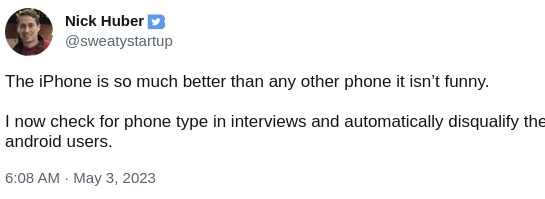
Interviewing people is hard and each of us has their own bag of tricks and filters we use to identify the correct candidate for the position. However, some of the ways that people use to filter out applicants just make you go ‘Wow!’ with a head shake. One such example is below:

The iPhone is so much better than any other phone it isn't funny. I now check for phone type in interviews and automatically disqualify the Android Users
The iPhone is so much better than any other phone it isn’t funny. I now check for phone type in interviews and automatically disqualify the Android Users

Using a phone preference as a filter is not the right way to filter out candidates, if this becomes the norm then folks will start filtering candidates on what music they like, what brands they wear or what car they drive. Unless you are working at apple rejecting people for using an Android phone (which for the record is way better then iPhone) is foolish. It is also extremely classist, it automatically filters out people who can’t afford to buy an expensive iPhone as the General cost range for an iPhone is between $500 – $1,500+ whereas an Android phone would range between $100-$1,750+. It also filters out people who care about compatibility of their phone with other users at their home as it is hard to connect an iPhone to an Android ecosystem.

Plus it tells me that you are more concerned about arbitrary markers of evaluation than actually relevant criteria. Personally, I think that if the person interviewing me is using something like this as a filtering mechanism then I am better off getting rejected as who know what insane criteria they might come up with for performance evaluation once you join and start working with them.

I do have a lot of thoughts on interview processes and how some companies do screening but that is a post for another time.

– Suramya

May 19, 2023

KeePass exploit helps retrieve cleartext master password – Fix ETA July 2023

Filed under: Computer Security,My Thoughts,Tech Related — Suramya @ 8:06 PM

Security is hard to do and no matter how careful you are while coding every software will have bugs in it and some of these bugs have major security implications. Keepass which is a very popular password manager is vulnerable to extracting the master password from the application’s memory, allowing attackers who compromise a device to retrieve the password even with the database is locked. The bug is being tracked as CVE-2023-32784.

The issue was discovered by a security researcher known as ‘vdohney’ who has unfortunately also published PoC code that exploits the vulnerability called the “KeePass Master Password Dumper” on GitHub.

KeePass Master Password Dumper is a simple proof-of-concept tool used to dump the master password from KeePass’s memory. Apart from the first password character, it is mostly able to recover the password in plaintext. No code execution on the target system is required, just a memory dump. It doesn’t matter where the memory comes from – can be the process dump, swap file (pagefile.sys), hibernation file (hiberfil.sys), various crash dumps or RAM dump of the entire system. It doesn’t matter whether or not the workspace is locked. It is also possible to dump the password from RAM after KeePass is no longer running, although the chance of that working goes down with the time it’s been since then.

Tested with KeePass 2.53.1 on Windows (English) and KeePass 2.47 on Debian (keepass2 package). PoC might have issues with different encodings (languages), but that’s not confirmed as of now (see issue #3). Should work for the macOS version as well. Unfortunately, enabling the Enter master key on secure desktop option doesn’t help in preventing the attack.

The attack does require either physical access to the system or the system would need to be infected with Malware that give an attacker remote access with the ability to perform thread dumps. They can also extract the password from the process dump, swap file (pagefile.sys), hibernation file (hiberfil.sys) or RAM dump of the entire system.

The fix for the problem is in the works and the initial testing looks promising. Personally I think that the security researcher should have waited to release the PoC code till the fix is available but to each their own I guess.

Source: Bleepingcomputer.com: KeePass exploit helps retrieve cleartext master password, fix coming soon

May 18, 2023

Lost in Translation: Movie Synopsis edition

Filed under: Humor — Suramya @ 10:52 PM

This screenshot of the synopsis for ‘Alien’ popped up in my feed earlier and I couldn’t stop laughing.

“Space ship people get up from sleeping coffin and have eat. Computer woman find strange noisings on planet and astronauts go to seeing. Astronauts find big elephant man who dead then find too many egg/

Astronaut is possess by egg demon and new egg demon is come when eat bad noodle. Seven friends and cat all try to find egg demon before ship go home but is hard working.

Who will life to escaping? Who is bad milk blood robot? Scream not working because space make deaf.”

This reminds me of “All your base are belong to us” which was another masterpiece of bad translation.

– Suramya

May 17, 2023

Request to advertise ‘Men’s Beauty’ topics on Linuxgazette.net

Filed under: Humor,Linux/Unix Related — Suramya @ 7:18 PM

As some of you might know, I host a mirror for Linuxgazette.net and this usually results in an email every couple of months for changes to the existing articles and requests to advertise. I recently received an email requesting information about linuxgazette.net for advertising. Now there are a few problems with this, firstly I don’t host linuxgazette.net I just host a mirror of the site. Second problem was the content/topic they want to advertise on the site:

Beards seem to have become popular again, but do you think they will stick? Time will tell, but personally, I wouldn’t mind seeing more men with a cleanly shaven face 😍

I’m getting in touch today because I have some clients looking for advertising opportunities that are related to Men’s Beauty (Should I call it Men’s “Beauty”). After I stumbled across linuxgazette.net I figured I’d reach out and see if you ever work with brands, or have a media kit available.

I mean historically Linux admins do have a reputation of keeping big beards but this is ridiculous. Of course I know that this mail was probably sent out by an automated bot but it did make me laugh .

– Suramya

May 16, 2023

Using AI powered chatbots to answer questions about a book series

One of the things that I have been wanting for a while is the ability to look up stuff about a book or series so that when a new book in the series comes out I don’t have to re-read the old books before starting the new one. I end up doing that because otherwise since I have forgotten a large part of the backstory it would make the new book a lot less enjoyable. There are some authors who solve this problem by summarizing the backstory when the book starts and it is really useful. When ChatGPT and associated AI bots started picking up one of the ideas I came up with was to create a chatbot trained on a book series so that I can ask it a question about the book and get an answer. Would be really useful when dealing with book series with a large cast and multiple overlying stories.

Recently privateGPT showed up in my feed with the following claim: “Ask questions to your documents without an internet connection, using the power of LLMs. 100% private, no data leaves your execution environment at any point. You can ingest documents and ask questions without an internet connection!” and it seemed like it was the perfect tool for what I wanted to do so I downloaded the program from GitHub and set it up on my machine.

Once the software was installed, I copied a single book from the Mercedes Lackey Valdemar series called Darian’s Tale 01: Owlflight into a temp directory and told privateGPT to ingest the contents. The ingestion took hours even though the file was only ~600kb in size, I left it running overnight and it completed sometime during the night. Then I ran the prompt to be able to query the chatbot. The first few times I tried querying it, the app crashed because I ran out of memory. So I enabled SWAP on my system and then it finally ran the query and answered.

Unfortunately the answers I got were complete nonsense. You can see the questions I asked and the answers I got below:

Enter a query: what is a heartstone

llama_print_timings:        load time =   974.93 ms
llama_print_timings:      sample time =     0.00 ms /     1 runs   (    0.00 ms per run)
llama_print_timings: prompt eval time =   974.77 ms /     7 tokens (  139.25 ms per token)
llama_print_timings:        eval time =     0.00 ms /     1 runs   (    0.00 ms per run)
llama_print_timings:       total time =   977.55 ms

A heartstone is a type of music that is typically composed in the key of F major. It is characterized by a steady rhythm and a melody that is often slow and mournful. 
Heartstones are often used in classical music and are often associated with love and loss. They are also used in some contemporary music genres, such as folk and world music.

The correct answer is (as per Valdemar Fandom Wiki):

A Heartstone is both an artificial node produced by the Tayledras and the node’s physical anchor. The knowledge of how to create a Heartstone was given to the Tayledras by the Star-Eyed after the Sundering of the Clans. She tasked the Tayledras to cleanse the untamed magic caused by the Mage Wars. A Heartstone is used as a vessel to contain the cleansed magic. Ley-Lines are re-routed by Adepts and Masters to drain entirely into the Heartstone, bringing the surrounding area back to normal. Once their work is finished at that location, the Clan will establish a new Vale and Heartstone in a new area that needs cleansing. They drain the old Heartstone entirely and transfer the energy to the new Heartstone where they will begin their work anew.

So I asked another question:

Enter a query: who are the Hertasi

llama_print_timings:        load time =   974.93 ms
llama_print_timings:      sample time =     0.00 ms /     1 runs   (    0.00 ms per run)
llama_print_timings: prompt eval time = 26948.27 ms /     7 tokens ( 3849.75 ms per token)
llama_print_timings:        eval time =     0.00 ms /     1 runs   (    0.00 ms per run)
llama_print_timings:       total time = 26976.13 ms

The Herta si are a type of ghostly beings in the world of Eri. They are often associated with love and romance, and they are known for their ability to control and manipulate emotions. 
They are often depicted as beautiful, ethereal creatures, with long, flowing hair and eyes that glow with an otherworldly light. 

In this result it is talking about characters from a completely different series called the Herta. The correct answer is:

Hertasi are popularly considered to be one of the five non-human sentient races created by Urtho, but the work to “uplift” the hertasi was begun earlier, by Sorcerer-Adept Khal Herta. When he died, his work passed to Urtho.

The wild hertasi began as large, solitary lizards living in swamps, with the intelligence of a dog. They were “mild-tempered reptiles, available in large quantities, living fairly simple lives.”[1] They could have been described as semi-sentient before the Adepts took a hand. After Khal Herta’s efforts, Hertasi “had simple structures, organized hunting and fishing, and rudimentary medicine.”[1] Today, they are extremely active, intelligent, cave and tunnel-dwelling, social creatures.

Since the results were completely useless like all the other AI chatbots that I have tried so far, I have removed the software on my machine and will come back to this at somepoint later in time by when things would have hopefully improved.

– Suramya

May 15, 2023

Quickly and easily removing the background in images or videos

Filed under: Tech Related — Suramya @ 6:29 PM

At times you want to get a copy of the foreground in a given image so that you can use it in another image, however traditionally that required an expertise in photoshop and a lot of patience. Now, thanks to Johnathan Nader there is an opensource tool called backgroundremover that allows you to remove the background from any image quickly and easily.

Installing the tool was quite simple and on my Debian machine I just had to run the following command:

pip3 install backgroundremover --break-system-packages

The –break-system-packages parameter was included because otherwise Debian doesn’t let you install/update global packages using PIP. Another option to install would have been to install a virtual environment for python and update there but I don’t like doing that, and was fairly confident that this wouldn’t break anything important.

After installation the usage is quite simple, you just pass it the image or video where you want to remove the background and the output filename and the system does the rest. It does take a minute or so the first time to download the models etc but after that it is fairly quick to finish. The command to convert looks something like:

backgroundremover -i inputfile.jpg -o outputfile.jpg

Once the script finishes you have an output file without the background. In my testing if the foreground was large and the focus of the image the system was able to successfully remove the background. In some cases a bunch of background artifacts were seen in the image next to the foreground image but it was still quite good.

It would have been awesome if we could have passed a flag to the program to remove the foreground instead of the background. That would have allowed us to remove photo-bombers or random folks who walked in on a photo being taken. I know there are scripts out there that do this but haven’t really tried any of them out.

– Suramya

« Newer PostsOlder Posts »

Powered by WordPress