Suramya's Blog : Welcome to my crazy life…

August 19, 2025

Indian Railways Pilots Solar power generation using removable Solar Panels on railway tracks

Filed under: Emerging Tech,Science Related — Suramya @ 12:05 AM

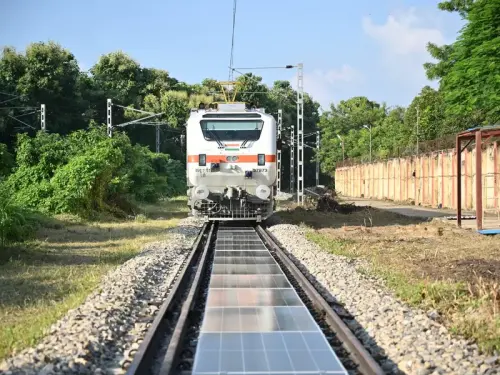
India is pushing hard on renewable energy and is already 3rd in the world for Solar power production reducing our reliance on Fossil fuels. Now Indian railways has taken another step towards reducing it’s dependence on fossil fuels by deploying India’s first 70m removable solar panel system (28 panels, 15KWp) between railway tracks at Banaras Locomotive Works on Line No 19 in a test run. The pilot project installed removable solar panels on the sleepers (the support beams beneath the tracks) on 70 metres of track and uses an indigenously designed installation procedure to mount solar panels without disrupting train traffic.

The pilot covers 70 metres of track with a 15 KWp installed capacity using 28 panels. It offers a power density of 220 KWp per kilometre and an energy density of 880 units per kilometre per day. Each panel measures 2278 × 1133 × 30 mm, weighs 31.83 kg, and has a module efficiency of 21.31% with 144 half-cut monocrystalline PERC bifacial cells.

With Indian Railways’ network spanning 1.2 lakh kilometres, officials said the technology could be widely deployed on yard lines without the need for land acquisition, as it uses the space between tracks. The estimated capacity is 3.21 lakh units per kilometre per year.

Indian Railways install first solar panels between tracks at BLW Varanasi Photograph: Ministry of Railways

One of the downsides of Solar is the need for a large area to mount the panels and that is frequently a point that detractors of Solar keep bringing up. This method allows us to deploy panels without need of a lot of space and infrastructure to mount the panels since the panels fit neatly between the tracks. I am a little skeptical about the durability of the panels and how long they will last under a track with regular usage but that is what the trial period is for to see if this is a feasible & sustainable plan.

I thought that it would be easier to put the panel above the track & train like a sunshade on the track but that would be more expensive because of the need to put infra to mount the panels etc. Hopefully this test will be successful and we will see the project rolled out on a large scale soon.

The Swiss have been exploring this idea for a few years now and have initiated a parallel pilot with 48 specially designed solar panels that have been laid along a 100-metre stretch of tracks in Buttes, a village in western Switzerland. Both initiatives appear to be running independently but I might be wrong about that.

Its good to see us working towards a more sustainable future using innovative ideas and solutions.

– Suramya

July 29, 2025

Using an Aerogel and sunlight to desalinate water now possible based on new research

Filed under: Emerging Tech,Science Related — Suramya @ 10:09 PM

Even though the earth is ~71% water only 3 percent of that is freshwater with a minuscule .3 percent of the water is accessible for us to use. This is the cause of major concern as the population increases and more water is being consumed by data-centers powering AI & Bitcoins there is a major water shortage worldwide. As of now over 1.1 billion people worldwide lack access to water and it is expected that two-thirds of the world’s population may face water shortages in the next few years. (source). Which makes this a very important and urgent problem for us to solve. One of the ways to address this is to desalinate sea water and there are various systems that use desalination techniques to convert sea-water into freshwater but most of them require a lot of energy making them costly and hard to scale.

Which is why this new research by Xi Shen of the Hong Kong Polytechnic University is so important. They have created an aerogel that is far more efficient at turning over fresh water than previous methods of desalination. Aerogels are ultralight materials made of carbon nanotubes which are quite cheap to manufacture and when added to water and exposed to sunlight the aerogel works as a evaporator that creates water-vapor that can be condensed and drunk. The research was published in the ACS Energy Letters.

The spongy aerogel, 3D-printed in layers from a paste that contained carbon nanotubes and cellulose nanofibers, had thin boundaries in between its long, evenly distributed microscopic pores. This was intended to increase vapor output. Each layer was also frozen right after it was printed, so it would be solid when the next layer was printed on top.

The research team tested out the aerogel by submerging it in a cup of seawater with a curved cover made of transparent plastic. When sunlight shone through the plastic, it heated the aerogel in the cup, and water vapor evaporated and condensed on the lid, flowing into a funnel that took it to a separate container. Their system had an output of about 3 tablespoons of drinkable water, but because this aerogel is both durable and allows for scaling up without compromising efficiency, it has the potential to go much further.

“We have tested the performance for up to a week and saw no performance degradation,” Shen told Ars Technica. “While I cannot give you a definitive answer on how regularly the aerogel will need to be replaced, because this work is still in the early stages, we are now planning to do real-world tests to see its long-term performance.”

The research is still in early phases but looks promising based on the existing results. I am looking forward to reading more about this as the technology matures.

Source: ArsTechnica.com: This aerogel and some sun could make saltwater drinkable

– Suramya

July 25, 2025

Using WiFi signals to identify people is now possible as per new research by Italian scientists

Filed under: Emerging Tech,My Thoughts,Tech Related — Suramya @ 6:46 PM

Our society is increasingly becoming a surveillance state across the globe. The number of active cameras in the world that record everything we do in the public have been exponentially increasing every year and it is now possible to follow a person across locations and track them easily. Systems have been using gait analysis, facial recognition etc to identify folks and now they have a new way to identify (or re-identify) people using Wifi. Researchers(Danilo Avola, Daniele Pannone, Dario Montagnini, and Emad Emam, from La Sapienza University of Rome) in Italy have developed a way to create a biometric identifier for people based on the way the human body interferes with Wi-Fi signal propagation and claim to have reached a 95.5% accuracy.

In 2020, the Wifi Alliance approved the IEEE 802.11bf specification that supported Wi-Fi Sensing which used existing Wi-Fi signals to sense motion amongst other things and routers with this capability are available in the market already. This study expands the Wi-Fi Sensing capabilities by using the Channel State Information (CSI) of a Wifi signal to distinguish individuals based on how their bodies alter signal waveforms. By learning the patterns from CSI sequences, the study claims to perform Re-ID by capturing and matching these radio biometric signatures.

“The core insight is that as a Wi-Fi signal propagates through an environment, its waveform is altered by the presence and physical characteristics of objects and people along its path,” the authors state in their paper. “These alterations, captured in the form of Channel State Information (CSI), contain rich biometric information.” CSI in the context of Wi-Fi devices refers to information about the amplitude and phase of electromagnetic transmissions. These measurements, the researchers say, interact with the human body in a way that results in person-specific distortions. When processed by a deep neural network, the result is a unique data signature.

Researchers proposed a similar technique, dubbed EyeFi, in 2020, and asserted it was accurate about 75 percent of the time. The Rome-based researchers who proposed WhoFi claim their technique makes accurate matches on the public NTU-Fi dataset up to 95.5 percent of the time when the deep neural network uses the transformer encoding architecture. “The encouraging results achieved confirm the viability of Wi-Fi signals as a robust and privacy-preserving biometric modality, and position this study as a meaningful step forward in the development of signal-based Re-ID systems,” the authors say.

The study claims are impressive but I am skeptical about the claims in it, primarily because it is quite easy to modify how Wifi signals propagate through your body. For example, I can carry a metal mesh rolled up in my pocket and then later on open it up and put it around my ribcage. I have immediately modified how the WiFi signal passes through the body and the study doesn’t go into details on how it would work in that scenario or other similar cases. In fact spraying metal infused water on myself would also change how the signal interacts with my body.

They claim this is more privacy preserving because it doesn’t show the face or body but I feel it is worse because it allows (if it works) folks to track a person with good accuracy across locations. Which makes it a powerful surveillance tool. I can imagine it being deployed in restrooms of companies like ‘Three Brothers Machine Manufacturing’ in China who have strict bathroom break policies (two-min max) to ‘boost efficiency’, as it will allow them to monitor who is inside a bathroom without having active camera’s in the bathroom.

Facial recognition is already flaky in real world use with a high error rate of 34.7% for darker-skinned people, according to a 2018 study titled “Gender Shades” by Joy Buolamwini and Timnit Gebru. People have been arrested after being falsely identified by facial recognition systems and I feel that if this WhoFi system gets deployed in large scale we will see similar issues with it as well.

Source: The Register: Humans can be tracked with unique ‘fingerprint’ based on how their bodies block Wi-Fi signals

– Suramya

July 16, 2025

Grok comes to Tesla and its nowhere near to bringing KITT closer to reality

Filed under: Artificial Intelligence,Computer Software,My Thoughts — Suramya @ 8:34 PM

Elon Musk announced that Grok AI would be included in Tesla’s about a week ago and unlike most of his announcements an initial release of the tool to Tesla happened earlier this week. This is extremely scary because what we are calling AI is nowhere close to being intelligent and putting it in control of a 2000 KG metal vehicle is what I would call a ‘bad idea’.

A lot of us grew up watching Knight Rider and KITT from the series is the golden standard for AI Cars. The extremely talented Design Thinking Comic created a comic where they imagined how Knight Rider 2025 would work with the current generation of LLM’s instead of the fictional KITT AI.

Knight Rider 2025, with a current generation LLM

Till recently my knowledge of the Tesla cars was based on information I read online and videos that I had watched, but I got to see the car in person during my recent trip to the US and my experience as a passenger was that the car looks really cool but there are a lot of usability issues. Like the weird way to open the door and loads of other issues folks have been posting about which have caused serious enough issues that Tesla had to issue multiple recalls in the past year for its cars. The Cybertruck, on the other hand was even uglier than I had imagined it to be.

The “Move fast and break things” philosophy is not something that should be applied to a car as it has serious real world impact potentially endangering lives. (It is a bad idea in general even for regular software development but that is a separate topic for another day)

– Suramya

May 17, 2025

Reflect Orbital Raises $20M to increase light pollution on Earth

Filed under: Astronomy / Space,Emerging Tech,My Thoughts,Tech Related — Suramya @ 11:59 PM

Solar power is awesome and we need more companies investing into this technologies but this project by Reflect Orbitals seems like a phenomenally bad idea. They are aiming to use orbital reflectors to shine sunlight on solar panel farms to extend the time they can generate power. In addition they are also looking at providing nighttime lighting i.e. an impossible to turn off bright light in the sky to light up a construction project or event.

Reflect’s ultimate vision is to boost solar power production on Earth. It aims to position mirrors in orbit to beam down sunlight to solar farms just before dawn, and just after dusk—effectively increasing the total time during which a solar farm can generate electricity.

In the meantime, the company has other plans to bring in revenue. Since its founding in 2021, the company has received 260,000+ requests for nighttime lighting. Future services could include illuminating overnight construction projects, public events, disaster relief efforts, and defense operations.

We already have problems due to light pollution such as health problems, confusing the circadian rhythm of animals and humans and many many more such problems. This system will light up areas without the consent of folks living there just because there is an event going on nearby. It will have a massive impact on the nocturnal animals, astronomers amongst others. But from a money minded perspective it makes complete sense as it allows companies to work through the night never mind the impact on others.

Even if we go with their press release and assume that they are only going to use it just before dawn and just after sunset it will still have a massive impact. Birds will not know when to fly back to their nests because it would still be light, nocturnal creatures will have less time to hunt/mate/survive because the length of the dark time is reduced.

The sad part is that they have raised $20 million already on this claiming to be ready to launch the first set of satellites next spring to illuminate 10 locations around the world. Thankfully there doesn’t seem to be much interest around this technology at this time but lets see. Hopefully that will continue and this nonsense shutdown fast.

Source: payloadspace.com: Reflect Orbital Raises $20M Series A

– Suramya

May 11, 2025

VibeCon – the biggest vibe coding conference!

Filed under: Artificial Intelligence,Humor,My Thoughts — Suramya @ 1:51 PM

Took me a few seconds to figure this out. Register for VibeCon – the biggest vibe coding conference! .

VibeCon - the biggest vibe coding conference! Register now: localhost:3000/registration
VibeCon – the biggest vibe coding conference! Register now: localhost:3000/registration

The funny part is that a lot of folks who are ‘Vibe Coding’ will not get the joke here…

Source: Mastodon: @leyrer@23.social

– Suramya

May 9, 2025

OpenAI site can’t figure out how to allow users to change their password’s

Filed under: Artificial Intelligence,Humor,My Thoughts — Suramya @ 9:56 PM

Changing passwords regularly is a good way to ensure that your accounts are secure. Yes I know about the new NIST guidelines on password changing but I disagree with it. If you are using a password manager (and you should be) then changing passwords on a regular basis is not a hard thing to do.

In any case, I noticed that the password on a bunch of my accounts had not been changed in a while so was updating them; one of the accounts is on OpenAI that I had created when it had launched but not really used much after that. After logging in I spent a few minutes trying to find the option to change my password but couldn’t find it, finally had to go to the FAQ’s to find out how to change the password and I saw the following:


Instructions on how to reset the password

How to reset your ChatGPT password

  • Log out of your account, or open a private/incognito browser window.
  • Go to the ChatGPT home page
  • Click Log in.
  • Enter your email address and click Continue.
  • Select Forgot password? on the password entry screen.
  • Follow the instructions in the password reset email you receive.

They really don’t know how to implement a simple change password functionality… I mean this is not something I expect from a billion dollar company. I have seen this on sites created by startups but never at a large company. Although, if their site is created using their AI code generation then that would kind of explains this. 😉

– Suramya

May 3, 2025

AI is not going to take your job even though VC’s keep claiming that is the case

Filed under: Artificial Intelligence,My Thoughts — Suramya @ 9:49 PM

99% of what we see about what AI can do is basically hype, especially stuff from VC’s (Venture Capitalists) or other leaders in companies that have invested in AI. Then you have people like Marc Andreessen who seem to be living in an alternate reality all together because that’s the only explanation I have for them making statements like the one below. I mean it is an interesting take that your super power AI will be able to generate actual art like paintings, books and poems etc but not be able to be a VC because ‘it (being a VC) is more art than science.’ I mean if it can generate actual art (that doesn’t suck) what is stopping it from doing a VC job even if it more ‘art’ than science? After all you are claiming that it can perform other intangible skills so why not your job?


Marc Andreessen says when AI does everything else, VC might be one of the last jobs still done by humans. It's more art than science.
Marc Andreessen says when AI does everything else, VC might be one of the last jobs still done by humans. It’s more art than science.

The funny part is that an AI can actually do a VC’s job more easily than create art that that people like. I would love to have an AI that actually works. I mean, I am a Sci-Fi fan, so yeah I would absolutely geek out about AI in real. Unfortunately what we have now is nothing close to being intelligent and that just sucks.

– Suramya

February 25, 2025

India’s First Vertical Bi-Facial Solar Plant installed on the Delhi Metro

Filed under: Emerging Tech,My Thoughts,Science Related — Suramya @ 9:46 PM

India is working hard towards reducing our dependency on fossil fuels and moving to alternative/renewable power source. As part of this effort we have been aggressively installing more and more solar plants across India. The Delhi Metro installed India’s First Vertical Bi-Facial Solar Plant last week. The new 50kW vertical solar plant at Okhla Vihar Metro Station features bi-facial panels that capture sunlight from both sides, enhancing energy generation efficiency.

India added a record 25 GW solar capacity in 2024 which is a 204% jump from previous year. Part of it was due to the commissioning of projects that supposed to go online in 2023 but got delayed and went live in 2024. Even with that being the case this is a great milestone and the total generation capacity for India has topped 100GW, putting India in the top 3 countries worldwide for Solar power production.

Solar and other green energy sources are awesome. They allow you to generate power without creating harmful byproducts like coal or petrol based energy generators do. Unfortunately this means that Coal and Oil industries are completely against them and constantly create posts, advertisements and ‘research’ that show how bad the renewable energy sources are. Basically it is a constant bombardment of FUD (Fear Uncertainty & Doubt) to cause people to distrust the technology.

The following comics keep showing up in my feed and it is typical of how people portray green power and electric vehicles. According to them there is no point in getting an electric car or a green power alternative because they all use coal/gas fueled power plants in the background and that can’t be further from the truth.

In fact, the main reason ‘people’ (read oil/coal companies) don’t want us to switch to renewable is explained very well by the following comic:

Solar Power isn't feasible because we can't own the sun
Solar Power isn’t feasible because we can’t own the sun

One (valid) cause for concern is that it is expensive to setup, which is true but not the whole story. We setup a solar power plant at my parents place in Delhi and while it does take up space it is not as bad as people make it sound. One set of panels actually makes a great share in front of the room on the roof, the other is on top of that room so helps keep the temperature in that room down and with the temperature in Delhi hitting 52.8 Deg C it is not a small consideration.

The setup we have is for a 10kwa solar panels and it costed us ~4,50,000 lac. Based on our regular usage we will recover the cost in about 4 1/2 years (its been almost 4 years since we set it up).

There is a pretty good subsidy for Solar being offered by the Indian government at the central level so it is a great time to setup a Solar power plan wherever you can. My cousin has also set it up in UP and it is a big help over there because they are no longer dependent on the power company for power.

With the new more powerful panels nowadays the time taken to recover the cost of the setup is down to a few years. To be fair, the process of generating the solar panel does create waste that is a pollutant but that is minuscule compared to the waste generated by a coal/gas power plant.

– Suramya

January 22, 2025

ELIZA Resurrected using original code after 60 years

If you have been following the AI chat bot news/world then you would have heard the name ELIZA come up. Eliza was the world’s first chatbot created over 60 years ago by MIT professor Joseph Weizenbaum and was the first language model which a user could interact with. It had a significant impact on the AI world (Actual AI research not the LLM wanna be AI we have right now) and was the first to attempt the Turing test. It was originally written in a programming language invented by Weizenbaum called the Michigan Algorithm Decoder Symmetric List Processor (MAD-SLIP) and the pattern matching directives were provided as separate scripts. Shortly after the initial release it was rewritten in LISP which went viral. Unfortunately the original code in MAD-SLIP went missing till recently soon after that.

One of the most famous ELIZA scripts was called Doctor that emulated a psychotherapist of the Rogerian school (in which the therapist often reflects back the patient’s words to the patient). Much to his surprise Weizenbaum found that folks attributed human-like feelings to the computer program. Wikipedia explains how the software worked:

ELIZA starts its process of responding to an input by a user by first examining the text input for a “keyword”.[5] A “keyword” is a word designated as important by the acting ELIZA script, which assigns to each keyword a precedence number, or a RANK, designed by the programmer.[15] If such words are found, they are put into a “keystack”, with the keyword of the highest RANK at the top. The input sentence is then manipulated and transformed as the rule associated with the keyword of the highest RANK directs.[20] For example, when the DOCTOR script encounters words such as “alike” or “same”, it would output a message pertaining to similarity, in this case “In what way?”,[4] as these words had high precedence number. This also demonstrates how certain words, as dictated by the script, can be manipulated regardless of contextual considerations, such as switching first-person pronouns and second-person pronouns and vice versa, as these too had high precedence numbers. Such words with high precedence numbers are deemed superior to conversational patterns and are treated independently of contextual patterns.[citation needed]

Following the first examination, the next step of the process is to apply an appropriate transformation rule, which includes two parts: the “decomposition rule” and the “reassembly rule”.[20] First, the input is reviewed for syntactical patterns in order to establish the minimal context necessary to respond. Using the keywords and other nearby words from the input, different disassembly rules are tested until an appropriate pattern is found. Using the script’s rules, the sentence is then “dismantled” and arranged into sections of the component parts as the “decomposition rule for the highest-ranking keyword” dictates. The example that Weizenbaum gives is the input “You are very helpful”, which is transformed to “I are very helpful”. This is then broken into (1) empty (2) “I” (3) “are” (4) “very helpful”. The decomposition rule has broken the phrase into four small segments that contain both the keywords and the information in the sentence.[20]

The decomposition rule then designates a particular reassembly rule, or set of reassembly rules, to follow when reconstructing the sentence.[5] The reassembly rule takes the fragments of the input that the decomposition rule had created, rearranges them, and adds in programmed words to create a response. Using Weizenbaum’s example previously stated, such a reassembly rule would take the fragments and apply them to the phrase “What makes you think I am (4)”, which would result in “What makes you think I am very helpful?”. This example is rather simple, since depending upon the disassembly rule, the output could be significantly more complex and use more of the input from the user. However, from this reassembly, ELIZA then sends the constructed sentence to the user in the form of text on the screen

Now after over 60 years the original code written in MAD-SLIP has been resurrected by Jeff Shrager, a cognitive scientist at Stanford University, and Myles Crowley,an MIT archivist, who found it among Weizenbaum’s papers back in 2021. Which is when they started working on getting the code to run, which was a significant effort. They first created an emulator that approximated the computers available in the 1960’s and then cleaned up the original 420-line ELIZA code to get it to work. They published a paper: ELIZA Reanimated: The world’s first chatbot restored on the world’s first time sharing system on 12th Jan where they explain the whole process.

ELIZA, created by Joseph Weizenbaum at MIT in the early 1960s, is usually considered the world’s first chatbot. It was developed in MAD-SLIP on MIT’s CTSS, the world’s first time-sharing system, on an IBM 7094. We discovered an original ELIZA printout in Prof. Weizenbaum’s archives at MIT, including an early version of the famous DOCTOR script, a nearly complete version of the MAD-SLIP code, and various support functions in MAD and FAP. Here we describe the reanimation of this original ELIZA on a restored CTSS, itself running on an emulated IBM 7094. The entire stack is open source, so that any user of a unix-like OS can run the world’s first chatbot on the world’s first time-sharing system.

You can try it out: here.

Source:

– Suramya

« Newer PostsOlder Posts »

Powered by WordPress