He did live long and prosper but unfortunately it wasn’t as long as we would want it to be. He will be missed by all his fans.
Leonard Nimoy the actor who played Mr Spock died on 27th Feb at the age of 84.
– Suramya
He did live long and prosper but unfortunately it wasn’t as long as we would want it to be. He will be missed by all his fans.
Leonard Nimoy the actor who played Mr Spock died on 27th Feb at the age of 84.
– Suramya
MS is spending a lot of time and effort trying to overcome the cloud of their previous actions where they did their level best to eradicate their competitors by any means necessary, even if they were morally in a grey area. The latest volley in this effort is their move to make MS Office available on the Android tablets for free. They have MS Word, MS Excel and MS Powerpoint available and the reviews so have have been very good even though the apps are technically still in Preview mode.
Today, we are excited to announce that we are further expanding the preview. We want more feedback from more users to ensure that Office apps work well on a range of different Android tablets before launching the official apps. To participate in the preview, you can use an ARM-based Android tablet running KitKat or Lollipop, with a screen size between 7″ and 10.1″. Starting today, anyone can go to Google Play and download the Word, Excel and PowerPoint preview apps. No waitlist. No requesting access. Just go and download the apps!
Office apps are one of the apps that need to be there on every OS. I have tried a lot of the alternatives like OpenOffice and other clones but I keep coming back to MS Office because of the stability and compatibility that it gives me with other Office users. On my Linux machine I use Crossover to have a native install of Office and it works great. When I get some time and restore Android to my Tablet (I am trying to install Kali Linux on it) I will try Office out on it even though I don’t see myself editing a lot of documents on the tablet.
Well this is all for now. Will write more later.
– Suramya
Source: androidcentral.com and Microsoft Blog Announcement
Last year the Internet arcade released over 900 classic arcade games playable in a browser to the public. Not satisfied with that accomplishment they topped it by releasing the over 2400 classic DOS games to the public and as before they are all playable in your web browser. The list of games include classics like Prince of Persia, The Oregon Trail, Castle Wolfenstein and many many more. This collection sure brings back a lot of memories for me.
If you’re a PC gamer of a certain age (cough), you’ve probably lamented that many of the titles you played as a kid are hard to use on modern systems without downloading emulators or waiting for special re-releases. Well, it just got a lot easier to relive your gaming glory days. The Internet Archive’s growing collection of web-based retro games now includes roughly 2,400 MS-DOS classics
I think I am going to be spending some time ensuring that the games function correctly in a browser. Purely for verification of the work done here of-course 🙂
– Suramya
Source: engadget.com
This year I decided to do something different for New Years and instead of the usual club/house party I went for a 48 hour camping event with live music. Think of it as a music festival with camping. The event is called Chasing Storm and it happened near Coorg which is about 270 km from Bangalore.
I Left for the event at 5am on the 31st and got there by 9:30am, unfortunately the entry for the camping area wasn’t opened up till 12:30pm because they were still in the process of setting up the tents and ensuring that folks didn’t get any reptilian visitor’s at night by spraying stuff to subdue snakes. Once we were in there wasn’t a lot to do till evening so we just hung around and chatted with other folks attending the festival. In the evening the live bands started playing and some of them were really good. I specially liked Swarathma and Solder.
The highlight of the event for me was getting to listen to Usha Uthup live. She is one of my all time favourite singers and hearing her in person was an awesome experience. It made the entire trip worth it. Even though the lady is 67 years old (she announced it on stage) the energy she has is amazing. I wanted to take a photo with her and get her autograph but wasn’t able to as she was swamped and then left before I got the chance.
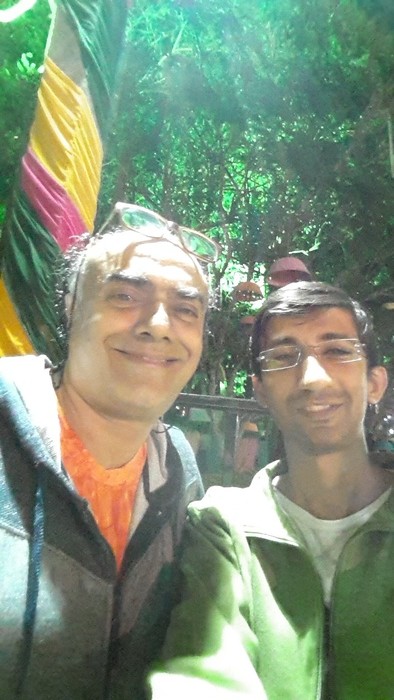
In any case I was busy chasing the other star who was also in attendance, ‘Rajit Kapur’ who played ‘Byomkesh Bakshi’ in the early 90’s TV series. The series is one my favourite Indian detective shows. So meeting him was a great pleasure. I did manage to get a photo with him (see below) and talk to him for a few mins. And before you ask; No I did not tell him that my sister named her dog after him (Vyomkesh) as I didn’t want him to beat me to death. 😉
Here are some pics (A lot of the night photos didn’t come out too well because of the disco lights) I took during the performances at Chasing Storm .


Solder live at Chasing Storm

Swarathma taking a bow
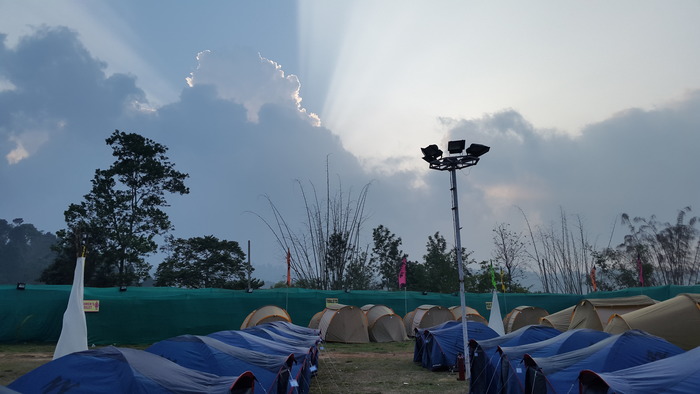
Finally here’s a photo of the camping area where we spent two days. Well, sort of… didn’t really get that much sleep over the two days because of the sheer no of things going on at the time.
The drive back was a bit painful because at 5am the visibility was down to maybe 2 mtrs and it took me about an hour to cover 10kms. Once the sun came out around 6 am the visibility improved and I was able to pick up a bit of speed but it wasn’t till about 7-7:30 that I was able to drive at a speed higher than crawling. Finally made it to Bangalore at 11am and went straight to work so that was fun. Survived that day mostly on Red bull and Coffee.
Over all it was a good experience and I had fun so it was worth the 500+ Kms drive. Well this is all for now. Will write more later.
– Suramya
PS: This was supposed to be posted last week but didn’t really have the energy required to write/think so kept pushing it out. But better late than never right?
I was surfing the web and found yet another post by some ‘genius’ who claims that people below 40 can’t fix anything and just consume. Considering I am 34 right now I must be one of those people who can’t fix anything. So I guess the tooth fairy must have come and fixed all the stuff I have repaired over the years and the same must be true for things that my friends fixed (or permanently broke in some cases), or created or improved on.
Every few years a post or an article will come out stating something to the effect of “Woe is me, the kids nowadays don’t know anything. They refuse to learn and just want to play on ‘gadget x’ and not listen to their elders (me)”. Here’s a quote that most of these folks will agree with “The children now love luxury. They have bad manners, contempt for authority; they show disrespect for elders and love chatter in place of exercise.”. Can you guess who made this quote? It was made by Socrates in Greece. Yes, that Socrates. Every generation thinks that the next generation is useless, they don’t do enough, they have it easy whereas the previous generation had so many hardships that they barely had any fun.
One of easiest ways to put down someone is to make such baseless statements that ‘kids nowadays don’t fix anything’. Guess what, plenty of them do fix stuff, or build new things. If that wasn’t the case then all new inventions will have stopped in another 30-40 years because anyone capable of making new stuff would have died by then. Just because they don’t fix stuff/or work on things the same way you did doesn’t mean that they don’t know what they are doing.

If you still think that is the case, visit the nearest hackerspace or checkout sites like hackaday.com. There are plenty of folks out there who are pushing the limits of both hardware and software. For example this virtual machine in Excel was created by a highschool student. If folks weren’t out there pushing the limits then event’s like Hacking for Kids, rootz etc would not exist and companies selling electronics/hacking tools for kids would go out of business.
Keep in mind that not everyone has the same aptitude, take my dad and my mom for example. Dad loves to take things apart and fix them while mom prefers to write articles and read. The same is true for my nephews/nieces as well, some of them are technically inclined and others are not. It is human nature. Think of how boring it would be if everyone was interested in the same thing.
Please do me a favor, stop publishing this nonsense, all you are doing is telling people that you are an idiot (I wanted to use a much stronger word but…) who is stuck in their ways and is scared of the next generation so goes out of their way to put them down. I am going to close this post with two words for these folks “Grow up…”.
– Suramya
One of the many downsides of using Windows is that there is no central way of updating all software installed on the computer in one shot. In Debian I can do an ‘apt-get upgrade’ and it will upgrade all the software installed on the system to the latest versions available. Patch my PC attempts to give you the same functionality on a Windows system. It has support for around 100 different applications and it can install or update them automatically when you run a scan.
I haven’t tried it out because I don’t have a Windows machine, but it is recommended by the folks at Lifehacker so it should be stable and work as advertised.
However please use it at your own risk, I am not responsible if this manages to destroy your computer or summon an imp.
– Suramya
Microsoft Excel should soon be classified as an Operating System. In the past we have seen a 3D shoot them up Doom Clone, a Flight Simulator and other games included in it as Easter eggs. Then we saw people using it to watch movies at work, and now here’s the latest entry that forces Excel way outside its comfort zone…
A programmer named Ãdám was participating in a contest where he had to solve a problem in Excel but the official rules prohibited the use of Excel macros so he went and created an assembly interpreter for Excel and used it to solve the problem instead. Talk about overkill. The idea is quite interesting. However the thought process required to imagine this as a possibility and then actually going ahead and implementing this is mind boggling.
This is a virtual Harvard architecture machine without writable RAM; the stack is only lots and lots of IFs. The instructions – mostly load, MOV, JNZ, INC, and CMP solves this problem, examining two inputs to see if they multiples of each other. If you’re wondering, an example cell from [Ãdám]’s Excel sheet looks like this:
=F6
   INDEX($C$2:$C99999,$G2,1),
   IF(AND(INDEX($B$2:$B99999,$G2,1)="JZ",$I2=0),
      INDEX($C$2:$C99999,$G2,1),
         IF(AND(INDEX($B$2:$B99999,$G2,1)="JNZ",$I2<>0),
         INDEX($C$2:$C99999,$G2,1),
         G2+1
         )
      )
   )
)
You can check out Adam’s solution at
Thanks to hackaday.com for the original article.
-Suramya
So I have a new toy that I am super excited about and It is a birthday gift from me to myself. 🙂 I have been wanting to get a smartwatch since last year when the Samsung gear came out but when I saw the gear I didn’t like the way it looked so ended up not buying it. Now that I have bought the Moto 360, I am glad I didn’t buy the gear because it beats the Gear hands down, no questions asked. I have been using it for 3 days now and I love it.
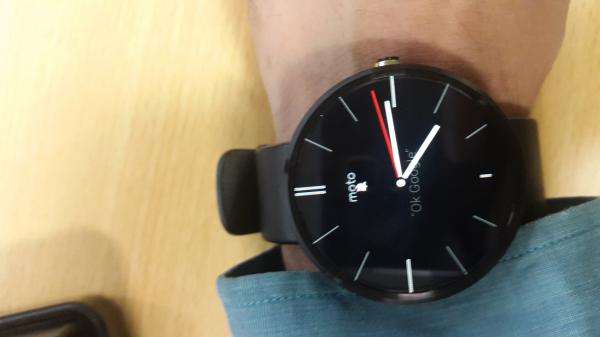
The initial setup of the watch was easy, I just had to download an app on my phone and follow the prompts, took me about 2 mins (excluding the time to download the app) to complete the pairing and setup. Once the app was installed the watch downloaded the latest firmware and upgraded automatically after I charged the battery which was surprisingly very fast. Once the upgrade completed it was connected to my S5 and has been working like a charm.
The default apps on the 360 are the Fitness apps, ability to receive any notifications on the watch and control the music app and the Google camera app from the watch. It has built in voice recognition which works fantastically great and is integrated with Google Now. Tonight we tried it out in a restaurant where we had gone out for a team outing and it had no trouble with the voice recognition even with the background noise. In addition to the default apps so far I have also installed a flashlight app, a dictation app and another camera app that lets me use the watch as a viewfinder for the camera on my phone. I keep finding cool new apps for the watch every day so will probably be installing a lot more stuff on it in the near future.
As I said earlier Voice recognition works for most of the things I would want to do on the watch, like use to to initiate a call or dictate a reply to an SMS, start an app etc. For the rest the touch screen works fine. Took me a bit of time to figure out how to run the new apps I installed because that isn’t really intuitive initially (or maybe I was just sleep deprived) but once I figured that out I was good to go. I think it would have made sense for them to put this in the help section.
The watch is not bulky at all and is lighter than my other watch. Lots of folks have complained about its size online but I didn’t find that to be an issue. However the battery life could have been better. In my daily use I am down to about 35% charge by the time I am ready to sleep after starting with a full charge in the morning. The charger looks nice and the charging is fast, however since the watch has a custom charger it means that I have to make sure that I carry it with me when I am traveling because none of my other chargers work with it. Sure, I can buy another charger for the office but it’s a pain.
The other issue that I noticed with it is that the heart rate sensor is crap. Every single time I have tried to check my heart rate (using both fit and the Moto software) it has failed with a sensor time out message, although Vinit did manage to get it to work once so I know the sensor works.
For the most part I have been using the watch to read my SMS/Whatsapp/Email messages without having to pull out my phone and monitoring my step count. Apparently I walk around a lot more than I thought which is good. 🙂 Also the ability to decline calls with a message from the watch is very handy when your phone is at your desk and you are at another desk working on something or in a meeting.
I am planning on installing the Analog keyboard for Android that I blogged about earlier but that will be over the weekend when I have some breathing room to experiment. I will share my findings and experiences going forward so if you are interested do keep an eye on the blog for new posts.
Well, this is all for now. It’s time for me to crash for the night. Will post more later.
– Suramya
So I was trying to buy a new Hard Disk from ebay and get it shipped to one of my co-workers place before he fly’s to India. (Yes, another one. What can I say; you can never have too much storage). Once I put it in my shopping cart I got the option to select the Shipping and there I got to see the amazing gem below:
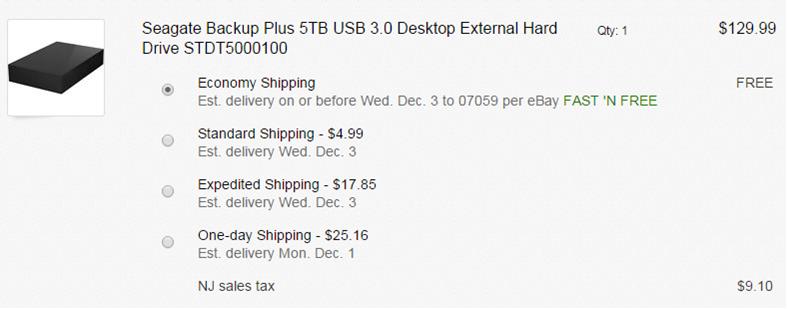
So I can choose to get my shipment on the 3rd of Dec for free, or I can pay $4.99 or $17.85 and get it quicker on the 3rd of Dec… Now how do I choose which is the best option for me, I think I will go for 3rd Dec for free… Another interesting thing is that the 1 day shipping for which I would shell out $25.16 will get me my package on the 1st Dec (4 days from the day I ordered). Unbelievable.
– Suramya
Powered by WordPress