Suramya's Blog : Welcome to my crazy life…

May 9, 2021

Teaching Cyber Security basics to kids

Filed under: Computer Security,My Thoughts,Tech Related — Suramya @ 8:04 PM

There is an ongoing effort over at Australia to teach cyber-security to five-year-old kids. I am sure that it will be no surprise to anyone who knows me that I think that this is a brilliant idea. Security is a mindset and the earlier we can teach kids about the pitfalls and dangers online, the safer they will be online.

Our generation grew up with the internet and still I see that most people are not that serious about security. I had a long argument/discussion with Jani on why she had to have a passcode for her phone and why she couldn’t use the same password for everything. Now she understands what I was talking about and uses a password manager with unique password for each account. But that is not the same with my parents, I still have not managed to convince them to use a password manager. 🙁

A little while ago I was talking to mom and she commented that my nephew Vir doesn’t share his account passwords with anyone and when my mom is typing her password he looks away. I credit Vinit for teaching him this and am really happy about it. This is what you get when a kid is taught about security from the get go. Instead of learning it later as an add on. Another year or so and I will have him start using a password manager as well.

Habits learnt as a kid are really hard to unlearn and that is why I think it is really important that we get to kids as early as possible and teach them about cyber security. I mean we already teach them regular security and safety so why not cyber security and safety? Remember, they are spending a lot more time on the computer and the internet than we ever did and they need to be taught how to be careful online.

Well this is all for now. Will post more later.

– Suramya

May 6, 2021

Blast from the Past: Is Your Son a Computer Hacker?

Filed under: Humor — Suramya @ 5:37 PM

While surfing the web, I came across this article on Hacker News from 2001, where a parent found out that their son is a computer hacker and now wants to highlight the symptoms to other parents so that their kids don’t fall to the same trap that he did. I first read this article when I was in college and found it as idiotic and funny then as I do now. Apparently, using AMD or having flash installed on your machine makes you a hacker. So does reading “Programming with Perl” by Timothy O’Reilly. If any of you reading this are parents, please do actual research rather than reading random articles on the web or watching YouTube videos.

Without further ado, read on to find out if your son is a hacker:

———
As an enlightened, modern parent, I try to be as involved as possible in the lives of my six children. I encourage them to join team sports. I attend their teen parties with them to ensure no drinking or alcohol is on the premises. I keep a fatherly eye on the CDs they listen to and the shows they watch, the company they keep and the books they read. You could say I’m a model parent. My children have never failed to make me proud, and I can say without the slightest embellishment that I have the finest family in the USA.

Two years ago, my wife Carol and I decided that our children’s education would not be complete without some grounding in modern computers. To this end, we bought our children a brand new Compaq to learn with. The kids had a lot of fun using the handful of application programs we’d bought, such as Adobe’s Photoshop and Microsoft’s Word, and my wife and I were pleased that our gift was received so well. Our son Peter was most entranced by the device, and became quite a pro at surfing the net. When Peter began to spend whole days on the machine, I became concerned, but Carol advised me to calm down, and that it was only a passing phase. I was content to bow to her experience as a mother, until our youngest daughter, Cindy, charged into the living room one night to blurt out: “Peter is a computer hacker!”

As you can imagine, I was amazed. A computer hacker in my own house! I began to monitor my son’s habits, to make certain that Cindy wasn’t just telling stories, as she is prone to doing at times.

After a few days of investigation, and some research into computer hacking, I confronted Peter with the evidence. I’m afraid to say, this was the only time I have ever been truly disappointed in one of my children. We raised them to be honest and to have integrity, and Peter betrayed the principles we tried to encourage in him, when he refused point blank to admit to his activities. His denials continued for hours, and in the end, I was left with no choice but to ban him from using the computer until he is old enough to be responsible for his actions.

After going through this ordeal with my own family, I was left pondering how I could best help others in similar situations. I’d gained a lot of knowledge over those few days regarding hackers. It’s only right that I provide that information to other parents, in the hope that they will be able to tell if their children are being drawn into the world of hacking. Perhaps other parents will be able to steer their sons back onto the straight and narrow before read this list carefully and if their son matches the profile, they should take action. A smart parent will first try to reason with their son, before resorting to groundings, or even spanking. I pride myself that I have never had to spank a child, and I hope this guide will help other parents to put a halt to their son’s misbehaviour before a spanking becomes necessary.

1. Has your son asked you to change ISPs?

Most American families use trusted and responsible Internet Service Providers, such as AOL. These providers have a strict “No Hacking” policy, and take careful measures to ensure that your internet experience is enjoyable, educational and above all legal. If your child is becoming a hacker, one of his first steps will be to request a change to a more hacker friendly provider.

I would advise all parents to refuse this request. One of the reasons your son is interested in switching providers is to get away from AOL’s child safety filter. This filter is vital to any parent who wants his son to enjoy the internet without the endangering him through exposure to “adult” content. It is best to stick with the protection AOL provides, rather than using a home-based solution. If your son is becoming a hacker, he will be able to circumvent any home-based measures with surprising ease, using information gleaned from various hacker sites.

2. Are you finding programs on your computer that you don’t remember installing?

Your son will probably try to install some hacker software. He may attempt to conceal the presence of the software in some way, but you can usually find any new programs by reading through the programs listed under “Install/Remove Programs” in your control panel. Popular hacker software includes “Comet Cursor”, “Bonzi Buddy” and “Flash”.

The best option is to confront your son with the evidence, and force him to remove the offending programs. He will probably try to install the software again, but you will be able to tell that this is happening, if your machine offers to “download” one of the hacker applications. If this happens, it is time to give your son a stern talking to, and possibly consider punishing him with a grounding.

3. Has your child asked for new hardware?

Computer hackers are often limited by conventional computer hardware. They may request “faster” video cards, and larger hard drives, or even more memory. If your son starts requesting these devices, it is possible that he has a legitimate need. You can best ensure that you are buying legal, trustworthy hardware by only buying replacement parts from your computer’s manufacturer.

If your son has requested a new “processor” from a company called “AMD”, this is genuine cause for alarm. AMD is a third-world based company who make inferior, “knock-off” copies of American processor chips. They use child labor extensively in their third world sweatshops, and they deliberately disable the security features that American processor makers, such as Intel, use to prevent hacking. AMD chips are never sold in stores, and you will most likely be told that you have to order them from internet sites. Do not buy this chip! This is one request that you must refuse your son, if you are to have any hope of raising him well.

4. Does your child read hacking manuals?

If you pay close attention to your son’s reading habits, as I do, you will be able to determine a great deal about his opinions and hobbies. Children are at their most impressionable in the teenage years. Any father who has had a seventeen year old daughter attempt to sneak out on a date wearing make up and perfume is well aware of the effect that improper influences can have on inexperienced minds.

There are, unfortunately, many hacking manuals available in bookshops today. A few titles to be on the lookout for are: “Snow Crash” and “Cryptonomicon” by Neal Stephenson; “Neuromancer” by William Gibson; “Programming with Perl” by Timothy O’Reilly; “Geeks” by Jon Katz; “The Hacker Crackdown” by Bruce Sterling; “Microserfs” by Douglas Coupland; “Hackers” by Steven Levy; and “The Cathedral and the Bazaar” by Eric S. Raymond.

If you find any of these hacking manuals in your child’s possession, confiscate them immediately. You should also petition local booksellers to remove these titles from their shelves. You may meet with some resistance at first, but even booksellers have to bow to community pressure.

5. How much time does your child spend using the computer each day?

If your son spends more than thirty minutes each day on the computer, he may be using it to DOS other peoples sites. DOSing involves gaining access to the “command prompt” on other people’s machines, and using it to tie up vital internet services. This can take up to eight hours. If your son is doing this, he is breaking the law, and you should stop him immediately. The safest policy is to limit your children’s access to the computer to a maximum of forty-five minutes each day.

6. Does your son use Quake?

Quake is an online virtual reality used by hackers. It is a popular meeting place and training ground, where they discuss hacking and train in the use of various firearms. Many hackers develop anti-social tendencies due to the use of this virtual world, and it may cause erratic behaviour at home and at school.

If your son is using Quake, you should make hime understand that this is not acceptable to you. You should ensure all the firearms in your house are carefully locked away, and have trigger locks installed. You should also bring your concerns to the attention of his school.

7. Is your son becoming argumentative and surly in his social behaviour?

As a child enters the electronic world of hacking, he may become disaffected with the real world. He may lose the ability to control his actions, or judge the rightness or wrongness of a course of behaviour. This will manifest itself soonest in the way he treats others. Those whom he disagrees with will be met with scorn, bitterness, and even foul language. He may utter threats of violence of a real or electronic nature.

Even when confronted, your son will probably find it difficult to talk about this problem to you. He will probably claim that there is no problem, and that you are imagining things. He may tell you that it is you who has the problem, and you should “back off” and “stop smothering him.” Do not allow yourself to be deceived. You are the only chance your son has, even if he doesn’t understand the situation he is in. Keep trying to get through to him, no matter how much he retreats into himself.

8. Is your son obsessed with “Lunix”?

BSD, Lunix, Debian and Mandrake are all versions of an illegal hacker operation system, invented by a Soviet computer hacker named Linyos Torovoltos, before the Russians lost the Cold War. It is based on a program called “xenix”, which was written by Microsoft for the US government. These programs are used by hackers to break into other people’s computer systems to steal credit card numbers. They may also be used to break into people’s stereos to steal their music, using the “mp3” program. Torovoltos is a notorious hacker, responsible for writing many hacker programs, such as “telnet”, which is used by hackers to connect to machines on the internet without using a telephone.

Your son may try to install “lunix” on your hard drive. If he is careful, you may not notice its presence, however, lunix is a capricious beast, and if handled incorrectly, your son may damage your computer, and even break it completely by deleting Windows, at which point you will have to have your computer repaired by a professional.

If you see the word “LILO” during your windows startup (just after you turn the machine on), your son has installed lunix. In order to get rid of it, you will have to send your computer back to the manufacturer, and have them fit a new hard drive. Lunix is extremely dangerous software, and cannot be removed without destroying part of your hard disk surface.

9. Has your son radically changed his appearance?

If your son has undergone a sudden change in his style of dress, you may have a hacker on your hands. Hackers tend to dress in bright, day-glo colors. They may wear baggy pants, bright colored shirts and spiky hair dyed in bright colors to match their clothes. They may take to carrying “glow-sticks” and some wear pacifiers around their necks. (I have no idea why they do this) There are many such hackers in schools today, and your son may have started to associate with them. If you notice that your son’s group of friends includes people dressed like this, it is time to think about a severe curfew, to protect him from dangerous influences.

10. Is your son struggling academically?

If your son is failing courses in school, or performing poorly on sports teams, he may be involved in a hacking group, such as the infamous “Otaku” hacker association. Excessive time spent on the computer, communicating with his fellow hackers may cause temporary damage to the eyes and brain, from the electromagnetic radiation. This will cause his marks to slip dramatically, particularly in difficult subjects such as Math, and Chemistry. In extreme cases, over-exposure to computer radiation can cause schizophrenia, meningitis and other psychological diseases. Also, the reduction in exercise may cause him to lose muscle mass, and even to start gaining weight. For the sake of your child’s mental and physical health, you must put a stop to his hacking, and limit his computer time drastically.

I encourage all parents to read through this guide carefully. Your child’s future may depend upon it. Hacking is an illegal and dangerous activity, that may land your child in prison, and tear your family apart. It cannot be taken too seriously.
———

– Suramya

May 2, 2021

Infinite Nature: Creating Perpetual Views of Natural Scenes from a Single Image

Filed under: Emerging Tech,Interesting Sites,My Thoughts — Suramya @ 11:28 PM

Found this over at Hacker News , where researchers have created technologies that use existing video’s and images and extrapolate them into an infinite scrolling natural view that is very relaxing to watch and at times looks very tripy. The changes are slow so you don’t see how the image is changing but if you wait for a 20 seconds and compare that image with the first one you will see how it differs.

We introduce the problem of perpetual view generation—long-range generation of novel views corresponding to an arbitrarily long camera trajectory given a single image. This is a challenging problem that goes far beyond the capabilities of current view synthesis methods, which work for a limited range of viewpoints and quickly degenerate when presented with a large camera motion. Methods designed for video generation also have limited ability to produce long video sequences and are often agnostic to scene geometry. We take a hybrid approach that integrates both geometry and image synthesis in an iterative render, refine, and repeat framework, allowing for long-range generation that cover large distances after hundreds of frames. Our approach can be trained from a set of monocular video sequences without any manual annotation. We propose a dataset of aerial footage of natural coastal scenes, and compare our method with recent view synthesis and conditional video generation baselines, showing that it can generate plausible scenes for much longer time horizons over large camera trajectories compared to existing methods.

The full paper is available here Infinite Nature: Perpetual View Generation of Natural Scenes from a Single Image with a few sample generated videos. One of the examples is below:

This is a very impressive technology. I can see a lot of uses for it in video games to generate real estate for flight simulators to fly over or fight over. It can be used for VR world developments or just to relax people. It might also be possible to take footage from TV shows and extrapolate them to allow folks to explore it in VR. (After a lot more research is done on this as the tech is still experimental). We could also simulate alien worlds using pics taken by our probes to train astronauts and settlers realistically instead of relying on fake windows and isolated area’s.

Check the site out for more such videos. Looking forward to future technologies built up over this.

– Suramya

May 1, 2021

Do you need to display your books in a way to look more sophisticated?

Filed under: My Thoughts — Suramya @ 10:32 PM

Anyone who knows me, knows that I love books and own a lot of them, both digital and physical. I prefer physical books as they are more tactile and because I grew up reading physical books but I love my kindle just for the fact that I can add 20 books to it and still have to carry only a slim device. The first time I traveled to the US my carry on luggage consisted of 6-7 novels a jacket and my documents/other important papers etc and I finished all the books before I landed. I still carry a lot of books when I travel. So, a good book shelf is something I am really interested in. I tried some of the fancy book shelves but I have too many books for them to work for me. At my parents place we have a whole room with shelves up to the ceiling just for books and at my place in Bangalore I have a whole wall of shelves going up to the roof with a provision to extend the shelves if required. I have slowed down a bit on the book purchases in the past 6 months because I am supposed to be studying 🙂 but I plan to get back to it with a vengeance once that is done.

There is an article on Lifehacker on How to Display Your Books Like a More Sophisticated Adult. I looked at it because I thought I could learn some interesting/new shelving technique, but that is not the case (pun not intended) here. It is yet another effort for people to show off / pretend that they read books and try to impress others with their collection & ‘wisdom’. Basically this whole thing is to look down on others, pretend to have sophistication and judge others. As the article says

Nice-looking bookcases look professional. Elegant, even. They show off a sense of sophistication that others will notice.

Take the Twitter account Bookcase Credibility, for example, as a great place for learning (and judging) bookcase arrangement.

Don’t believe me? Let’s look at some of the suggestions from the post:

Consider arranging your books by color : I really don’t see the point in this. I don’t think anyone who likes reading would want to shelve their books by color, it just makes it harder to find other books by the same author, or of the same topic. Making it look colorful is not the objective for me, it is to organize it in a way where I can find books quickly and easily. Now we might disagree on how to order the books (personally I like by author) but I can see the sense of putting them by genre or categories as well. Color is just such a random way of putting the books.

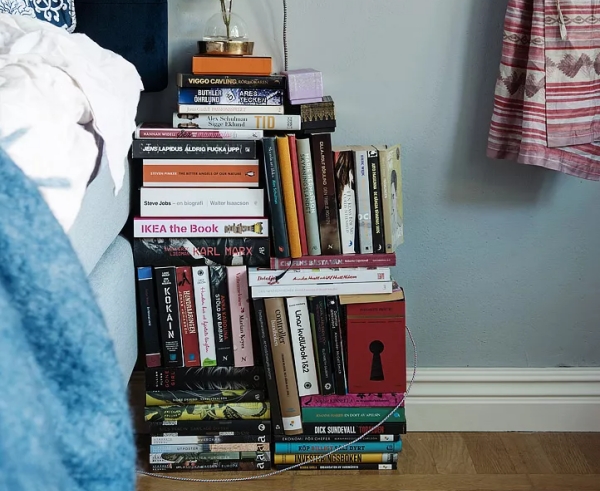
Display your books in wall boxes : This is pure show-off for books. If I tried it I would only have boxes all over the wall and the extra space used by the wood would be unusable to store books. Which is the point of the shelves.

Use a suspension book rack to make a statement Another just for show book shelf. If I tried this for my books the weight would be too much for the anchor. Plus there is a lot of space wasted that can be used to store books.


How does this make any sense? Books are not laundry to be hung around

Make coffee tables and nightstands with larger books : I thought about this, I don’t want to put my books as a night stand I have spilled enough fluids on the stand and stored random crap on them that it would absolutely spoil the books. Plus if I want to read a book at the bottom there is no way to take it out without having to dismantle the entire thing and then I can’t put it back together till I finish the book and can put it back. Which means that I would have a pile of books on my floor, plus no nightstand. How is this a recommendation for someone who actually reads the books they purchase? Within a year the books will have stains and marks all over them from spills etc.


Someone please explain to me how I would take out the Unix Installation book or Art at Auction to read without having to dismantle everything?

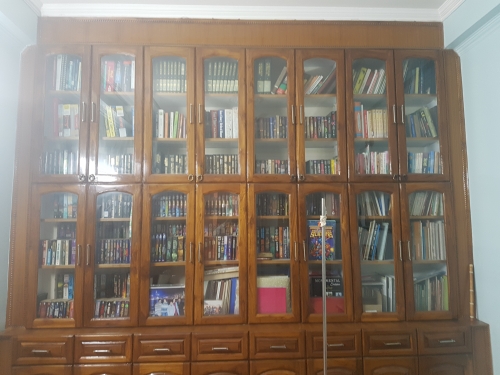
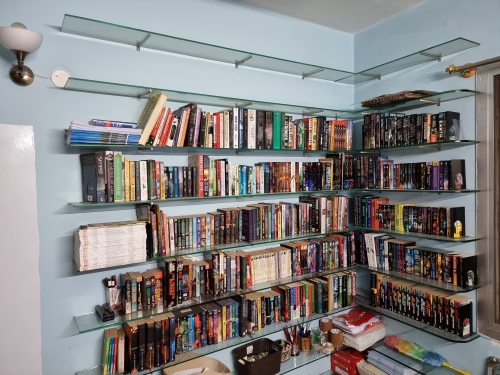
Now, since I have been talking about bookshelves, here are mine:


My collection in Delhi


My collection in Bangalore

The Delhi pic is a few years old, but the Bangalore one is current (I took it while writing this post). Yes, I am read most of the books in both places. The only ones I haven’t read are the Law books and the few Biographies that Jani and mom have bought. My dream house would have a few rooms just for books. so that is a goal that I am working towards… 🙂

So, to conclude don’t bother with showing off your books in some fancy way. If you are passionate about something it will come through without you having to showcase it. Also, people can make out if the books are there just for show so keep that in mind as well.

Well this is all for now. Will write more later.

– Suramya

April 30, 2021

Review and test of Fawkes: Software to protect your pictures from AI/Reverse searches.

Filed under: Computer Software,My Thoughts,Tech Related — Suramya @ 11:28 PM

Yesterday, I wrote about Fawkes & Photo Ninja which can be used to protect your photos from facial recognition models and reverse image searches. This is a very interesting field and I had mentioned about creating a service that does it for free instead of charging like what Photo Ninja is doing.

The first step to that is to check if the program (Fawkes) actually works the way it is supposed to, so I downloaded a pic from the internet (my profile pic on Twitter) and ran it through Fawkes. The program takes a while to run (~20 seconds per image) depending on the no of people in the photo. It detected the faces very reliably and modified the image. When using the default settings the output is saved as a PNG file but you can override it using a command line parameter. It requires you to provide the directory you want to run it against but if you don’t pass it the directory, it doesn’t give any errors. It took me a few mins to figure out what the issue was (yes, I know… My brain is tired). The command to run it in the current directory with debug (because I like seeing what the software is doing) is:

./protection --debug --directory .

I then took the resultant, file and searched for it via Google Images, Yandex and TinEye. None of them were able to find any results with the new image. So that part of the software works great. 🙂 Now coming to how the software modifies the image, I saw that it adds 2 rows of pixelisation to the image. First is near the hairline and cuts across the hair and forehead, and the second is near the chin and is about 5-10 pixels wide. It is clearly visible in larger photos, but when zoomed out it doesn’t look too jarring. Frankly it looks like the image got damaged and is kind of obvious when you look at it.

In my very basic tests it made the same change everytime so I have a feeling that we can train image recognition software to look for this modification and ignore it. It might be more powerful to put the modifications at random locations in the image (over the faces) that way it is harder to train the software to counter it. Plus if the visual noise section can be reduced it would be great. Maybe instead of a long blur that is noticeable we can try to do multiple small changes that change the pic without making it obvious that the image was modified.

Below are the two images, the original on the left and the modified version on the right.


Sample output of the Fawkes

I then looked at running this on my webserver, but due to the restrictions there I wasn’t able to get it to run. Although, to be honest I only tried for about 20-30 mins because I was tired. If I can’t get it to run on the server then the other option is that I run it on my home computer but I will need to look at that in more detail before I commit to making this site. I have a rough draft of the requirements and feature list but still looking at the options before I start working on it. It will be a good way to take my mind of what is going on in the world so that is good.

Well this is all for now. Will keep you posted on how this project goes.

– Suramya

April 29, 2021

Using Photo Ninja to shield users’ photos from reverse image searches and facial recognition AI

Filed under: Interesting Sites,My Thoughts — Suramya @ 1:15 AM

Last year I had posted about the Fawkes project that allowed users to modify their photos to avoid them from being used to power facial recognition and image recognition technologies. But the problem with these technologies is that it requires you to setup a server/run it on your machine which is hard for regular folks to do and that reduces the usage of the tool, even though it is very useful.

Now, a company called DoNotPay is launching a new service called Photo Ninja that allows you to upload a photo you want to shield and the software adds a layer of pixel-level changes that are barely noticeable to humans, but dramatically alter the image in the eyes of roving machines making it harder for someone to perform a reverse search on and to use for training AI models.

This is a great start and makes it really easy for people to use the service which costs $36 a year.

“Photo Ninja uses a novel series of steganography, detection perturbation, visible overlay, and several other AI-based enhancement processes to shield your images from reverse image searches without compromising the look of your photo,” says the company.

AI systems are trained to analyze pictures by looking at the pixel-level data, and adversarial examples can trick them by changing the pixel colors in a subtle enough way that the human eye doesn’t notice anything different but a computer fails to categorize the image as it usually would or interprets it as a wholly different image.

Anti-creep software — There are various reasons why you might want to use Photo Ninja. Before joining a dating service like Bumble, you could run your pictures through Photo Ninja so that weirdos can’t upload them to Google’s reverse image search and find your social media profiles without getting your consent, for instance.

I wonder if there is a demand for a similar service that could be powered with Fawkes and be provided for free to all users. I am thinking about setting something up like a Bot or a site that does this for free. I think there is a market for it and it would be a great side project for me to work on during this lockdown.

What do you think?

– Suramya

April 24, 2021

Get Vaccinated & Ignore the Anti-vax nonsense! Every Indian 18+ is eligible for vaccine starting May 1st.

Filed under: My Thoughts — Suramya @ 3:46 AM

On May 1st all adults in India are eligible for getting vaccinated against Covid-19. Unfortunately, I have heard a few folks repeating the standard Anti-vaxer nonsense about how the vaccine is not safe and we don’t know the long term results of the injection. This is from educated folks who I thought would know better. Then there were some folks who were waiting to see what happens before getting vaccinated. I usually end up scolding all of them about vaccines. In India we have given 13,56,67,949 vaccine doses as of now, how many more do you need to see before you are willing to take the vaccine?

Another fact people keep bringing up is that people have gotten Covid even after getting the second shot. There was a study done to look at the numbers of infections after the second vaccine shot and as per the research, only .04 (.03 if you got Covishield) of the people were infected after the second shot and even in those folks the infection was not as deadly as it is in folks who didn’t get a shot. Compare this with the infection rate without the vaccine: As of today Positivity rate over 15% (15.9% in Karnataka) in 146 districts, 5-15% in 274 others. Please look at the numbers, we can’t handle the increasing numbers and you have seen the situation in the hospitals where people are frantically looking for ICU beds and oxygen tanks.


Covid infection numbers after second vaccination

It’s easy to blame the government for not doing enough to control the pandemic but I must ask you, are you doing enough to control it? The basic measure is to wear your mask when out side. This means that the mask should cover your nose and mouth fully. Having a mask over your chin does not stop the spread of Corona, it just makes you look like an idiot.

Also, there is no 5G tracking chip in the vaccine. The government/Bill Gates/Whoever does not need to inject you with a chip to track you, they can very easily (and much more cheaply) track you using your phone or using the multiple camera’s out there everywhere. The image below came up in my feed a little while ago, it claims that the item shown is a 5G tracking antenna which was injected into their niece when they got vaccinated. This claim is ridiculous at so many level but lets take a walk down logic lane and do some calculations to show how stupid this is. The length of this ‘chip’ is about the same as the width of the finger in the photo, a quick search gives us the average thickness of a human finger as 1.6 to 2 cm. Now lets try to get the thickness of the ‘chip’. Using GIMP I see that the ‘chip’ is ~168 pixels long and ~35 pixels wide at its thickest point. A quick calculation allows us to convert this pixel thickness to cm: 1.6/168 * 35 = .33 cm (3.3 mm). To give you an idea of how thick that is, check out this 3mm thick ring that is available for sale on Amazon.

So, coming back to the injection. In order for someone to inject you with a 3mm thick chip/antenna, the needle has to be atleast 3.5mm thick (maybe more because this is just rough calculations). As per the CDC guidelines the needle used for Covid injections should be 21 gauge for Pfizer and for Covaxin a 23 – 25 gauge needle should be used. Looking up the gauge scale on Wikipedia we see that this translates to 0.8192mm (21 Gauge) – 0.5144mm (23 gauge) – 0.6414mm (25 Gauge) of thickness. Now please explain to me how we can fit 3.3mm thick antenna into a needle that is less than a millimeter thick.

Please use your brains when looking at these forwards because most of them don’t make sense. You just need to look at them logically.

To close the post, I would like to say that the best way to stop the spread is to get vaccinated. While that is going on, we need to continue wearing masks and social distance because that is the only way to control the disease. I don’t know about you but I am tired of not being able to meet friends and going out for a few drinks or just watching a movie in the theater.

Let’s work together to end this pandemic.

– Suramya

April 20, 2021

Converting old tires into graphene to reinforce concrete

Filed under: Emerging Tech — Suramya @ 7:42 PM

Waste tires are are a major pain to recycle and usually end up in landfills or being burned for fuel/heat. They are especially popular with the poor because they take a while to burn and thus give heat for a longer duration. Unfortunately, the process is also very polluting and the smoke from these fires is especially bad for the environment (and for the folks breathing it in). However, there are not many uses for these tires at scale that are not more polluting, but that changes now. Thanks to research by Rice researchers, we now have a way to convert waste rubber into turbostratic graphene, which can be employed to strengthen concrete.

Most conventional production processes for graphene are time-consuming, solvent-intensive, and energetically demanding. To circumvent these limitations for mass production, flash Joule heating (FJH) has been shown to be an effective method to synthesize graphene. Here, methods for optimizing production of graphene from rubber waste feedstocks are shown. Through careful control of system parameters, such as pulse voltage and pulse time, turbostratic flash graphene (tFG) can be produced from rubber waste. It is characterized by Raman spectroscopy, X-ray diffraction and thermogravimetric analysis. The resulting tFG can be easily exfoliated and dispersed into various solvents because of its turbostratic arrangement. Addition of tFG into Portland cement results in a significant increase in the compressive strength of the composite. From a materials perspective, FJH offers a facile and inexpensive method for producing high quality tFG from rubber waste materials, which would otherwise be disposed of in landfills or burned for fuel. FJH allows for upcycling of low-value rubber waste into high-value carbon nanomaterials for use as reinforcing additives.

The researchers estimate that the conversion process’s electricity would cost about $100 per ton of starting carbon. It is great that more people are focusing on alternate uses / conversion of these ‘unusable’ items to more useable stuff.

More details are available here: Flash graphene from rubber waste

– Suramya

April 9, 2021

How do stereotypes form and how you can avoid them?

Filed under: My Thoughts — Suramya @ 11:59 PM

Stereotypes are basically over generalized beliefs about a particular group or class of people. By stereotyping we infer that a person belonging to a particular group has all the characteristics all members of that group are supposed to have. Evolutionally stereotypes help us respond to situations faster because we have encountered a similar situation before.

These stereotypes in turn lead to social categorization because we have a tendency to group things together. This creates the us-vs-them mentality and creates in-groups and out-groups which in turn lead to prejudice. Basically that group members of an in-group will seek to find negative aspects of an out-group, thus enhancing their self-image and bond within the group because then the group members will be less likely to leave the group as they are prejudiced against the other groups. Prejudiced views can and do result in racism which in its extreme forms may result in genocide. This happened in Germany with the Jews and in Rwanda between the Hutus and Tutsis. There are countless more such examples.

Stereotypes are created when we listen to the people around us. Our friends, relatives co-workers etc would talk about people in a certain way or we see movies, read stories that depict people in a particular way and slowly we internalize that outlook without realizing it. For example, Chinese and Indians are supposed to be really good at math and during my freshman year in college, my advisor put me in Honors math course on his own because as per him “You are Indian so you should be good at math.” Personally I really dislike math so I hated that course. This is a minor example, but there are extreme cases where these stereotypes cause real harm, for example the stereotypical African American is supposed to be lazy, rude and in a gang, so people from these communities don’t get the opportunities that other communities get because it is expected that a majority of the folks in that community would join a gang. Over time this becomes a self fulfilling prophecy as kids join gangs because they don’t have other options.

There are so many examples of stereo types and how they harm the communities that entire books have been written on the subject. All I want to say is that people should be judged on their own merits and not on how they look like.

The best way to reduce stereotypes is to expose folks to other cultures and people without diluting them. Travel is a great way of achieving this and I can personally vouch for it as I have met folks from across the world during my trips and nothing beats meeting someone from another part of the world and realizing that they are just like you and have similar wants and needs.

– Suramya

April 8, 2021

Moving a Windows install to another drive on the same computer shouldn’t be this hard

Filed under: Computer Software,Linux/Unix Related,My Thoughts,Tech Related — Suramya @ 11:27 PM

I recently bought a new SSD drive for my Laptop because even after upgrading everything else (except the CPU) the system was still slow and looking at the process use I could see that it was waiting for disk read/write for the most part and that was causing the slowness. Once I got the new drive, I had to move the existing OS installs from the old disk to the new one. I have three operating systems (OS) on the disk: Windows, Debian and Kali. I need the windows OS for my classes (my proctored exams have to be taken on a windows machine) and others are for my tinkering and general use computing. The disk layout on the old drive was as follows:

root@Wyrm:~# fdisk -l
Disk /dev/sda: 931.51 GiB, 1000204886016 bytes, 1953525168 sectors
Disk model: ST1000LM024 HN-M
Units: sectors of 1 * 512 = 512 bytes
Sector size (logical/physical): 512 bytes / 4096 bytes
I/O size (minimum/optimal): 4096 bytes / 4096 bytes
Disklabel type: dos
Disk identifier: 0x0f04ad34

Device     Boot     Start       End   Sectors   Size Id Type
/dev/sda1  *         2048   1126399   1124352   549M  7 HPFS/NTFS/exFAT
/dev/sda2         1126400 102402047 101275648  48.3G  7 HPFS/NTFS/exFAT
/dev/sda3       102402048 135956479  33554432    16G 82 Linux swap / Solaris
/dev/sda4       135956480 468862127 332905648 158.7G  5 Extended
/dev/sda5       135958528 175017985  39059458  18.6G 83 Linux
/dev/sda6       175022080 237936641  62914562    30G 83 Linux
/dev/sda7       237940736 468862127 230921392   675G 83 Linux

I partitioned the new disk as a copy of the old drive, except for the data partition which was smaller as the disk was smaller. I used dd to clone each partition on to the corresponding new partition using the following command: (where sdb was the new drive).

dd if=/dev/sda1 of=/dev/sdb1 bs=2k

Once I copied the partitions over, all I had to do was refresh the GRUB boot loader config using the following command:

update-grub

After the config was updated, I was able to boot into Linux from both my Debian and Kali partitions on the new drive. However, that didn’t work for Windows. It gave be a screen-full of random characters like what you see when you try to open a binary file in a text editor and refused to boot. Thankfully I had not deleted the old windows partition so I was able to try a few more things, but *nothing* worked. Windows would just refuse to boot from the new drive. The only solution I found that could have potentially worked was a Paid software that supposedly allows you to clone your windows install on new disks/computers. Since I didn’t want to spend money on something I should have been able to do for free, I didn’t try it.

In the end after wasting a lot of time on this, I was tired of trying various things so just decided to reinstall windows on the new drive. It wasn’t a major loss because I didn’t have much data on Windows but I still dislike the fact that I had to do so just to put in a new drive. Imagine the hoops I would have had to jump if I wanted to move to a new computer. Actually I don’t have to imagine, I did jump thorough them when I moved my install from my old laptop to this one.

My linux install on the laptop is an exact clone of my desktop install. I used dd to create an image of my Linux install on the desktop and then wrote the image on the laptop. It worked perfectly fine at the first try. All I had to change was the hostname so that my DHCP server didn’t have a nervous breakdown but other than that everything worked without a single problem. Even the graphics drivers auto adjusted on the new machine. Imagine if we could do the same thing for a Windows install.

– Suramya

« Newer PostsOlder Posts »

Powered by WordPress