Suramya's Blog : Welcome to my crazy life…

September 11, 2025

Thinking about SciFi Voice command Interfaces from a usability perspective

Filed under: My Thoughts,Tech Related — Suramya @ 10:08 AM

Saw the following post by @tante where they talk about how voice commands have been embedded in our consciousness for years as a really advanced user interface but practically speaking they would be a terrible interface.
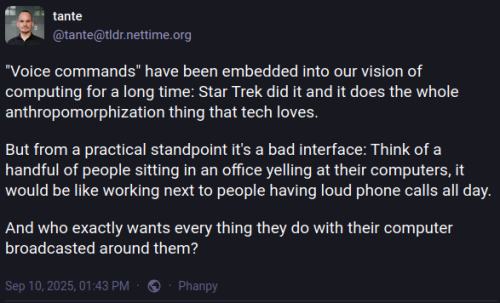
Voice commands have been embedded into our vision of computing for a long time: Star Trek did it and it does the whole anthropomorphization thing that tech loves. But from a practical standpoint it's a bad interface: Think of a handful of people sitting in an office yelling at their computers, it would be like working next to people having loud phone calls all day. And who exactly wants every thing they do with their computer broadcasted around them?

“Voice commands” have been embedded into our vision of computing for a long time: Star Trek did it and it does the whole anthropomorphization thing that tech loves.

But from a practical standpoint it’s a bad interface: Think of a handful of people sitting in an office yelling at their computers, it would be like working next to people having loud phone calls all day.

And who exactly wants every thing they do with their computer broadcasted around them?

This is something that has bothered me pretty much since I first watched Star Trek (and how they interfaced with computers) and started working on computers myself. So it was good to see someone else share my point of view on this topic.

From usability perspective, a voice interface is one of the worst ways to interact with the computer, as it is imprecise. The caveat being that it is a good interface from an accessibility perspective but from a general purpose, everyday use I don’t think I would use voice to interact with a computer as it is a very limiting and insecure way to interact with a computer in my opinion.

The way Star Trek thinks about it is that the computer is advanced enough to understand what you are trying to do based on a single line command and then do it for you but we are nowhere near close to achieving that right now and even if the tech existed, imagine sitting in an open office setup where already it is annoying to work because you get to listen into random zoom calls & discussions happening around you. Now think about how bad it would be if we also had to listen to every command that people around you are issuing to their computer (followed by the numerous corrections), I would go mad if I had to listen to it for any period of time.

Another issue to think about when multiple people are working in a small area and trying to interact with their computer: How do you ensure that you are commands don’t accidentally run on your neighbor’s computer? Imagine sitting next to someone logged into a production database while you are connected to a dev database and you tell the computer to wipe all the data in the database. But in addition to the command running on your machine the machine next to you also heard the command and wipes out the entire production database.

In addition there is the whole security aspect of the technology to think about. Do you really want everyone around you to hear what you are working on? (Especially if it is something confidential). Plus authenticating verbally like how they do it on Star Trek is really insecure. In Star Trek when they are issuing a command that requires authentication the person actually just states their authentication code loudly for everyone around them to hear. That is absolutely insecure and easy to bypass. We already have technology that can imitate anyone’s voice really well, so this authentication code could easily be bypassed using similar tech. For example, they could create a Hologram version of the person and have that issue the command or use any of the other similar technology to achieve the same thing. In the non-fiction world, voice modifiers are already good enough to fool most if not all voice verification systems so having a verbal authentication code is not really a very secure way of doing things.

So, while it is cool and looks really futuristic I wouldn’t recommend a voice interface as the only way to work with a computer.

– Suramya

September 8, 2025

Using WiFi signals to measure heart rate without wearable’s is now possible

Filed under: Emerging Tech,My Thoughts,Tech Related — Suramya @ 2:23 PM

Currently WiFi is one of those technologies that is pretty much prevalent across the world, you go to the smallest (inhabited) island in the middle of nowhere and you will get a WiFi signal. Which is why folks have been trying to use it for various tasks such as identifying people or as motion sensors etc.

Building on that researchers at University of California, Santa Cruz have created a system that allows them to measure the heart rate using the signal from a household WiFi device with state-of-the-art accuracy—without the need for a wearable. The system called “Pulse-Fi,” was published in the proceedings of the 2025 IEEE International Conference on Distributed Computing in Smart Systems and the Internet of Things (DCOSS-IoT).

Non-intrusive monitoring of vital signs has become increasingly important in various healthcare settings. In this paper, we present Pulse-Fi, a novel low-cost system that uses Wi-Fi Channel State Information (CSI) and machine learning to accurately monitor heart rate. Pulse-Fi operates using low-cost commodity devices, making it more accessible and cost-effective. It uses a signal processing pipeline to process CSI data fed into a custom low-compute Long Short-Term Memory (LSTM) neural network model. We evaluated Pulse-Fi using two datasets: one that we collected locally using ESP32 devices named ESP-HR-CSI Dataset and another containing recordings of 118 participants using the Raspberry Pi 4B called EHealth, making it the most comprehensive data set of its kind. Our results show that Pulse-Fi can effectively estimate heart rate from CSI signals with comparable or better accuracy than hardware with multiple antenna systems, which can be expensive.

The ability to monitor the health of any person remotely without the cost of a wearable or extra sensors is pretty groundbreaking. I can see it in use at hospitals, elderly care and nursing homes etc. However, as with all technologies there is a downside as well. Once we have the ability to monitor the pulse of anyone remotely, I can see the various security and government agencies around the world falling over each other to get it implemented as widely as possible. Imagine having this at an airport where you can monitor for abnormal heartbeat or increase in pulse rate to watch out for a suicide bomber (never mind the poor nervous flyer who got tackled out of nowhere or the person nervous about their first date). Offices with sensitive data or intelligence agencies will end up using it as a non-stop lie/threat detector.

But that is still in the future as the technology is still in an early stage and it is not clear how accurate it will be when used in a crowded location.

Source: ucsc.edu: WiFi signals can measure heart rate—no wearables needed

– Suramya

August 26, 2025

Building an app that no one uses is useless

Filed under: My Thoughts,Tech Related — Suramya @ 11:27 AM

A quote that all of us have heard multiple times is If You Build It, They Will Come. This has launched countless applications/websites/solutions over the past few decades and very few of them actually had people come and use it. But due to confirmational bias people only remember the successes and thus this quote is still used actively in Business schools and by the Startup community. The latest example of this was shared by @nixCraft earlier, where a person spent $300k on an app no one uses.

I’m about to lose my mind and my investor’s money.Developer swears it’s ‘technically perfect’ but I can’t get a single doctor to adopt it. Two years ago we raised a seed round to build a patient management app for primary care doctors. Hired this boutique dev shop, spent 18 months and $300k building what they call a “technically superior solution.” The app works flawlessly. Zero bugs, clean UI, integrates with major EHRs, HIPAA compliant, the whole nine yards. Our developers are genuinely proud of it. But here’s the problem: doctors hate it. We’ve demoed it to 50+ practices. Same feedback every time. “It’s nice but it doesn’t fit our workflow.” “Too many clicks.” “We already have a system that works.” Meanwhile I see these basic-looking apps with terrible UIs getting massive adoption because they solve one specific pain point really well. Starting to think we built the app WE wanted to build instead of what doctors actually needed. Like we got so caught up in making it technically impressive that we forgot to make it useful.

I am awestuck that they managed to spend 300k over 18 months without realizing that no one wanted their solution and then instead of trying to figure out why people don’t want their solution they stuck to their guns and lost even more money.

One of the first things I learnt when I started programming was that your job is to solve problems for the customer, not showcase amazing technology. (If you can do both then that’s awesome). If you look at the quote above, the part in Italics pretty much explains why this app failed. In short the creator was so busy creating a “technically superior solution” that they forgot to create an app that the user actually wanted.

Earlier in my carrier I had the opportunity to work with a NGO that was working with various startups to create technology to help blind people and something they said really stuck with me. He told me that most companies try to create a system that mimic’s how a person would see the world and then translate that into something that a blind person could use and most of these attempts failed miserably because that is not what blind users wanted. They wanted technology that allowed them to interact with the world using their way. We are so used to having the ability to see that we think that if a person can’t see then we need to create something that allows them to see. But that is not what the users are looking for so the tech failed. The one company that had a promising solution spent a good amount of time talking to the prospective users of their technology and then built a solution that addressed specific pain points. Unfortunately, I didn’t stay in touch with the team but I am sure they are doing well because they are solving user problems.

The world’s most awesome and superior technology is of no use if no one actually uses it. We have been trained to think of users as ‘necessary evil’ and their are thousands of jokes around that make fun of users as being somehow clueless and stupid, some oldies call them lusers (a play on the word losers and users). But keep in mind without these users the systems we create are of no use. If you are not solving a business problem (or user pain point) with your solution then you might as well not build it in the first place.

There is one caveat here, you should always find out what problem the user is trying to solve and not just build what the user is asking for without digging into it. A lot of times people will come to you and say that I need XYZ, but when you dig into the problem they are trying to solve you realize that a different solution would be more effective in solving that problem instead.

This is why we need people from the product team to work with the engineering team together to understand what the user wants and how best to deliver that to the user.

– Suramya

August 21, 2025

Try an Email quiz to see if you can identify valid email addresses

Filed under: Interesting Sites,Tech Related — Suramya @ 8:05 AM

Most people don’t really think about email addresses and how to validate if they are correct or not but developers have to do that frequently so that their applications can ensure people don’t input invalid data into the system. At first glance this seems like a fairly simple task but like all things the devil is in the details.

Sam Rose over at Mastodon shared a link to an interesting site with an Email Quiz that asks visitor to decide if each email address shown is valid or not. I tried it out earlier and only managed to get a little over 50% of the answers correct. You should check the site out and see what you score.

– Suramya

August 13, 2025

Stop trying to gatekeep Women and ‘others’ in Tech

Filed under: My Thoughts,Tech Related — Suramya @ 9:47 AM

Lesley made this ‘simple’ request on Mastadon “Guys,Please. Be better than the commenters.” while linking to the screenshot below. It is really sad that it’s 2025 and we still have idiots try to gatekeep people out of ‘their’ playhouse.

Full text below the screenshot
Idiot:Fucking tourists.
Jessica Weiland: Ah so you are a kind one. Thank you for the positive feedback and the willingness to make security accessible and easy to understand for all.
Idiot:Jessica Weiland this is our world. You had yours. You ruined it. Now
Jessica Weiland: What is your world, please do tell.
Idiot: the world of the electron and the switch, the beauty of the baud. We fled here when women like you laughed at us when we were 13. Now you’re here too. Fuck off.

What a sad life they must have to be so threatened by everyone and everything. The irony is that the quote he makes “the world of the electron and the switch, the beauty of the baud.” is from the Hacker’s Manifesto aka The Conscience of a Hacker and was famously quoted in the movie Hackers and is considered a cornerstone of hacker culture (the original meaning not the folks breaking into systems). He just doesn’t quote the full text because it contradicts the nonsense he is sprouting. Below is the relevant section, and I have bolded the important part that he is ignoring:

This is our world now… the world of the electron and the switch, the
beauty of the baud.
We make use of a service already existing without paying
for what could be dirt-cheap if it wasn’t run by profiteering gluttons, and
you call us criminals. We explore… and you call us criminals. We seek
after knowledge… and you call us criminals. We exist without skin color,
without nationality, without religious bias… and you call us criminals.
You build atomic bombs, you wage wars, you murder, cheat, and lie to us
and try to make us believe it’s for our own good, yet we’re the criminals.

Yes, I am a criminal. My crime is that of curiosity. My crime is
that of judging people by what they say and think, not what they look like.

My crime is that of outsmarting you, something that you will never forgive me

What is really relevant is the last line which is what this guy is most upset about. In his mind You can only be the best if you keep the riff-raff (meaning anyone not like them) out.

This is where we all come in, We all need to stand up to this nonsense and call it out when and where we see it. It’s not just a joke, it is extremely demoralizing for someone to be told that they don’t belong and are not good enough to be in Tech. It seems funny to us because we are not the butt of the joke, put the shoe on the other foot and you will realize how unfunny it is. If you are threatened by the girl (or anyone else) in the team because they are better then use that excuse to work towards improving your skill, learn from them. Remember it is not a zero sum game and a rising tide lifts all boats so if your team is strong it will help you as well.

The women in tech have been systematically whitewashed out of our history. For example did you know that a woman (Hedy Lamarr) pioneered the wireless & frequency hopping technology that would one day form the basis for today’s WiFi, GPS, and Bluetooth communication systems? There are a million such examples and then there are the unknown geniuses whose husbands/bosses/coworkers take credit for their work leaving them in the dark while profiting from the work they did.

Remember it is not their world. It’s ours. The world of the electron and the switch, the beauty of the baud where we exist without skin color,without nationality, without religious bias… Yes, I am a criminal. My crime is that of curiosity.

– Suramya

August 6, 2025

Lessons learnt from AWS deleting a 10-year account and all that data without warning

Filed under: My Thoughts,Tech Related — Suramya @ 11:31 PM

The Tech industry has successfully convinced almost everyone that moving to the Cloud is the best option for them and in a lot of cases it is true. If you are a startup or trying out new idea’s or a small shot that doesn’t have a full time IT staff then it is more cost efficient and quicker to run everything on the cloud so that you don’t have to worry about it. However, remember what they say:

There is no cloud, it's just someone else's computer
There is no cloud, it’s just someone else’s computer

Once your data is on their computer you don’t really have full control of it anymore. If it is unencrypted then they can access it and depending on their terms of service use it for various purposes like training their AI models etc. If asked they can share your data with US law enforcement or others even if the server is physically not in the US. (Microsoft admitted under oath that it ‘cannot guarantee’ data sovereignty)

Another major risk is that if your account gets deleted or frozen for whatever reason then you loose all the data stored there with almost no recourse in most cases. Hacker News and Reddit are filled with threads where people have suddenly been locked out of their accounts and are desperate to get through to someone that can restore access. The latest instance of this is where Seuros who is a very prominent Open Source developer had their 10 year old account on AWS deleted without warning with no possibility of recovering the data. Then AWS tried to cover up their mistake and refused to give clear answers on the status of the data for over 20 days.

Seuros did almost everything correctly, they had a comprehensive backup strategy that:

  • Multi-region replication across AWS Europe (completely separate from US infrastructure)
  • Dead man’s switch implemented for disaster recovery
  • Proper backup architecture following AWS’s own best practices
  • Segregated encryption keys stored separately from data

But the only thing that they didn’t account for was the possibility that AWS itself would be the cause of the data loss across all the backups and redundancies. If you have data that you want to preserve you should ensure that you have a local copy of all the data no matter what service guaranty your cloud providers are giving. Nothing in the world is 100% secure/safe so if you don’t have a local copy then there is a possibility that you can loose the data permanently.

Some people will suggest instead of a local copy you can have copies on multiple cloud servers but that has a recurring cost implication to it. I would rather buy an external drive for a few hundred dollars and then periodically sync your data to it. This ensures that you have a copy of the data in your control no matter what happens to it on the server side.

If your cloud provider (Google Photos or Drive/AWS/Azure/Dropbox etc etc) is the only place you have copies of important data then you are risking complete loss of the data for something that isn’t in your control. Think about it before you put all your eggs in one basket.

– Suramya

August 4, 2025

BSNL offers 4G internet with 2GB per day for 1 Rs only.

Filed under: My Thoughts,Tech Related — Suramya @ 7:34 PM

Internet has become a necessity in the modern world and with so many of the services and functionality moving online it is more and more important that folks are able to connect to the internet cheaply. In 2020 (The last time I had looked at this), India had the cheapest mobile data in the world with the average cost of 1GB of mobile data are India ($0.09), Israel ($0.11), Kyrgyzstan ($0.21), Italy ($0.43), and Ukraine ($0.46).

Bharat Sanchar Nigam Limited (BSNL) which is a government-owned telecom network has launched a new offer that beats the 2020 costs hands down. They have launched a mobile data plan for new customers that offers unlimited voice calls and 4G data (2GB per day) at just Re 1(0.011 USD) per month.

This is an awesome offer and would be a tough competitor for the other mobile data providers. I expect other providers to start offering significant discounts in the near future as well just as they did when Jio launched their solution.

– Suramya

July 25, 2025

Using WiFi signals to identify people is now possible as per new research by Italian scientists

Filed under: Emerging Tech,My Thoughts,Tech Related — Suramya @ 6:46 PM

Our society is increasingly becoming a surveillance state across the globe. The number of active cameras in the world that record everything we do in the public have been exponentially increasing every year and it is now possible to follow a person across locations and track them easily. Systems have been using gait analysis, facial recognition etc to identify folks and now they have a new way to identify (or re-identify) people using Wifi. Researchers(Danilo Avola, Daniele Pannone, Dario Montagnini, and Emad Emam, from La Sapienza University of Rome) in Italy have developed a way to create a biometric identifier for people based on the way the human body interferes with Wi-Fi signal propagation and claim to have reached a 95.5% accuracy.

In 2020, the Wifi Alliance approved the IEEE 802.11bf specification that supported Wi-Fi Sensing which used existing Wi-Fi signals to sense motion amongst other things and routers with this capability are available in the market already. This study expands the Wi-Fi Sensing capabilities by using the Channel State Information (CSI) of a Wifi signal to distinguish individuals based on how their bodies alter signal waveforms. By learning the patterns from CSI sequences, the study claims to perform Re-ID by capturing and matching these radio biometric signatures.

“The core insight is that as a Wi-Fi signal propagates through an environment, its waveform is altered by the presence and physical characteristics of objects and people along its path,” the authors state in their paper. “These alterations, captured in the form of Channel State Information (CSI), contain rich biometric information.” CSI in the context of Wi-Fi devices refers to information about the amplitude and phase of electromagnetic transmissions. These measurements, the researchers say, interact with the human body in a way that results in person-specific distortions. When processed by a deep neural network, the result is a unique data signature.

Researchers proposed a similar technique, dubbed EyeFi, in 2020, and asserted it was accurate about 75 percent of the time. The Rome-based researchers who proposed WhoFi claim their technique makes accurate matches on the public NTU-Fi dataset up to 95.5 percent of the time when the deep neural network uses the transformer encoding architecture. “The encouraging results achieved confirm the viability of Wi-Fi signals as a robust and privacy-preserving biometric modality, and position this study as a meaningful step forward in the development of signal-based Re-ID systems,” the authors say.

The study claims are impressive but I am skeptical about the claims in it, primarily because it is quite easy to modify how Wifi signals propagate through your body. For example, I can carry a metal mesh rolled up in my pocket and then later on open it up and put it around my ribcage. I have immediately modified how the WiFi signal passes through the body and the study doesn’t go into details on how it would work in that scenario or other similar cases. In fact spraying metal infused water on myself would also change how the signal interacts with my body.

They claim this is more privacy preserving because it doesn’t show the face or body but I feel it is worse because it allows (if it works) folks to track a person with good accuracy across locations. Which makes it a powerful surveillance tool. I can imagine it being deployed in restrooms of companies like ‘Three Brothers Machine Manufacturing’ in China who have strict bathroom break policies (two-min max) to ‘boost efficiency’, as it will allow them to monitor who is inside a bathroom without having active camera’s in the bathroom.

Facial recognition is already flaky in real world use with a high error rate of 34.7% for darker-skinned people, according to a 2018 study titled “Gender Shades” by Joy Buolamwini and Timnit Gebru. People have been arrested after being falsely identified by facial recognition systems and I feel that if this WhoFi system gets deployed in large scale we will see similar issues with it as well.

Source: The Register: Humans can be tracked with unique ‘fingerprint’ based on how their bodies block Wi-Fi signals

– Suramya

May 21, 2025

Trouble shooting random shutdown of my desktop

Filed under: Computer Hardware,My Thoughts,Tech Related — Suramya @ 2:54 AM

Day before yesterday my computer randomly started switching off late at night. So I thought it could be a problem with the power supply or the power cable or the extension board powering the computer. First I changed the power cable and that seemed to resolve the problem. Unfortunately a little while later it happened again and I had to change the cable again before you started working. Which was very strange and made me think that the problem could be happening because of a short or something in the extension board that I was using so I ordered a new one for next day delivery.

In the mean time I connected the computer to a different board but it powered down again completely after a random interval. So I concluded that the issue had to be with the power supply itself and started looking options to get a new power supply as soon as possible. The local shop I used to use to get computer parts had gone out of business, so I asked around for recommendations and was going to reach out to them the next day (as it was around 1am at this time)

Once I had a plan of action I thought to try changing the cable again just to see what would happen and surprisingly the system powered on successfully. As I was working on the computer I heard a low volume beep from the computer but I didn’t see any message on the terminal as to why the beep was triggered and while I was checking on that I suddenly remembered that the system can also beep in case of overheating which can and does cause a shutdown. So I checked the temperature of the motherboard and the CPU and both were hovering at 98 degree Celsius. I remember from past experiences that the auto powerdown temperature in the BIOS is usually set to 100 Deg C so I figured that could be what was causing the problem.

I took a flashlight and took a look at the motherboard and CPU to see if there were any obvious problems causing the overheating and lo and behold one of the CPU fans was not working because a cable had moved which was blocking it from turning. I moved the cable out and once the fan started working again the CPU temperature started to drop quickly and its been a day and a half now with no issues.

Thankfully I had not ordered the replacement powersupply as that was not needed. The moral of the story is that we should always check hardware and software before you decide to replace equipment and if possible give your mind a bit of time to process information before going ahead and replacing the hardware.

– Suramya

May 17, 2025

Reflect Orbital Raises $20M to increase light pollution on Earth

Filed under: Astronomy / Space,Emerging Tech,My Thoughts,Tech Related — Suramya @ 11:59 PM

Solar power is awesome and we need more companies investing into this technologies but this project by Reflect Orbitals seems like a phenomenally bad idea. They are aiming to use orbital reflectors to shine sunlight on solar panel farms to extend the time they can generate power. In addition they are also looking at providing nighttime lighting i.e. an impossible to turn off bright light in the sky to light up a construction project or event.

Reflect’s ultimate vision is to boost solar power production on Earth. It aims to position mirrors in orbit to beam down sunlight to solar farms just before dawn, and just after dusk—effectively increasing the total time during which a solar farm can generate electricity.

In the meantime, the company has other plans to bring in revenue. Since its founding in 2021, the company has received 260,000+ requests for nighttime lighting. Future services could include illuminating overnight construction projects, public events, disaster relief efforts, and defense operations.

We already have problems due to light pollution such as health problems, confusing the circadian rhythm of animals and humans and many many more such problems. This system will light up areas without the consent of folks living there just because there is an event going on nearby. It will have a massive impact on the nocturnal animals, astronomers amongst others. But from a money minded perspective it makes complete sense as it allows companies to work through the night never mind the impact on others.

Even if we go with their press release and assume that they are only going to use it just before dawn and just after sunset it will still have a massive impact. Birds will not know when to fly back to their nests because it would still be light, nocturnal creatures will have less time to hunt/mate/survive because the length of the dark time is reduced.

The sad part is that they have raised $20 million already on this claiming to be ready to launch the first set of satellites next spring to illuminate 10 locations around the world. Thankfully there doesn’t seem to be much interest around this technology at this time but lets see. Hopefully that will continue and this nonsense shutdown fast.

Source: payloadspace.com: Reflect Orbital Raises $20M Series A

– Suramya

« Newer PostsOlder Posts »

Powered by WordPress