Suramya's Blog : Welcome to my crazy life…

June 5, 2022

Hacking a computer using Ham radio transmissions is now possible!

Filed under: Computer Security,Computer Software,Tech Related — Suramya @ 11:59 PM

Hacking a computer by getting them to listen to a Ham Radio station broadcast seems like the plot of a bad movie or TV series about ‘hackers’ but this is not a fictional story. It is now in fact possible to hack a WinXP & Windows 10 computer over the air, All we need to do is ensure that the target is using WinARPS on their computer to listen to the broadcast and then they are fair game.

I am in awe of this finding because figuring out how to generate radio packets that will cause a memory overflow/corruption and then figure out who to generate the packets in a way that allows you to get RCE (Remote Code Execution) requires phenomenal hacking skills and understanding of the underlying systems.

WinARPS is unlikely to get a fix for the issue because the author no longer has an environment to build/test the software as the last update to the code was back in 2013. However the author is aware of the problem and who knows they might get the environment working again and fix the issue.


Video demo of the issue on a Windows 10 machine (Credit: Coalfire.com)

This bug does show us that we can have the world’s most protected / isolated system but if there is any way to get external information/input then the system can potentially be attacked.

You can read the full walk through of the process at: Hacking Ham Radio: WinAPRS – Part 5

– Suramya

May 29, 2022

No, Coding is not a 24×7 brutal job

Filed under: My Thoughts,Tech Related — Suramya @ 2:59 AM

Some guys think that girls can’t do the things they do because only ‘real men’ ™ can do those things. Obviously they are wrong but enough of them exist that it is causing problems for women when trying to be part of the world where they have to work/interact with these folks. These idiots exist in Tech, gaming, Cybersec and pretty much every field out there and folks have to keep proving their worth to these idiots with their artificial view points.
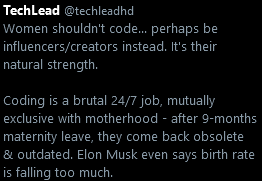
The latest iteration of this stupidity is by @TechLeadHD over at Twitter who recently posted the following gem:

Women shouldn’t code… perhaps be influences/creators instead. It’s their natural strength.

Coding is a brutal 24/7 job, mutually exclusive with motherhood – after 9-months maternity leave, they come back obsolete & outdated. Elon Musk even says birth rate is falling too much

Apparently this guy is not aware that the first programmer in the world was a woman – Ada Lovelace. Other women were crucial in the first few years to get the computers to a state where we could use them in day to day work. Read though this partial list of women who have been influenced the evolution of the computer over the years.

Another thing, coding is not a brutal 24×7 job. If you have to code 24×7 on a daily basis to complete your work then there is something wrong since it looks like you don’t know what you are doing and need to spend all day writing code that others could have completed in a few hours. I have been coding since 1996 (26 years and counting), and while there are times where we have worked round the clock for days or even weeks because we were on a deadline or had a critical issue to resolve that is not the norm. You usually work normal hours and put in crunch time in case of problems or last minute changes.

I do come back home and continue coding or working on personal projects because I enjoy doing that, not because it is mandatory. This guy is making it sound like you are working in a mine somewhere and have a quota of code to be written everyday, where if you don’t achieve the quota then you don’t get food. Sorry most companies don’t work that way. If they try they will not be in business for long.

Coders do take vacations and spend time with people outside the computer. This myth of the lone geek solving all problems is just that – ‘a myth’. In my company I rather have a decent programmer who works well with others than an excellent one who can’t work in a team. In the long term the former is more productive and useful than the latter because people can and do leave a company because of bad teammates.

The part about maternity leave is slightly true but any good programmer will ramp back up quickly after a break. Just because they had a kid doesn’t mean they loose all skills and can’t ramp up. If that was the case then people taking sabbaticals would have the same problem as well. I have had team mates who went on maternity leave and once back they ramped back up quickly. We had to make a few adjustments to ensure things worked out but that is what a good manager/team lead does, you work around the restrictions your team has to ensure that they are able to perform optimally. The more diverse the viewpoint the more potential solutions you can get. Just because you have a way of working or came up a certain way doesn’t mean that others couldn’t have achieved a similar result with a different method. As Perl puts it: There’s more than one way to do it.

We as men need to ensure we object when this sort of comments are made and try our best to ensure that these self appointed gatekeepers are overridden. Imagine if Ada Lovelace had a manager with a similar mindset then we wouldn’t have had a programming language for years maybe decades. Now think of all the other potential Ada’s who are being locked out due to people like this. I mean the guy literally admits to trashing women’s resume’s while at Google: Women still shouldn’t code and I trashed their resumes at Google so they could raise families instead.

It seriously annoys me that we have idiots like this in the tech world in leadership roles. Imagine where we would be if we utilized 100% of our workforce instead of just half?

– Suramya

May 14, 2022

Using algae sealed in a AA battery to generate enough electricity to run a microprocessor for 6 months

Powering computers and all our devices requires us to use batteries if they can’t be connected to a power source/electrical socket. For the most part this means that we use NiCa or Lithium batteries. The problem with this is that they require us to use rare earth metals that are hard to find and process, which makes them expensive and mining the metals are potentially bad for the environment. The other problem is that they need frequent replacement and create a lot of waste. Due to this a lot of effort is going on to find better ways of generating power.

Now, Christopher Howe and other researchers from the University of Cambridge have managed create a power source using blue-green algae to generate enough electricity to power a processor performing calculations (to simulate load). Using a type of cyanobacteria called Synechocystis sp. PCC 6803 sealed in a container about the size of an AA battery, made of aluminum and clear plastic they were able to generate the 0.3 microwatts of power to run the CPU for 45 minutes followed by 15 minutes of standby, which required 0.24 microwatts of power.

The system ran without additional intervention for 6 months and the computer was placed on a windowsill at one of the researchers’ houses during the test and the ambient light was enough to power the processor. There are indications that this can be scaled up to generate more power for more resource intensive applications but even if that doesn’t work out, the current setup could potentially be used to power IoT devices that don’t require that much power to run such as sensors/monitors deployed in the forests/cities for monitoring.

Sustainable, affordable and decentralised sources of electrical energy are required to power the network of electronic devices known as the Internet of Things. Power consumption for a single Internet of Things device is modest, ranging from μW to mW, but the number of Internet of Things devices has already reached many billions and is expected to grow to one trillion by 2035, requiring a vast number of portable energy sources (e.g., a battery or an energy harvester). Batteries rely largely on expensive and unsustainable materials (e.g., rare earth elements) and their charge eventually runs out. Existing energy harvesters (e.g., solar, temperature, vibration) are longer lasting but may have adverse effects on the environment (e.g., hazardous materials are used in the production of photovoltaics). Here, we describe a bio-photovoltaic energy harvester system using photosynthetic microorganisms on an aluminium anode that can power an Arm Cortex M0+, a microprocessor widely used in Internet of Things applications. The proposed energy harvester has operated the Arm Cortex M0+ for over six months in a domestic environment under ambient light. It is comparable in size to an AA battery, and is built using common, durable, inexpensive and largely recyclable materials.

Their research has been published in the Energy & Environmental Science journal and work is ongoing to build on top of it to look at commercial applications.

Source: A colony of blue-green algae can power a computer for six months

– Suramya

May 9, 2022

Researchers have created the first one-way superconductor which could lower energy used by computers

Filed under: Computer Hardware,Emerging Tech,Science Related,Tech Related — Suramya @ 6:58 PM

Computers use massive amounts of energy worldwide and with the increasing dependence on computers in our life the energy utilization is only going to go up. To give you an idea, the International Energy Agency estimates that 1% of all global electricity is used by data centers. There are multiple efforts ongoing to reduce the power consumption and the recent advances by Mazhar Ali from Delft University of Technology in the Netherlands and his colleagues are a great step forward in this direction.

Mazhar and team have successfully demonstrated a working superconducting diode by sandwiching a 2D layer of a material called niobium-3 bromine-8, which is thought to have a built-in electric field, between two 2D superconducting layers. When electrons travel through the structure in one direction, they don’t encounter resistance, but in the other direction they do. This is unique because till now we had only gotten a diode working with non-superconducting metals (as they would not give any resistance in either direction).

The superconducting analogue to the semiconducting diode, the Josephson diode, has long been sought with multiple avenues to realization being proposed by theorists1,2,3. Showing magnetic-field-free, single-directional superconductivity with Josephson coupling, it would serve as the building block for next-generation superconducting circuit technology. Here we realized the Josephson diode by fabricating an inversion symmetry breaking van der Waals heterostructure of NbSe2/Nb3Br8/NbSe2. We demonstrate that even without a magnetic field, the junction can be superconducting with a positive current while being resistive with a negative current. The ΔIc behaviour (the difference between positive and negative critical currents) with magnetic field is symmetric and Josephson coupling is proved through the Fraunhofer pattern. Also, stable half-wave rectification of a square-wave excitation was achieved with a very low switching current density, high rectification ratio and high robustness. This non-reciprocal behaviour strongly violates the known Josephson relations and opens the door to discover new mechanisms and physical phenomena through integration of quantum materials with Josephson junctions, and provides new avenues for superconducting quantum devices.

The next step is to create a superconducting transistor, but there are multiple challenges ahead that need to be overcome before this can be commercially released. The first problem is that the diode only works when it’s temperature is at 2 kelvin, or -271°C which uses more energy than the diode saves. So the team is looking at alternative materials so that they can get it to work at 77 Kelvin (which is when nitrogen is liquid) so the energy used would be less and we would have an energy-saving diode.

Another issue to be sorted is that the current process of making the diode is manual and would need to be automated for large scale production. But that is a future problem as they first need to find a combination of materials that works at a reasonable energy cost.

Source: First one-way superconductor could slash energy used by computers
Paper: The field-free Josephson diode in a van der Waals heterostructure

– Suramya

May 5, 2022

Thoughts around using GPS tracking to stop car thieves

Filed under: Computer Security,My Thoughts,Tech Related — Suramya @ 2:56 PM

Earlier today, I saw the following tweet Retweeted by the BengaluruCityPolice where they recommend that we install a hidden GPS tracker in the car that can be used to find the car if it is ever stolen.

https://twitter.com/DCPNEBCP/status/1522082935519674369

On the surface this sounds like a great idea but there are larger implications that we are missing here. But first lets talk about why this wouldn’t work for long:

  • The thief’s are not fools, once this technique starts getting more popular the first thing they will do is search the car from top to bottom to find and remove the tracker.
  • If the car is underground or behind concrete/metal then the GPS tracker will not be able to transmit. So no signal.

There are other reasons as well but these are the top two that make the tracker useless. Now let’s look at the drawbacks shall we:

Once we have a GPS tracker in the car, all movement information of the car is now tracked and stored online. The current data privacy laws in India allow cops or others to get access to this data fairly simply. This data can also be sold to others (after anonymizing it) but it is quite simple to de-anonymize a dataset as proven by various people recently, such as the case last year where a Priest was outed as a user of Grindr app due to data de-anonymizer.

This is especially risky for women as this potentially allows people to figure out where they live or work, what their schedule looks like etc. Another problem is misuse of data by the company hosting it. History has shown that insiders at companies that store private data have used their access to view private details. This includes cops, tech employees etc. So the more data that is stored the more risk of data misuse and this doesn’t take into account the possibility of attackers hacking into the network to steal the movement data.

Once people have the data, it can then be used for many things such as:

  • Abusers can track their victims (wives/kids)
  • Identify who is having an affair with whom (Uber did this)
  • Figure out who is undergoing medical treatments
  • Criminals can see when we are on vacation and the house is empty.
  • Locate people who are traveling home at late night through empty areas
  • Employers could begin tracking employees to see if an employee is thinking about leaving by looking at visits to competitor’s office etc

These are not theoretical concerns there are been proven cases for each of the above. The risk is grave enough that the US Women’s Law Organization, which deals with a lot of domestic abuse cases has a whole section dedicated to GPS monitoring abuse.

We need to look at all aspects of the technology before we start implementing on a large scale. This includes looking at how the tech could potentially be misused.

– Suramya

May 4, 2022

Using reflection in pupils in public selfies to figure out the different ways a user can hold a device

Filed under: Computer Software,My Thoughts,Tech Related — Suramya @ 11:58 PM

Users in TV/Movies have been able to zoom enhance photo’s that look like they were taken with a broken down webcam from the 80’s to give crystal clear images for a while now. In fact the Zoom/Enhance trope has become so common that there are a whole bunch of meme’s out there for it.

Till recently such activities were possible only in the fictional world, thanks to advances in photo technologies and the increasing no of mega-pixels (plus other things) in the modern camera this is now possible in the real world as well. A few years ago, a Japanese stalker was arrested after he stalked and assaulted a 21-year-old “Japanese idol” at her home by zooming into a high-resolution selfie posted by the singer to view the train station reflected in her eye.

Now, a group of researchers from Keio University, Yahoo Japan, and the Tokyo University of Technology are using publicly posted selfies by users to examine the reflection of the smartphone taking the picture in the pupils of the photo to figure out how the phone is being used i.e. the different ways a user can hold a device like a smartphone: with both hands, just the left, or just the right in portrait mode, and the same options in horizontal mode. There are a bunch of potential uses for this technique and it is interesting and unique research.

But it also highlights the fact that we need to be careful of what we post/share as there might be information in the picture that we didn’t want to share. If you search for ‘photo sent caught cheating’ you will find multiple instances of folks sending pics that got them in trouble because there was something in the pic that gave the game away, such as this one or this one

Source: Using Pupil Reflection in Smartphone Camera Selfies

– Suramya

April 29, 2022

Malware in Windows: TPM Bypasses & Firmware level persistence

Malware is the short form for Malicious Software and is basically software that allows attackers to infect a computer system or device to steal information, disrupt operations or gain access to sensitive data. It is a general term that includes viruses, worms, trojans, spyware, rootkits etc. (Cisco, 2021)

Conceptually the foundations for creating malware were laid almost simultaneously with the creation of the first computers. In 1951, John von Neumann proposed methods on how to create self-replicating automata (Neumann, 1951) and a few years later in 1959 Lionel Penrose published his paper on ‘Self-Reproducing Machines’ this paper was used as the basis for creating replicating machine code that were the basis of the later generations of malware. In 1970’s the creeper virus infected the ARPANET (Milošević, 2013) followed shortly after by Rabbit (Milošević, 2013) which spread rapidly to computers and created copies of itself overloading the machine and impacting system performance. (Milošević, 2013)

In the 1986, the first malware called Brain.A that targeted the PC platform was released. (Milošević, 2013) It used floppy disks as the infection mechanism by infecting the boot sector of every floppy disk used in an infected computer. Other viruses of the time used similar mechanisms to propagate and were quite prevalent by the measures of the time. Once Microsoft Windows was released viruses were created that targeted the new operating system with WinVir being the first virus for the new operating system, it gained persistence by modifying the Windows Executable files. (Milošević, 2013) It spread to new systems over floppy disks.
For almost a decade, infected disks and CD’s remained the primary method of infection for computers. In 1998 this changed with the release of Happy99 in late 1998 that spread via email attachments. Another popular vector for virus infections was macro viruses that infected Microsoft word files which were shared frequently with other users allowing the virus to spread. With the increasing popularity of the Internet, the new malware created during this time leveraged the internet as a transmission vector.

In early 2000, Code Red worm was created that leveraged vulnerabilities in the IIS webservers to propagate. (Milošević, 2013) This opened a new infection vector where the malware would scan for and exploit systems running vulnerable software.

Over the years, malware has become more and more common and has evolved to gain persistence using multiple methods such as using rootkits to infect the OS kernel and other such methods. The one constant throughout the years was that we could clean up a malware infection by formatting the infected drive and restoring from a clean backup. As long as the backup and the installation media were clean we could be confident that the infection was cleared.

Unfortunately, this is no longer the case with new strains of malware using sophisticated techniques to gain persistence using the computer firmware.

A. UEFI malware – The early years

UEFI rootkits were referenced in various leaks and were considered mostly theoretical. The Hacking Team referenced something called ‘rkloader’ in their internal presentations and the Vault7 leaks referenced ‘DerStarke’ which was an EFI/UEFI boot implant. But there was no real evidence of these being used so they were considered mostly theoretical for the most part.

This changed in 2018 when the first rootkit that leveraged the UEFI to achieve persistence was discovered. This malware called Lojax was created by the Sednit APT group. It used a malicious UEFI module written into the SPI flash memory to ensure that it was able to execute malware during the boot up process. (ESET Research, 2018)

B. UEFI Malware – Infecting SPI flash memory

The LoJax malware used the kernel driver RwDrv.sys to access the UEFI settings. The driver is distributed with RWEverything, a freeware utility that can read the BIOS information in most computers. (ESET Research, 2018)

The malware used this driver to read the contents of the SPI flash memory into a file, by running a file called ReWriter_binary.exe. The data in the SPI is stored in volumes using the Firmware File System (FFS). It then parses the volues to search for the Ip4Dxe file. This file along with DXE Core is then modified to add the malicious UEFI module to it post which the entire file is written back to the SPI memory. If the configuration allows write access to SPI the malware immediately writes to the SPI memory but if write access is disabled it exploited a race condition vulnerability in the BIOS locking mechanism to bypass the write protection in SPI flash memory. (CERT, 2015)

C. MoonBounce: UEFI Bootkit

The MoonBounce Bootkit is the third instance of malware that uses UEFI to gain persistence, with Lojax and MosaicRegressor being the other two instances where it was used.

MoonBounce is a lot more sophisticated than the previous iterations and it executes completely in the system memory without writing anything to the hard drive making it a lot harder to detect than the previous iterations of the malware. It stages the execution and deployment of payloads over the internet allowing the attacker to deploy payloads on the system to achieve specific tasks.
MoonBounce was detected in spring 2021 and like the previous iterations attacks the DXE Core module in UEFI to infect the SPI Memory.

D. Using TPM Module & Trusted Computing to protect against this attack

The TPM Module in the modern machines is designed to provide hardware-based, security-related functions and allows the system to secure the system using integrated cryptographic keys.

If TPM is enabled and is being used correctly then it gives the system a way to ensure that all firmware and boot files are unmodified. If any of the files are modified then they will not pass the cryptographic check and the boot process will be halted. This would prevent the infected SPI memory from being loaded and would warn the defenders that their system has been breached.

Unfortunately, it is possible to disable the TPM chip for historical compatibility reasons, so the malware can do the same. One of the ways to disable the check and bypass the Secure Boot & TPM check is to modify the registry files in Windows. The steps to do so are very simple and are shown below (Tibbetts, 2021):

  • At the run prompt type in regedit, and press Enter.
  • Go to Computer\HKEY_LOCAL_MACHINE\SYSTEM\Setup
  • Right-click on Setup and click New > Key. Name that LabConfig
  • Click on LabConfig, then right-click on the right pane, and click New > DWORD (32-bit Value).
  • Name the entry as BypassTPMCheck and change its Value data to 1
  • Create two more DWORDS and change the Value data to 1 just like you did above and name them BypassRAMCheck and BypassSecureBootCheck.

This removes the check for Secure Boot and while it can be desired at times it does open up the system to risk so should only be used for specific use cases where no other option is available.

Protecting against malware using firmware level persistence

To protect against this threat, we need to ensure that all components of the operating system and software on the computer are patched and updated to the latest version. We should enable end-point monitoring and IDS on the network to detect infection attempts. This will allow us to detect the malware before it infects the system and block it pre-emptively. The internet and email gateways should scan all incoming files to detect and block malware. In addition to the standard precautions to protect against malware, we should also ensure that all systems on the network are running the latest version of the UEFI/BIOS available.

Unfortunately, the remediation of the security issues in UEFI is a hard problem and doesn’t have an easy solution. So, the best way to protect against the threat is to try to prevent the system from getting infected in the first place.

Another option to detect infected SPI Memory is to create a tool that periodically creates a dump of the SPI memory and compares the checksum of the dump with a known clean dump. If the values don’t match then there is a high probability that the memory is infected and the administrators can then take steps to clean the firmware by flashing it with a known clean version of the firmware.

With the new methods of persistence available to the malware writers the best way to protect the assets is to try to ensure that you prevent the infection from happening in the first place. Once the machine is infected the task becomes harder and we would need to spend extra time and effort to clean and restore the systems to a clean state.
Done correctly this will decrease the risk of data exfiltration but no technique to detect infection is perfect so a lot of review and audits need to be done on a periodic basis to ensure that the system is still secure.

References

CERT. (2015, January 5). CERT/CC Vulnerability note vu#766164. VU#766164 – Intel BIOS locking mechanism contains race condition that enables write protection bypass. Retrieved March 21, 2022, from https://www.kb.cert.org/vuls/id/766164

Cisco. (2021, July 30). What is malware? – definition and examples. Cisco. Retrieved March 21, 2022, from https://www.cisco.com/c/en_in/products/security/advanced-malware-protection/what-is-malware.html
ESET Research. (2018, October 9). Lojax: First UEFI rootkit found in the wild, courtesy of the Sednit Group. WeLiveSecurity. Retrieved March 21, 2022, from https://www.welivesecurity.com/2018/09/27/lojax-first-uefi-rootkit-found-wild-courtesy-sednit-group/

Neumann, J. V. (1951). Massachusetts Institute of Technology. Theory of Self Replicating Automata. Retrieved March 21, 2022, from https://cba.mit.edu/events/03.11.ASE/docs/VonNeumann.pdf
Tibbetts, T. (2021, July 10). How to bypass secure boot & trusted platform module. Providing Free and Editor Tested Software Downloads. Retrieved March 21, 2022, from https://www.majorgeeks.com/content/page/bypass_tpm.html.


This was a paper for my Class in Q1 2022 which is why it is more formal than my usual posts.
April 28, 2022

Microsoft finds a Linux flaw that grants root access to untrusted users

Filed under: Computer Security,Linux/Unix Related,Tech Related — Suramya @ 11:30 AM

Now that is not a heading I thought I would ever write… I mean 20 years ago imagining that Microsoft would be working with Linux to the point where it would find and report a bug in Linux was unimaginable. For the longest time MS considered Linux to be a massive danger to it’s operations which is why former Microsoft CEO Steve Ballmer famously branded Linux “a cancer that attaches itself in an intellectual property sense to everything it touches” back in 2001. However that has now changed and Windows now has a Windows Subsystem for Linux (wsl) that allows users to run Linux programs from within Windows seamlessly.

This particular flaw which is tracked as CVE-2022-29799 and CVE-2022-29800 combine threats including directory traversal, symlink race, and time-of-check time-of-use (TOCTOU) race condition to gain root access. It was found when a Microsoft researcher Jonathan Bar Or was examining the code for a component known as “_run_hooks_for_state”. The flow to exploit would look something like the following (Thanks ARS Technica for the walkthrough):

Prepare a directory ”/tmp/nimbuspwn” and plant a symlink ”/tmp/nimbuspwn/poc.d“ to point to “/sbin”. The “/sbin” directory was chosen specifically because it has many executables owned by root that do not block if run without additional arguments. This will abuse the symlink race issue we mentioned earlier.
For every executable filename under “/sbin” owned by root, plant the same filename under “/tmp/nimbuspwn”. For example, if “/sbin/vgs” is executable and owned by root, plant an executable file “/tmp/nimbuspwn/vgs” with the desired payload. This will help the attacker win the race condition imposed by the TOCTOU vulnerability.
Send a signal with the OperationalState “../../../tmp/nimbuspwn/poc”. This abuses the directory traversal vulnerability and escapes the script directory.
The networkd-dispatcher signal handler kicks in and builds the script list from the directory “/etc/networkd-dispatcher/../../../tmp/nimbuspwn/poc.d”, which is really the symlink (“/tmp/nimbuspwn/poc.d”), which points to “/sbin”. Therefore, it creates a list composed of many executables owned by root.
Quickly change the symlink “/tmp/nimbuspwn/poc.d” to point to “/tmp/nimbuspwn”. This abuses the TOCTOU race condition vulnerability—the script path changes without networkd-dispatcher being aware.
The dispatcher starts running files that were initially under “/sbin” but in truth under the “/tmp/nimbuspwn” directory. Since the dispatcher “believes” those files are owned by root, it executes them blindly with subprocess.Popen as root. Therefore, our attacker has successfully exploited the vulnerability.

The vulnerability has been patched in the networkd-dispatcher and users running vulnerable systems should patch immediately.

Source: Microsoft finds Linux desktop flaw that gives root to untrusted users

– Suramya

April 27, 2022

MIT’s Ultra-thin speakers can be used to make any surface into a low-power, high-quality audio source

Filed under: Computer Hardware,Emerging Tech,Tech Related — Suramya @ 9:51 PM

Noise Cancellation is one of those things that initially we think that we don’t need but once you start using it, it becomes indispensable. I got my first set of noise canceling headsets back in 2002-2003 when I had a coworker who was extremely loud and would insist on sharing their thoughts in a very loud voice. The cherry on top was that a lot of what they said was wrong and it would grab my attention. I would be peacefully working then I would hear something and be like did they just make this statement? In short it was very distracting. So I got a noise canceling headset and was able to ignore them. Since then I have ensured that I always have my noise canceling headsets handy both at work and while traveling.

But you can’t install noise canceling everywhere (at least not cheaply). I have been fortunate that most of the places I have stayed at I didn’t have the problem of loud neighbors but others are not as fortunate. Loud neighbors are one of the major problems in urban life. Which is why I love this new invention by the folks over at MIT that allows you to convert your entire wall into a noise cancelling surface by putting ultra-thin speakers as a wallpaper in your room. These speakers are very thin & use very little power (100 milliwatts of electricity to power a single square meter).

their design relies on tiny domes on a thin layer of piezoelectric material which each vibrate individually. These domes, each only a few hair-widths across, are surrounded by spacer layers on the top and bottom of the film that protect them from the mounting surface while still enabling them to vibrate freely. The same spacer layers protect the domes from abrasion and impact during day-to-day handling, enhancing the loudspeaker’s durability.

To build the loudspeaker, the researchers used a laser to cut tiny holes into a thin sheet of PET, which is a type of lightweight plastic. They laminated the underside of that perforated PET layer with a very thin film (as thin as 8 microns) of piezoelectric material, called PVDF. Then they applied vacuum above the bonded sheets and a heat source, at 80 degrees Celsius, underneath them.

Because the PVDF layer is so thin, the pressure difference created by the vacuum and heat source caused it to bulge. The PVDF can’t force its way through the PET layer, so tiny domes protrude in areas where they aren’t blocked by PET. These protrusions self-align with the holes in the PET layer. The researchers then laminate the other side of the PVDF with another PET layer to act as a spacer between the domes and the bonding surface.

The applications are endless for this technology. They can be used to soundproof apartments, planes, cars etc. They can be used to create 3D immersive experiences cheaply without having to install gigantic speakers. They could also be used in phones and other devices to play sound/music. Since they are paper-thin, we can apply them as a wallpaper in a room that can be removed when moving out, which would allow renters to install them in the apartments.

The work is still in its early stages but it looks very promising.

Source: Gizmodo: Cover Your Wall in MIT’s New Paper Thin Speakers to Turn Your Bedroom Into a Noise Cancelling Oasis

– Suramya

April 25, 2022

Rainbow Algorithm (one of the candidates for post-quantum Cryptography) can be broken in under 53 hours

Quantum Computing has the potential to make the current encryption algorithms obsolete once it gets around to actually being implemented on a large scale. But the Cryptographic experts in charge of such things have been working on Post Quantum Cryptography over the past few years to offset this risk. After three rounds they had narrowed down the public-key encryption and key-establishment algorithms to Classic McEliece, CRYSTALS-KYBER, NTRU, and SABER and te finalists for digital signatures are CRYSTALS-DILITHIUM, FALCON, and Rainbow.

Unfortunately for the Rainbow algorithm, Ward Beullens at IBM Research Zurich in Switzerland managed to find the corresponding secret key for a given Rainbow public key in 53 hours using a standard laptop. This would allow anyone with a laptop to ‘prove’ they were someone else by producing the secret key for a given public key.

The Rainbow signature scheme [8], proposed by Ding and Schmidt in 2005, is one of the oldest and most studied signature schemes in multivariate cryptography. Rainbow is based on the (unbalanced) Oil and Vinegar signature scheme [16, 11], which, for properly chosen parameters, has withstood all cryptanalysis since 1999. In the last decade, there has been a renewed interest in multivariate cryptography, because it is believed to resist attacks from quantum adversaries. The goal of this paper is to improve the cryptanalysis of Rainbow, which is an important objective because Rainbow is currently one of three finalist signature
schemes in the NIST Post-Quantum Cryptography standardization project.

This obviously disqualifies the algorithm from being standardised as it has a known easily exploitable weakness. It goes on to prove that cryptography is not easy and the only way to ‘prove’ the strength of an algorithm is to let others test them for vulnerabilities. Or as Bruce Schneier put it in Schneier’s Law: ‘Anyone can create an algorithm that they themselves can’t break.’ , you need others to validate that claim.

Paper: Breaking Rainbow Takes a Weekend on a Laptop by Ward Beullens (PDF)
Source: New Scientist: Encryption meant to protect against quantum hackers is easily cracked

– Suramya

« Newer PostsOlder Posts »

Powered by WordPress