Suramya's Blog : Welcome to my crazy life…

April 29, 2022

Malware in Windows: TPM Bypasses & Firmware level persistence

Malware is the short form for Malicious Software and is basically software that allows attackers to infect a computer system or device to steal information, disrupt operations or gain access to sensitive data. It is a general term that includes viruses, worms, trojans, spyware, rootkits etc. (Cisco, 2021)

Conceptually the foundations for creating malware were laid almost simultaneously with the creation of the first computers. In 1951, John von Neumann proposed methods on how to create self-replicating automata (Neumann, 1951) and a few years later in 1959 Lionel Penrose published his paper on ‘Self-Reproducing Machines’ this paper was used as the basis for creating replicating machine code that were the basis of the later generations of malware. In 1970’s the creeper virus infected the ARPANET (Milošević, 2013) followed shortly after by Rabbit (Milošević, 2013) which spread rapidly to computers and created copies of itself overloading the machine and impacting system performance. (Milošević, 2013)

In the 1986, the first malware called Brain.A that targeted the PC platform was released. (Milošević, 2013) It used floppy disks as the infection mechanism by infecting the boot sector of every floppy disk used in an infected computer. Other viruses of the time used similar mechanisms to propagate and were quite prevalent by the measures of the time. Once Microsoft Windows was released viruses were created that targeted the new operating system with WinVir being the first virus for the new operating system, it gained persistence by modifying the Windows Executable files. (Milošević, 2013) It spread to new systems over floppy disks.
For almost a decade, infected disks and CD’s remained the primary method of infection for computers. In 1998 this changed with the release of Happy99 in late 1998 that spread via email attachments. Another popular vector for virus infections was macro viruses that infected Microsoft word files which were shared frequently with other users allowing the virus to spread. With the increasing popularity of the Internet, the new malware created during this time leveraged the internet as a transmission vector.

In early 2000, Code Red worm was created that leveraged vulnerabilities in the IIS webservers to propagate. (Milošević, 2013) This opened a new infection vector where the malware would scan for and exploit systems running vulnerable software.

Over the years, malware has become more and more common and has evolved to gain persistence using multiple methods such as using rootkits to infect the OS kernel and other such methods. The one constant throughout the years was that we could clean up a malware infection by formatting the infected drive and restoring from a clean backup. As long as the backup and the installation media were clean we could be confident that the infection was cleared.

Unfortunately, this is no longer the case with new strains of malware using sophisticated techniques to gain persistence using the computer firmware.

A. UEFI malware – The early years

UEFI rootkits were referenced in various leaks and were considered mostly theoretical. The Hacking Team referenced something called ‘rkloader’ in their internal presentations and the Vault7 leaks referenced ‘DerStarke’ which was an EFI/UEFI boot implant. But there was no real evidence of these being used so they were considered mostly theoretical for the most part.

This changed in 2018 when the first rootkit that leveraged the UEFI to achieve persistence was discovered. This malware called Lojax was created by the Sednit APT group. It used a malicious UEFI module written into the SPI flash memory to ensure that it was able to execute malware during the boot up process. (ESET Research, 2018)

B. UEFI Malware – Infecting SPI flash memory

The LoJax malware used the kernel driver RwDrv.sys to access the UEFI settings. The driver is distributed with RWEverything, a freeware utility that can read the BIOS information in most computers. (ESET Research, 2018)

The malware used this driver to read the contents of the SPI flash memory into a file, by running a file called ReWriter_binary.exe. The data in the SPI is stored in volumes using the Firmware File System (FFS). It then parses the volues to search for the Ip4Dxe file. This file along with DXE Core is then modified to add the malicious UEFI module to it post which the entire file is written back to the SPI memory. If the configuration allows write access to SPI the malware immediately writes to the SPI memory but if write access is disabled it exploited a race condition vulnerability in the BIOS locking mechanism to bypass the write protection in SPI flash memory. (CERT, 2015)

C. MoonBounce: UEFI Bootkit

The MoonBounce Bootkit is the third instance of malware that uses UEFI to gain persistence, with Lojax and MosaicRegressor being the other two instances where it was used.

MoonBounce is a lot more sophisticated than the previous iterations and it executes completely in the system memory without writing anything to the hard drive making it a lot harder to detect than the previous iterations of the malware. It stages the execution and deployment of payloads over the internet allowing the attacker to deploy payloads on the system to achieve specific tasks.
MoonBounce was detected in spring 2021 and like the previous iterations attacks the DXE Core module in UEFI to infect the SPI Memory.

D. Using TPM Module & Trusted Computing to protect against this attack

The TPM Module in the modern machines is designed to provide hardware-based, security-related functions and allows the system to secure the system using integrated cryptographic keys.

If TPM is enabled and is being used correctly then it gives the system a way to ensure that all firmware and boot files are unmodified. If any of the files are modified then they will not pass the cryptographic check and the boot process will be halted. This would prevent the infected SPI memory from being loaded and would warn the defenders that their system has been breached.

Unfortunately, it is possible to disable the TPM chip for historical compatibility reasons, so the malware can do the same. One of the ways to disable the check and bypass the Secure Boot & TPM check is to modify the registry files in Windows. The steps to do so are very simple and are shown below (Tibbetts, 2021):

  • At the run prompt type in regedit, and press Enter.
  • Go to Computer\HKEY_LOCAL_MACHINE\SYSTEM\Setup
  • Right-click on Setup and click New > Key. Name that LabConfig
  • Click on LabConfig, then right-click on the right pane, and click New > DWORD (32-bit Value).
  • Name the entry as BypassTPMCheck and change its Value data to 1
  • Create two more DWORDS and change the Value data to 1 just like you did above and name them BypassRAMCheck and BypassSecureBootCheck.

This removes the check for Secure Boot and while it can be desired at times it does open up the system to risk so should only be used for specific use cases where no other option is available.

Protecting against malware using firmware level persistence

To protect against this threat, we need to ensure that all components of the operating system and software on the computer are patched and updated to the latest version. We should enable end-point monitoring and IDS on the network to detect infection attempts. This will allow us to detect the malware before it infects the system and block it pre-emptively. The internet and email gateways should scan all incoming files to detect and block malware. In addition to the standard precautions to protect against malware, we should also ensure that all systems on the network are running the latest version of the UEFI/BIOS available.

Unfortunately, the remediation of the security issues in UEFI is a hard problem and doesn’t have an easy solution. So, the best way to protect against the threat is to try to prevent the system from getting infected in the first place.

Another option to detect infected SPI Memory is to create a tool that periodically creates a dump of the SPI memory and compares the checksum of the dump with a known clean dump. If the values don’t match then there is a high probability that the memory is infected and the administrators can then take steps to clean the firmware by flashing it with a known clean version of the firmware.

With the new methods of persistence available to the malware writers the best way to protect the assets is to try to ensure that you prevent the infection from happening in the first place. Once the machine is infected the task becomes harder and we would need to spend extra time and effort to clean and restore the systems to a clean state.
Done correctly this will decrease the risk of data exfiltration but no technique to detect infection is perfect so a lot of review and audits need to be done on a periodic basis to ensure that the system is still secure.

References

CERT. (2015, January 5). CERT/CC Vulnerability note vu#766164. VU#766164 – Intel BIOS locking mechanism contains race condition that enables write protection bypass. Retrieved March 21, 2022, from https://www.kb.cert.org/vuls/id/766164

Cisco. (2021, July 30). What is malware? – definition and examples. Cisco. Retrieved March 21, 2022, from https://www.cisco.com/c/en_in/products/security/advanced-malware-protection/what-is-malware.html
ESET Research. (2018, October 9). Lojax: First UEFI rootkit found in the wild, courtesy of the Sednit Group. WeLiveSecurity. Retrieved March 21, 2022, from https://www.welivesecurity.com/2018/09/27/lojax-first-uefi-rootkit-found-wild-courtesy-sednit-group/

Neumann, J. V. (1951). Massachusetts Institute of Technology. Theory of Self Replicating Automata. Retrieved March 21, 2022, from https://cba.mit.edu/events/03.11.ASE/docs/VonNeumann.pdf
Tibbetts, T. (2021, July 10). How to bypass secure boot & trusted platform module. Providing Free and Editor Tested Software Downloads. Retrieved March 21, 2022, from https://www.majorgeeks.com/content/page/bypass_tpm.html.


This was a paper for my Class in Q1 2022 which is why it is more formal than my usual posts.

April 25, 2022

Rainbow Algorithm (one of the candidates for post-quantum Cryptography) can be broken in under 53 hours

Quantum Computing has the potential to make the current encryption algorithms obsolete once it gets around to actually being implemented on a large scale. But the Cryptographic experts in charge of such things have been working on Post Quantum Cryptography over the past few years to offset this risk. After three rounds they had narrowed down the public-key encryption and key-establishment algorithms to Classic McEliece, CRYSTALS-KYBER, NTRU, and SABER and te finalists for digital signatures are CRYSTALS-DILITHIUM, FALCON, and Rainbow.

Unfortunately for the Rainbow algorithm, Ward Beullens at IBM Research Zurich in Switzerland managed to find the corresponding secret key for a given Rainbow public key in 53 hours using a standard laptop. This would allow anyone with a laptop to ‘prove’ they were someone else by producing the secret key for a given public key.

The Rainbow signature scheme [8], proposed by Ding and Schmidt in 2005, is one of the oldest and most studied signature schemes in multivariate cryptography. Rainbow is based on the (unbalanced) Oil and Vinegar signature scheme [16, 11], which, for properly chosen parameters, has withstood all cryptanalysis since 1999. In the last decade, there has been a renewed interest in multivariate cryptography, because it is believed to resist attacks from quantum adversaries. The goal of this paper is to improve the cryptanalysis of Rainbow, which is an important objective because Rainbow is currently one of three finalist signature
schemes in the NIST Post-Quantum Cryptography standardization project.

This obviously disqualifies the algorithm from being standardised as it has a known easily exploitable weakness. It goes on to prove that cryptography is not easy and the only way to ‘prove’ the strength of an algorithm is to let others test them for vulnerabilities. Or as Bruce Schneier put it in Schneier’s Law: ‘Anyone can create an algorithm that they themselves can’t break.’ , you need others to validate that claim.

Paper: Breaking Rainbow Takes a Weekend on a Laptop by Ward Beullens (PDF)
Source: New Scientist: Encryption meant to protect against quantum hackers is easily cracked

– Suramya

April 23, 2022

Molecular engines made of protein could power molecular machines

Filed under: Emerging Tech,My Thoughts — Suramya @ 11:48 PM

Nano-machines have long been staples of Sci-Fi stories where nanotech is used to cure illnesses , make new materials, kill people etc etc and in the recent years a lot of effort has been put in to make these machines real. Basically speaking, a nanomachine, also called a nanite, is a mechanical or electromechanical device whose dimensions are measured in nanometers (millionths of a millimeter, or units of 10 -9 meter). [What is Nanite] They are still in the R&D phase but a lot of progress is being made in the field.

Researchers at the University of Washington in Seattle have created the first building blocks of a molecular engine, namely the axles and rotors. The really cool part is that these are self assembling and use custom designed new proteins unlike any found in nature. The researchers used the advances in Deep learning software to predict what shape a given DNA sequence will fold into making it easier to find a code that makes the desired shape. This allows them to create custom shapes without having to modify existing molecules which can be quite hard.

The team made the machine parts by putting DNA coding for the custom proteins into E. coli bacteria, and then checked their structure using a method called cryogenic electron microscopy.

This showed that the axles assembled correctly inside the rotors, and also revealed the different configurations that would be expected if the axles were turning. But because cryogenic electron microscopy can only provide a series of stills rather than a moving picture, the team can’t say for sure if the axles are rotating.

If they are, it would only be a random back-and-forth movement driven by molecules knocking into each other, a phenomenon called Brownian motion. The team is now designing more components to drive the motion in one direction and create a rotary engine, says Baker.

The work is still in the preliminary stage and the team is designing more components to drive the motion in one direction and create a rotary engine to make sure that the movement seen in the current trials is not just due to Brownian motion. Once the technology is perfected it has a lot of use cases in fields such as BioMed to remove tumors, clean out arterial blocks, repair injuries and fields like material design where these machines can be used to create new materials which are stronger and lighter.

Source: Tiny axles and rotors made of protein could drive molecular machines
Paper: Computational design of mechanically coupled axle-rotor protein assemblies

– Suramya

April 22, 2022

Implications and Impact of Quantum Computing on Existing Cryptography

As all of you are aware the ability to break encryption of sensitive data like financial systems, private correspondence, government systems in a timely fashion is the holy grail of computer espionage. With the current technology it is unfeasible to break the encryption in a reasonable timeframe. If the target is using a 256-bit key an attacker will need to try a max of 2256 possible combinations to brute-force it. This means that even with the fastest supercomputer in the world will take millions of years to try all the combinations (Nohe, 2019). The number of combinations required to crack the encryption key increase exponentially, so a 2048-bit key has 22048 possible combinations and will take correspondingly longer time to crack. However, with the recent advances in Quantum computing the dream of breaking encryption in a timely manner is close to becoming reality in the near future.

Introduction to Quantum Computing

So, what is this Quantum computing and what makes it so special? Quantum computing is an emerging technology field that leverages quantum phenomena to perform computations. It has a great advantage over conventional computing due to the way it stores data and performs computations. In a traditional system information is stored in the form of bits, each of which can be either 0 or 1 at any given time. This makes a ‘bit’ the fundamental using of information in traditional computing. A Quantum computer on the other hand uses a ‘qubit’ as its fundamental unit and unlike the normal bit, a qubit can exist simultaneously as 0 and 1 — a phenomenon called superposition (Freiberger, 2017). This allows a quantum computer to act on all possible states of a qubit simultaneously, enabling it to perform massive operations in parallel using only a single processing unit. In fact, a theoretical projection has postulated that a Quantum Computer could break a 2048-bit RSA encryption in approximately 8 hours (Garisto, 2020).

In 1994 Peter W. Shor of AT&T deduced how to take advantage of entanglement and superposition to find the prime factors of an integer (Shor, 1994). He found that a quantum computer could, in principle, accomplish this task much faster than the best classical calculator ever could. He then proceeded to write an algorithm called Shor’s algorithm that could be used to crack the RSA encryption which prompted computer scientists to begin learning about quantum computing.

Introduction to Current Cryptography

Current security of cryptography relies on certain “hard” problems—calculations which are practically impossible to solve without the correct cryptographic key. Just as it is easy to break a glass jar but difficult to stick it back together there are certain calculations that are easy to perform but difficult to reverse. For example, we can easily multiply two numbers to get the result, however it is very hard to start with the result and work out which two numbers were multiplied to produce it. This becomes even more hard as the numbers get larger and this forms the basis of algorithms like the RSA (Rivest et al., 1978) that would take the best computers available billions of years to solve and all current IT security aspects are built on top of this basic foundation.

There are multiple ways of classifying cryptographic algorithms but in this paper, they will be classified based on the keys required for encryption and decryption. The main types of cryptographic algorithms are symmetric cryptography and asymmetric cryptography.

Symmetric Cryptography

Symmetric cryptography is a type of encryption that uses the same key for both encryption and decryption. This requires the sender and receiver to exchange the encryption key securely before encrypted data can be exchanged. This type of encryption is one of the oldest in the world and was used by Julius Caesar to protect his communications in Roman times (Singh, 2000). Caesar’s cipher, as it is known is a basic substitution cypher where a number is used to offset each alphabet in the message. For example, if the secret key is ‘4’ then each alphabet would be replaced with the 4th letter down from it, i.e. A would be replaced with E, B with F and so on. Once the sender and receiver agree on the encryption key to be used, they can start communicating. The receiver would take each character of the message and then go back 4 letters to arrive at the plain-text message. This is a very simple example, but modern cryptography is built on top of this principle.

Another example is from world war II during which the Germans were encrypting their transmissions using the Enigma device to prevent the Allies from decrypting their messages as they had in the first World War (Rijmenants, 2004). Each day both the receiver and sender would configure the gears and specific settings to a new value as defined by secret keys distributed in advance. This allowed them to transmit information in an encrypted format that was almost impossible for the allied forces to decrypt. Examples of symmetric encryption algorithms include Advanced Encryption Standard (AES), Data Encryption Standard (DES), and International Data Encryption Algorithm (IDEA).

Symmetric encryption algorithms are more efficient than asymmetric algorithms and are typically used for bulk encryption of data.

Asymmetric Cryptography

Unlike symmetric cryptography asymmetric cryptography uses two keys, one for encryption and a second key for decryption (Rouse et al., 2020). Asymmetric cryptography was created to address the problems of key distribution in symmetric encryption and is also known as public key cryptography. Modern public key cryptography was first described in 1976 by Stanford University professor Martin Hellman and graduate student Whitfield Diffie. (Diffie & Hellman, 1976)

Asymmetric encryption works with public and private keys where the public key is used to encrypt the data and the private key is used to decrypt the data (Rouse et al., 2020). Before sharing data, a user would generate a public-private keypair and they would then publish their public key on their website or in key management portals. Now, whoever wants to send private data to them would use their public key to encrypt the data before sending it. Once they receive the cipher-text they would use their private key to decrypt the data. If we want to add another layer of authentication to the communication, the sender would encrypt the data with their private key first and then do a second layer of encryption using the recipient’s public key. The recipient would first decrypt the message using their private key, then decrypt the result using the senders public key. This validates that the message was sent by the sender without being tampered. Public key cryptography algorithms in use today include RSA, Diffie-Hellman and Digital Signature Algorithm (DSA).

Quantum Computing vs Classical Computing

Current state of Quantum Computing

Since the early days of quantum computing we have been told that a functional quantum computer is just around the corner and the existing encryption systems will be broken soon. There has been significant investment in the field of Quantum computers in the past few years, with organizations like Google, IBM, Amazon, Intel and Microsoft dedicating a significant amount of their R&D budget to create a quantum computer. In addition, the European Union has launched a Quantum Technologies Flagship program to fund research on quantum technologies (Quantum Flagship Coordination and Support Action, 2018).

As of September 2020, the largest quantum computer is comprised of 65 qubits and IBM has published a roadmap promising a 1000 qbit quantum computer by 2023 (Cho, 2020). While this is an impressive milestone, we are still far away from a fully functional general use quantum computer. To give an idea of how far we still have to go Shor’s algorithm requires 72k3 quantum gates to be able to factor a k bits long number (Shor, 1994). This means in order to factor a 2048-bit number we would need a 72 * 20483 = 618,475,290,624 qubit computer which is still a long way off in the future.

Challenges in Quantum Computing

There are multiple challenges in creating a quantum computer with a large number of qubits as listed below (Clarke, 2019):

  • Qubit quality or loss of coherence: The qubits being generated currently are useful only on a small scale, after a particular no of operations they start producing invalid results.
  • Error Correction at scale: Since the qubits generate errors at scale, we need algorithms that will compensate for the errors generated. This research is still in the nascent stage and requires significant effort before it will be ready for production use.
  • Qubit Control: We currently do not have the technical capability to control multiple qubits in a nanosecond time scale.
  • Temperature: The current hardware for quantum computers needs to be kept at extremely cold temperatures making commercial deployments difficult.
  • External interference: Quantum computes are extremely sensitive to interference. Research at MIT has found that ionizing radiation from environmental radioactive materials and cosmic rays can and does interfere with the integrity of quantum computers.

Cryptographic algorithms vulnerable to Quantum Computing

Symmetric encryption schemes impacted

According to NIST, most of the current symmetric cryptographic algorithms will be relatively safe against attacks by quantum computer provided a large key is used (Chen et al., 2016). However, this might change as more research is done and quantum computers come closer to reality.

Asymmetric encryption schemes impacted

Unlike symmetric encryption schemes most of the current public key encryption algorithms are highly vulnerable to quantum computers because they are based on the previously mentioned factorization problem and calculation of discrete logarithms and both of these problems can be solved by implementing Shor’s algorithm on a quantum computer with enough qubits. We do not currently have the capability to create a computer with the required number of qubits due to challenges such as loss of qubit coherence due to ionizing radiation (Vepsäläinen et al., 2020), but they are a solvable problem looking at the ongoing advances in the field and the significant effort being put in the field by companies such as IBM and others (Gambetta et al., 2020).

Post Quantum Cryptography

The goal of post-quantum cryptography is to develop cryptographic algorithms that are secure against quantum computers and can be easily integrated into existing protocols and networks.

Quantum proof algorithms

Due to the risk posed by quantum computers, the National Institute of Standards and Technology (NIST) has been examining new approaches to encryption and out of the initial 69 submissions received three years ago, the group has narrowed the field down to 15 finalists and has now begun the third round of public review of the algorithms (Moody et al., 2020) to help decide the core of the first post-quantum cryptography standard. They are expecting to end the round with one or two algorithms for encryption and key establishment, and one or two others for digital signatures (Moody et al., 2020).

Quantum Key Distribution

Quantum Key Distribution (QKD) uses the characteristics of quantum computing to implement a secure communication channel allowing users to exchange a random secret key that can then be used for symmetrical encryption (IDQ, 2020). QKD solves the problem of secure key exchange for symmetrical encryption algorithms and it has the capability to detect the presence of any third party attempting to eavesdrop on the key exchange. If there is an attempt by a third-party to eavesdrop on the exchange, they will create anomalies in the quantum superpositions and quantum entanglement which will alert the parties to the presence of an eavesdropper, at which point the key generation will be aborted (IDQ, 2020). The QKD is used to only produce and distribute an encryption key securely, not to transmit any data. Once the key is exchanged it can be used with any symmetric encryption algorithm to transmit data securely.

Conclusion

Development of a quantum computer may be 100 years off or may be invented in the next decade, but we can be sure that once they are invented, they will change the face of computing forever including the field of cryptography. However, we should not panic as this is not the end of the world as the work on quantum resistant algorithms is going much faster than the work on creating a quantum computer. The world’s top cryptographic experts have been working on Quantum safe encryption for the past three years and we are nearing the completion of the world’s first post-quantum cryptography standard (Moody et al., 2020). Even if the worst happens and it is not possible to create a quantum safe algorithm immediately, we still have the ability to encrypt and decrypt data using one-time pads until a safer alternative or a new technology is developed.

References

Chen, L., Jordan, S., Liu, Y.-K., Moody, D., Peralta, R., Perlner, R., & Smith-Tone, D. (2016). Report on Post-Quantum Cryptography. https://doi.org/10.6028/nist.ir.8105

Cho, A. (2020, September 15). IBM promises 1000-qubit quantum computer-a milestone-by 2023. Science. https://www.sciencemag.org/news/2020/09/ibm-promises-1000-qubit-quantum-computer-milestone-2023.

Clarke, J. (2019, March). An Optimist’s View of the Challenges to Quantum Computing. IEEE Spectrum: Technology, Engineering, and Science News. https://spectrum.ieee.org/tech-talk/computing/hardware/an-optimists-view-of-the-4-challenges-to-quantum-computing.

Diffie, W., & Hellman, M. (1976). New directions in cryptography. IEEE Transactions on Information Theory, 22(6), 644–654. https://doi.org/10.1109/tit.1976.1055638

Freiberger, M. (2017, October 1). How does quantum computing work? https://plus.maths.org/content/how-does-quantum-commuting-work.

Gambetta, J., Nazario, Z., & Chow, J. (2020, October 21). Charting the Course for the Future of Quantum Computing. IBM Research Blog. https://www.ibm.com/blogs/research/2020/08/quantum-research-centers/.

Garisto, D. (2020, May 4). Quantum computers won’t break encryption just yet. https://www.protocol.com/manuals/quantum-computing/quantum-computers-wont-break-encryption-yet.

IDQ. (2020, May 6). Quantum Key Distribution: QKD: Quantum Cryptography. ID Quantique. https://www.idquantique.com/quantum-safe-security/overview/quantum-key-distribution/.
Moody, D., Alagic, G., Apon, D. C., Cooper, D. A., Dang, Q. H., Kelsey, J. M., Yi-Kai, L., Miller, C., Peralta, R., Perlner R., Robinson A., Smith-Tone, D., & Alperin-Sheriff, J. (2020). Status report on the second round of the NIST post-quantum cryptography standardization process. https://doi.org/10.6028/nist.ir.8309

Nohe, P. (2019, May 2). What is 256-bit encryption? How long would it take to crack? https://www.thesslstore.com/blog/what-is-256-bit-encryption/.
Quantum Flagship Coordination and Support Action (2018, October). Quantum Technologies Flagship. https://ec.europa.eu/digital-single-market/en/quantum-technologies-flagship

Rijmenants, D. (2004). The German Enigma Cipher Machine. Enigma Machine. http://users.telenet.be/d.rijmenants/en/enigma.htm.

Rivest, R. L., Shamir, A., & Adleman, L. (1978). A method for obtaining digital signatures and public-key cryptosystems. Communications of the ACM, 21(2), 120–126. https://doi.org/10.1145/359340.359342

Rouse, M., Brush, K., Rosencrance, L., & Cobb, M. (2020, March 20). What is Asymmetric Cryptography and How Does it Work? SearchSecurity. https://searchsecurity.techtarget.com/definition/asymmetric-cryptography.

Shor, P. w. (1994). Algorithms for quantum computation: discrete logarithms and factoring. Proceedings 35th Annual Symposium on Foundations of Computer Science, 124–134. https://doi.org/10.1109/sfcs.1994.365700

Singh, S. (2000). The code book: The science of secrecy from Egypt to Quantum Cryptography. Anchor Books.

Vepsäläinen, A. P., Karamlou, A. H., Orrell, J. L., Dogra, A. S., Loer, B., Vasconcelos, F., David, K. K., Melville A. J., Niedzielski B. M., Yoder J. L., Gustavsson, S., Formaggio J. A., VanDevender B. A., & Oliver, W. D. (2020). Impact of ionizing radiation on superconducting qubit coherence. Nature, 584(7822), 551–556. https://doi.org/10.1038/s41586-020-2619-8


Note: This was originally written as a paper for one of my classes at EC-Council University in Q4 2020, which is why the tone is a lot more formal than my regular posts.

– Suramya

April 21, 2022

It is possible to plant Undetectable Backdoors in Machine Learning Models

Machine learning (ML) is the big thing and ML algorithms are slowly creeping into all aspects of our life such as unlocking your phone using facial recognition, evaluating the eligibility for a loan, surveillance, what ads you see when surfing the web, what search results you get when searching for stuff etc etc. The problem is that ML algorithms are not infallible they depend on the training data used, confirmational bias etc. At the very least they enforce the existing bias for example, if a company only hires men 25-45 for a role then the ML data set will take this as the input and all future candidates will be evaluated against this criteria because the system thinks that this is what a success looks like. The algorithms themselves are getting more and more complicated and it is almost impossible to review and validate the findings. Due to this decisions are being made by machines that can’t be audited easily. Plus it doesn’t help that most ML models are proprietary and the companies refuse to let outsiders examine them due to Trade secrets and proprietary information used in them.

Another problem is that these ML models is adversarial perturbations where attackers make minor changes to the image/data going in to get a specific response/output. There are a lot of examples of this in the past few years and some of them are listed below (Thanks to Cory Doctorow for consolidating them in one place)

These all take advantage of flaws in the ML model that can be exploited using minor changes in the input data. However, there is another major exploit surface available which is incredibly hard to protect against: Backdoors in the ML models by creating a model that will accept a particular entry/key to produce a specific output. The ‘best’ part is that it is almost impossible to detect if this has been done because the model will function exactly the same as an un-tampered model and will only show the abnormal behavior for the specific key which would have been randomly generated by the creator during the training. If done well then the modifications will be undetectable for most tests.

A team for MIT and IAS has written a paper on it (“Planting Undetectable Backdoors in Machine Learning Models“) where they go into details of how this can be done and the potential impact. Unfortunately, they have not been able to come up with a feasible defense against this attack as of this time. Hopefully that will change as others start focusing on this problem and how to solve it.

Given the computational cost and technical expertise required to train machine learning models, users may delegate the task of learning to a service provider. We show how a malicious learner can plant an undetectable backdoor into a classifier. On the surface, such a backdoored classifier behaves normally, but in reality, the learner maintains a mechanism for changing the classification of any input, with only a slight perturbation. Importantly, without the appropriate “backdoor key”, the mechanism is hidden and cannot be detected by any computationally-bounded observer. We demonstrate two frameworks for planting undetectable backdoors, with incomparable guarantees.

First, we show how to plant a backdoor in any model, using digital signature schemes. The construction guarantees that given black-box access to the original model and the backdoored version, it is computationally infeasible to find even a single input where they differ. This property implies that the backdoored model has generalization error comparable with the original model. Second, we demonstrate how to insert undetectable backdoors in models trained using the Random Fourier Features (RFF) learning paradigm or in Random ReLU networks. In this construction, undetectability holds against powerful white-box distinguishers: given a complete description of the network and the training data, no efficient distinguisher can guess whether the model is “clean” or contains a backdoor.

Our construction of undetectable backdoors also sheds light on the related issue of robustness to adversarial examples. In particular, our construction can produce a classifier that is indistinguishable from an “adversarially robust” classifier, but where every input has an adversarial example! In summary, the existence of undetectable backdoors represent a significant theoretical roadblock to certifying adversarial robustness.

The paper is still waiting for the peer-review to complete but the concept and methods they describe seem solid so this is a problem we will have to solve sooner rather than later considering the speed with which ML models are impacting our life.

Source: Schneier on Security: Undetectable Backdoors in Machine-Learning Models

– Suramya

April 19, 2022

Please stop taking such photos unless you have a death wish.

Filed under: My Thoughts — Suramya @ 12:04 AM

The following image popped up in my feed earlier today and I am dumbfounded by what people feel is ok to do to get a perfect (Instagram?) picture.


Answer: Common sense and a working brain

This looks like it is an active road, as you can see cars in the background and there are cars driving towards them. They are lying down on a zebra crossing, in the rain which will make it difficult for drivers to stop the car quickly. Plus since no one expects idiots to be lying down on the road there is a good chance that someone who is not paying attention or is momentarily distracted can run them over and in this pose it is almost impossible for these two to get out of the way fast if a car is about to run them down.

I have taken a few sitting on the road photos over the years, but we ensured that the roads were empty and we could see for a fair distance so that we could get out of the way if there was oncoming traffic.

Come on folks, is taking a great pic really worth dying for? Or do you want to be remembered as the idiots who got run over when taking an Instagram pic? Please stop this idiotic behavior.

– Suramya

April 18, 2022

Oracle releases a ‘free’ version of Oracle Solaris 11.4 for opensource developers and non-production personal use

Filed under: Linux/Unix Related,My Thoughts — Suramya @ 2:59 AM

Last month Oracle released a ‘free’ version of Oracle Solaris 11.4 for opensource developers and non-production personal use. The key point to note is that this doesn’t mean that there is a free/opensource version of the OS now available because unlike the Open Solaris project (that was released in 2008 but was discontinued) this build is a similar to a beta release and contains pre-release builds of a particular SRU (which I think means a release version). To me it sounds like they want the opensource community to perform free testing for their releases while getting some positive publicity.

I don’t think I will be trying it out because I don’t really trust Oracle. They are notorious for their bad takes and really aggressive enforcement of their IP rights. Plus their history with opensource projects has been bumpy and you never know when they will change their mind and go in a different direction.

My first experience with Unix/Linux was SunOS 4.1 followed by Solaris 5. I even had a Sparc machine at one point but it got lost during one of the many moves I made over the years. I loved the OS and since I couldn’t run it on my machines I started using Linux which was a great alternative. When OpenSolaris was released I received installation CDs to try it out, unfortunately life got in the way and I never really tested it out (other than the initial install). It was disappointing when the project went defunct & shutdown. I took a look at the OpenSolaris Wikipage and it looks like none of the derivative projects that were supposed to take over really went anywhere. So that sucks.

I don’t think that Unix does anything that Linux can’t do and even then if you want to run Unix on your machines I would recommend you go for FreeBSD instead of this ‘free’ version.

Thanks to HackaDay: Solaris Might Be Free If You Want It for the initial link.

– Suramya

April 17, 2022

Air Quality in Delhi/NCR sucks

Filed under: My Thoughts — Suramya @ 10:32 AM

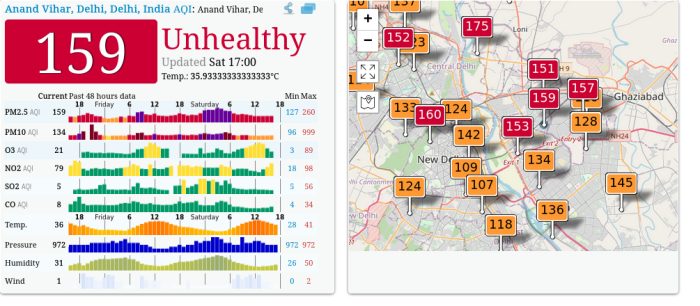
People complain about the air quality in Delhi/NCR a lot (and I am one of them). The Delhi government tries to blame it all on the annual burning of crops in Punjab but that is just an excuse as that happens once a year and the quality is bad through out the year. A few years ago I was in at our place in Noida and I walked out of my room & looked at the living room and found the view to be hazy. At first I thought that this was due to me not wearing my glasses but then realized that it was smog inside our house. I immediately searched for and installed my old air purifier (from our days in the US) and within a short time the haziness was gone.

Recently I bought the PHILIPS High Efficiency Air Purifier AC2887/20 for my house in Bangalore and when I saw how effective it is, I got the same thing for the parents to use in Delhi as well. The one I have in Bangalore ran 24/7 while there was construction going on inside our house (we had the bathrooms renovated) and I had no issues/allergic reactions due to the work being done. Without the purifier I would have been on a constant diet of Allegra the entire day with splitting headaches. You can imagine the amount of dust being generated due to the work but the purifier took it all in stride and I cleaned the external filter once because I thought I should (no alerts to clean came on) after the construction was done.

My father started using the purifier about a month ago (finally!) when the pollen season started and his allergies kicked in. It ran in his room mostly at the night and sometimes during the day as well. Earlier this week after he had been using it for about a month, he pinged me to ask for a particular error code being displayed on the purifier meant, so I found the manual for the device and looked it up. The error code (F0) meant that the external filter needed to be cleaned for the device to work at peak efficiency.

I ran it with construction going on in the other room and the filter never got so bad that the device had to ask me to clean it. Delhi/Noida air quality on the other hand is so bad that they had to clean it within a month of using it normally. Now tell me that the air quality in NCR is not bad! Plus there is no burning’s happening right now or Diwali so you can’t blame it on that either. No wonder Delhi was rated the most polluted capital city in the world.


Delhi Air Pollution: Real-time Air Quality Index (AQI) (Source: aqicn.org)

There needs to be an active urgent effort by the Government to reduce the pollution level, similar to what was done in the early 2000’s when the air quality had improved for a brief time after all the public transports were moved to CNG.

Till then I am going to ensure that the purifier is constantly running at home in Delhi. I don’t do it in the Bangalore house regularly but I do run a purifier in the car to reduce my exposure.

– Suramya

April 14, 2022

Ensure your BCP plan accounts for the Cloud services you depend on going down

Filed under: Computer Software,My Thoughts,Tech Related — Suramya @ 1:53 AM

Long time readers of the blog and folks who know me know that I am not a huge fan of putting everything on the cloud and I have written about this in the past (“Cloud haters: You too will be assimilated” – Yeah Right…), I mean don’t get me wrong, the cloud does have it’s uses and advantages (some of them are significant) but it is not something that you want to get into without significant planning and thought about the risks. You need to ensure that the ROI for the move is more than the increased risk to your company/data.

One of the major misconceptions about the cloud is that when we put something on there we don’t need to worry about backups/uptimes etc because the service provider takes care of it. This is obviously not true. You need to ensure you have local backups and you need to ensure that your BCP (Business Continuity Plan) accounts for what you would do if the provider itself went down and the data on the cloud is not available.

You think that this is not something that could happen? The 9 day and counting outage over at Atlassian begs to differ. On Monday, April 4th, 20:12 UTC, approximately 400 Atlassian Cloud customers experienced a full outage across their Atlassian products. This is just the latest instance where a cloud provider has gone down leaving it’s users in a bit of a pickle and as per information sent to some of the clients it might take another 2 weeks to restore the services for all users.

One of our standalone apps for Jira Service Management and Jira Software, called “Insight – Asset Management,” was fully integrated into our products as native functionality. Because of this, we needed to deactivate the standalone legacy app on customer sites that had it installed. Our engineering teams planned to use an existing script to deactivate instances of this standalone application. However, two critical problems ensued:

Communication gap. First, there was a communication gap between the team that requested the deactivation and the team that ran the deactivation. Instead of providing the IDs of the intended app being marked for deactivation, the team provided the IDs of the entire cloud site where the apps were to be deactivated.
Faulty script. Second, the script we used provided both the “mark for deletion” capability used in normal day-to-day operations (where recoverability is desirable), and the “permanently delete” capability that is required to permanently remove data when required for compliance reasons. The script was executed with the wrong execution mode and the wrong list of IDs. The result was that sites for approximately 400 customers were improperly deleted.

To recover from this incident, our global engineering team has implemented a methodical process for restoring our impacted customers.

To give you an idea of how serious this outage is, I will use my personal experience with their products and how they were used in one of my previous companies. Without Jira & Crucible/Fisheye no one will be able to commit code into the repositories or do code reviews of existing commits. The users will not be able to do production / dev releases of any product. Since Confluence is down users/teams can’t access guides/instructions/SOP documents/documentation for any of their systems. Folks who use Bitbucket/sourcetree would not be able to commit code. This is the minimal impact scenario. It gets worse for organizations who use CI/CD pipelines and proper SDLC processes/lifecycles that depend on their products.

If the outage was on the on-premises servers then the teams could fail over to the backup servers and continue, but unfortunately for them the issue is on the Atlassian side and now everyone just has to wait for it to be fixed.

Code commits blocks (pre-commit/post-commit hooks etc) can be disabled but unless you have local copies of the documentation stored in Confluence you are SOL. We actually faced this issue once with our on-prem install where the instructions on how to do the failover were stored on the confluence server that had gone down. We managed to get it back up by a lot of hit & try methods but after that all teams were notified that their BCP/failover documentation needed to be kept in multiple locations including hardcopy.

If the companies using their services didn’t prepare for a scenario where Atlassian went down then there are a lot of people scrambling to keep their businesses and processes running.

To prevent issues, we should look at setting up systems that take auto-backups of the online systems and store it on a different system (can be in the cloud but use a different provider or locally). All documentation should have local copies and for really critical documents we should ensure hard copy versions are available. Similarly we need to ensure that any online repositories are backed up locally or on other providers.

This is a bad situation to be in and I sympathize with all the IT staff and teams trying to ensure that their companies business is running uninterrupted during this time. The person who ran the script on the other hand on the Atlassian server should seriously consider getting some sort of bad eye charm to protect themselves against all the curses flying their way (I am joking… mostly.)

Well this is all for now. Will write more later.

April 13, 2022

Internet of Things (IoT) Forensics: Challenges and Approaches

Internet of Things or IoT consists of interconnected devices that have sensors and software, which are connected to automated systems to gather information and depending on the information collected various actions can be performed. It is one of the fastest growing markets, with enterprise IoT spending to grow by 24% in 2021 from $128.9 billion. (IoT Analytics, 2021).

This massive growth brings new challenges to the table as administrators need to secure IoT devices in their network to prevent them from being security threats to the network and attackers have found multiple ways through which they can gain unauthorized access to systems by compromising IoT systems.

IoT Forensics is a subset of the digital forensics field and is the new kid on the block. It deals with forensics data collected from IoT devices and follows the same procedure as regular computer forensics, i.e., identification, preservation, analysis, presentation, and report writing. The challenges of IoT come into play when we realize that in addition to the IoT sensor or device we also need to collect forensic data from the internal network or Cloud when performing a forensic investigation. This highlights the fact that Forensics can be divided into three categories: IoT device level, network forensics and cloud forensics. This is relevant because IoT forensics is heavily dependent on cloud forensics (as a lot of data is stored in the cloud) and analyzing the communication between devices in addition to data gathered from the physical device or sensor.

Why IoT Forensics is needed

The proliferation of Internet connected devices and sensors have made life a lot easier for users and has a lot of benefits associated with it. However, it also creates a larger attack surface which is vulnerable to cyberattacks. In the past IoT devices have been involved in incidents that include identity theft, data leakage, accessing and using Internet connected printers, commandeering of cloud-based CCTV units, SQL injections, phishing, ransomware and malware targeting specific appliances such as VoIP devices and smart vehicles.

With attackers targeting IoT devices and then using them to compromise enterprise systems, we need the ability to extract and review data from the IoT devices in a forensically sound way to find out how the device was compromised, what other systems were accessed from the device etc.

In addition, the forensic data from these devices can be used to reconstruct crime scenes and be used to prove or disprove hypothesis. For example, data from a IoT connected alarm can be used to determine where and when the alarm was disabled and a door was opened. If there is a suspect who wears a smartwatch then the data from the watch can be used to identify the person or infer what the person was doing at the time. In a recent arson case, the data from the suspects smartwatch was used to implicate him in arson. (Reardon, 2018)

The data from IoT devices can be crucial in identifying how a breach occurred and what should be done to mitigate the risk. This makes IoT forensics a critical part of the Digital Forensics program.

Current Forensic Challenges Within the IoT

The IoT forensics field has a lot of challenges that need to be addressed but unfortunately none of them have a simple solution. As shown in the research done by M. Harbawi and A. Varol (Harbawi, 2017) we can divide the challenges into six major groups. Identification, collection, preservation, analysis and correlation, attack attribution, and evidence presentation. We will cover the challenges each of these presents in the paper.

A. Evidence Identification

One of the most important steps in forensics examination is to identify where the evidence is stored and collect it. This is usually quite simple in the traditional Digital Forensics but in IoT forensics this can be a challenge as the data required could be stored in a multitude of places such as on the cloud, or in a proprietary local storage.

Another problem is that since IoT fundamentally means that the nodes were in real-time and autonomous interaction with each other, it is extremely difficult to reconstruct the crime scene and to identify the scope of the damage.

A report conducted by the International Data Corporation (IDC) states that the estimated growth of data generated by IoT devices between 2005 to 2020 is going to be more than 40,000 exabytes (Yakubu et al., 2016) making it very difficult for investigators to identify data that is relevant to the investigation while discarding the irrelevant data.

B. Evidence Acquisition

Once the evidence required for the case has been identified the investigative team still has to collect the information in a forensically sound manner that will allow them to perform analysis of the evidence and be able to present it in the court for prosecution.

Due to the lack of a common framework or forensic model for IoT investigations this can be a challenge. Since the method used to collect evidence can be challenged in court due to omissions in the way it was collected.

C. Evidence Preservation and Protection

After the data is collected it is essential that the chain of custody is maintained, and the integrity of the data needs to be validated and verifiable. In the case of IoT Forensics, evidence is collected from multiple remote servers, which makes maintaining proper Chain of Custody a lot more complicated. Another complication is that since these devices usually have a limited storage capacity and the system is continuously running there is a possibility of the evidence being overwritten. We can transfer the data to a local storage device but then ensuring the chain of custody is unbroken and verifiable becomes more difficult.

D. Evidence Analysis and Correlation

Due to the fact that IoT nodes are continuously operating, they produce an extremely high volume of data making it difficult to analyze and process all the data collected. Also, since in IoT Forensics there is less certainty about the source of data and who created or modified the data, it makes it difficult to extract information about ownership and modification history of the data in question.

With most of the IoT devices not storing metadata such as timestamps or location information along with issues created by different time zones and clock skew/drift it is difficult for investigators to create causal links from the data collected and perform analysis that is sound, not subject to interpretation bias and can be defended in court.

E. Attack and Deficit Attribution

IoT forensics requires a lot of additional work to ensure that the device physical and digital identity are in sync and the device was not being used by another person at the time. For example, if a command was given to Alexa by a user and that is evidence in the case against them then the examiner needs to confirm that the person giving the command was physically near the device at the time and that the command was not given over the phone remotely.

F. Evidence Presentation

Due to the highly complex nature of IoT forensics and how the evidence was collected it is difficult to present the data in court in an easy to understand way. This makes it easier for the defense to challenge the evidence and its interpretation by the prosecution.

VI. Opportunities of IoT Forensics

IoT devices bring new sources of information into play that can provide evidence that is hard to delete and most of the time collected without the suspect’s knowledge. This makes it hard for them to account for that evidence in their testimony and can be used to trip them up. This information is also harder to destroy because it is stored in the cloud.

New frameworks and tools such Zetta, Kaa and M2mLabs Mainspring are now becoming available in the market which make it easier to collect forensic information from IoT devices in a forensically sound way.

Another group is pushing for including blockchain based evidence chains into the digital and IoT forensics field to ensure that data collected can be stored in a forensically verifiable method that can’t be tampered with.

Conclusion

IoT Forensics is becoming a vital field of investigation and a major subcategory of digital forensics. With more and more devices getting connected to each other and increasing the attack surface of the target it is very important that these devices are secured and have a sound way of investigating if and when a breach happens.

Tools using Artificial Intelligence and Machine learning are being created that will allow us to leverage their capabilities to investigate breaches, attacks etc faster and more accurately.

References

Reardon. M. (2018, April 5). Your Alexa and Fitbit can testify against you in court. Retrieved from https://www.cnet.com/tech/mobile/alexa-fitbit-apple-watch-pacemaker-can-testify-against-you-in-court/.

M. Harbawi and A. Varol, “An improved digital evidence acquisition model for the Internet of Things forensic I: A theoretical framework”, Proc. 5th Int. Symp. Digit. Forensics Security (ISDFS), pp. 1-6, 2017.

Yakubu, O., Adjei, O., & Babu, N. (2016). A review of prospects and challenges of internet of things. International Journal of Computer Applications, 139(10), 33–39. https://doi.org/10.5120/ijca2016909390


Note: This was originally written as a paper for one of my classes at EC-Council University in Q4 2021, which is why the tone is a lot more formal than my regular posts.

– Suramya

« Newer PostsOlder Posts »

Powered by WordPress