Thinking of getting this as a gift for Surabhi for the next Rakhi. 😀

Wanna take a nap? Sure, let me get you a pillow.
Do you think I will survive gifting this?
– Suramya
Thinking of getting this as a gift for Surabhi for the next Rakhi. 😀
Do you think I will survive gifting this?
– Suramya
When I think of CSS (Cascading Style Sheets) I think of it as a way to change presentation and styling of a web page, but it looks like it is a full fledged programming language now that can run an entire x86 CPU emulator without using any Javascript.
Lyra Rebane managed this feat where you can write programs in C, compile them to x86 machine code with GCC, and run them inside CSS. A demo is available at: https://lyra.horse/x86css/. The demo doesn’t work in Firefox but works great in Chrome/Chromium based browsers.
Lyra is going to post a blog in the near future explaining how it all works and I for one am eagerly waiting for it because this is a phenomenal achievement.
How??
I plan on writing a blog post that explains how this works as well as many of the tricks used. Bookmark my blog or add it to your RSS reader.
Surely you still need a little bit of JavaScript?Nope, this is CSS-only!
There is a script tag on this site, which is there to provide a clock to the CSS – but this is only there to make the entire thing a bit faster and more stable. The CSS also has a JS-less clock implementation, so if you disable scripts on this site, it will still run. JavaScript is not required.
My CSS clock uses an animation combined with style container queries, which means you don’t need to interact with anything for the program to run, but it also means its a bit slower and less stable as a result. A hover-based clock, such as the one in Jane Ori’s CPU Hack, is fast and stable, but requires you to hold your mouse on the screen, which some people claim does not count as turing complete for whatever reason, so I wanted this demo to be fully functional with zero user input.
Source: @rebane2001@infosec.exchange
– Suramya
When I started working with computers way back in 1995, one of the first lessons I learnt was to keep things simple because the more complicated or more layers you have in your system the more ways there are for things to go wrong and more attack surfaces are available for a bad actor to target. This was called the KISS (Keep It Simple Stupid) principle. With the current systems adding more and more complexity it feels like people have stopped following that advice. Especially with LLM/AI getting added there is a layer of complexity that is like a black box because we can’t know enough about the model being used, such as what data was used to train it, what biases are included (knowingly or unknowingly) into the model etc.
Where cars used to be simple mechanical devices they are now instead computers on wheels that are getting more and more complicated. As per IEEE, a typical car may use 100 million lines of code and this is without AI/Self Driving systems coming into the picture.
We now have AI systems running on Cars that use models to drive cars, decide when to stop and what rules to follow. To explore the risk, researchers at the University of California, Santa Cruz, and Johns Hopkins tested the AI systems and the large vision language models (LVLMs) underpinning them and found that they would reliably follow instructions if displayed on signs held up in their camera’s view. This research adds to the growing list of evidence that AI decision-making can easily be tampered with, which is a major concern because a lot of decisions are slowly being outsourced to these “AI” systems some of which can have serious consequences.
The researchers have published their findings in a paper where they introduce CHAI (Command Hijacking against embodied AI), a physical environment indirect prompt injection attack that exploits the multimodal language interpretation abilities of AI models.
Abstract: Embodied Artificial Intelligence (AI) promises to handle edge cases in robotic vehicle systems where data is scarce by using common-sense reasoning grounded in perception and action to generalize beyond training distributions and adapt to novel real-world situations. These capabilities, however, also create new security risks. In this paper, we introduce CHAI (Command Hijacking against embodied AI), a new class of prompt-based attacks that exploit the multimodal language interpretation abilities of Large Visual-Language Models (LVLMs). CHAI embeds deceptive natural language instructions, such as misleading signs, in visual input, systematically searches the token space, builds a dictionary of prompts, and guides an attacker model to generate Visual Attack Prompts. We evaluate CHAI on four LVLM agents; drone emergency landing, autonomous driving, and aerial object tracking, and on a real robotic vehicle. Our experiments show that CHAI consistently outperforms state-of-the-art attacks. By exploiting the semantic and multimodal reasoning strengths of next-generation embodied AI systems, CHAI underscores the urgent need for defenses that extend beyond traditional adversarial robustness.
Potential consequences include self-driving cars proceeding through crosswalks without regard to humans crossing it, taking passengers to a different destination (potentially allowing bad actors to kidnap people), getting the car into an accident by forcing it to ignore traffic rules/oncoming traffic.
Source: schneier.com: Prompt Injection Via Road Signs
– Suramya
25 years ago, one of the first Internet meme’s took the net (and real life) by the storm. I am talking about “All Your Base Are Belong To Us” which was making fun of a bad translation of a Japanese videogame.
In honor of the anniversary Jamie Zawinski, downloaded the original Flash SWF file from Internet Archive, played it using Ruffle in a full-screen window, and replaced the audio with the original MP3 of “Invasion of the Gabber Robots” by The Laziest Men on Mars. The updated/clean version is now posted on Youtube and you can watch it in all it’s glory there:
Transcript:
Captain: What happen ?
Mechanic: Somebody set up us the bomb.
Operator: We get signal.
Captain: What !
Operator: Main screen turn on.
Captain: It’s you !!
CATS: How are you gentlemen !!
CATS: All your base are belong to us.
CATS: You are on the way to destruction.
Captain: What you say !!
CATS: You have no chance to survive make your time.
CATS: Ha ha ha ha …
Operator: Captain !!
Captain: Take off every ‘ZIG’!!
Captain: You know what you doing.
Captain: Move ‘ZIG’.
Captain: For great justice.
Folks nowadays are so used to things going viral that it is hard for them to realize how big of a phenomenon this was (along with the Alien song). I have posted about this earlier as well. Talking about it has made me want to look up the Alien Song, so will do that now.
That’s all for now. Will post more later.
Source: jwz.org: All Your Base, slight remaster (via: mastodon.social)
Diablo II is one of my all time favorite games and I have been playing it on and off since it first released back in 2000. The game had five character classes when it first launched and two more classes were added in the expansion Diablo II: Lord of Destruction released a year later.
Now 25 years later Diablo II a new playable class called ‘Warlock’ is coming to Diablo II as part of the ‘Reign of the Warlock‘ expansion. In addition to the new character class the update also has new quests, Terror Zones etc.
Fresh from the gates of the Burning Hells, the Reign of the Warlock is upon us! This major update brings the Warlock, the first new playable class to Diablo II in 25 years. The Warlock is a mysterious, dark scholar who’s spent years studying their taboo craft in the shadows, but no longer. Wield their awesome power to bind demons and wreak havoc upon your foes.
Reign of the Warlock brings fresh new Terror Zones, fearsome Colossal Ancients to conquer, alongside player requested quality-of-life changes, and more. Use this powerful new class to carve through the demon hordes, using your dark arts to dominate your foes.
It shows how popular the game is when the studio releases an update with new content to a 26 year old game.
Source: @arstechnica@mastodon.social
In my previous post I spoke about how I like Star Trek: Starfleet Academy while others didn’t because reasons. After I posted it I was thinking about how people who don’t like something feel it is their duty to dump on anyone who dares like it instead and that prompted this post. It is ok to not like something, but just because you don’t like it doesn’t mean you get to harass people who like it.
Over the weekend I was at this flea market with my cousin and we were talking about books and movies. Somehow the topic of Lord of the Rings came up and I told her that I absolutely dislike the books because the author spends 10 pages telling you what was there for breakfast. Her reaction was to the affect of “what is wrong with you? How can you not like it???”. I shared why I don’t like it and she shared that she likes the books especially because of the world building. I could have dumped on her to make her feel bad but why do that? People are allowed to have different tastes and likings.
Jani and me are polar opposites in the movies and books we both like and that is ok. I don’t care for Christmas movies or romcoms while she doesn’t like scifi/fantasy movies. Should I make her feel bad about liking such movies? Of course not. I do however make fun of them sometimes but not to the point where you put down the person liking the movie.
So, long story short. If you don’t like a movie or a book or whatever and someone else does. You don’t get to crap on their happiness in enjoying it. It is ok to disagree and discuss the reason why you don’t like it (up to a point) but you shouldn’t put them down (as a person) for liking it.
– Suramya
As some of you might know already I am a huge Star Trek fan. I have watched every iteration of the franchise multiple times and have loved all of them except Deep Space 9, which I found to be one of the most boring TV shows I had watched. Was not a huge fan of Enterprise either but it was still watchable and I managed to finish watching all of it. Star Trek is a show with a 60 year history which makes adding a new show in the canon a potentially dicey affair because of how it would affect other shows and potentially create continuity errors. Which is why I find the ~1000 year jump in Discovery and the setting of Star Trek Academy in the 32nd century interesting. It allows the creators to start off with a clean slate and not worry about paradoxes and continuity issues.
The latest show in the series is called ‘Star Trek: Academy’ which is set about a hundred years after the ‘Burn’ which had brought down the Federation. It follows the first class of Star Fleet Cadets in a hundred years as they work towards becoming officers and rebuilding the Federation. I watched the show and so far quite like it, it still has the message of hope and how people need to work together to rebuild while retaining the core ethos of Star Trek, which is: Infinite Diversity in Infinite Combinations.
Once the show launched we had the standard backlash from the usual suspects who think that any show that shows people other than straight white males in the story are destroying the franchise. One of the funnier complaints against the show was about how Nahla Ake played by Holly Hunter who is the half-Lanthanite captain of the USS Athena and the chancellor of Starfleet Academy sits in the show. I will admit it was a bit disconcerting to see a captain sit with her feet folded up into the captain’s chair but after the initial surprise it didn’t detract from her authority and was just a humorous sideline.
But to listen to the detractors, that quirk is destroying the core foundation of the show and it highlights how straight white men are being hounded out of their spaces because of politics. They keep talking about how the new show is making things political whereas the original didn’t do politics/social commentary at all.
Listening to their complaints I started wondering if we were watching the same show or not. Star Trek has always been political and covered important topics such as authoritarianism, imperialism, class warfare, economics, racism, religion, human rights, sexism, feminism, and the role of technology. In fact Gene Roddenberry himself stated: “[By creating] a new world with new rules, I could make statements about sex, religion, Vietnam, politics, and intercontinental missiles. If you talked about purple people on a far off planet, they (the television network) never really caught on.”
I do admit that I don’t like all the characters in the show and especially dislike the character Sam (Series Acclimation Mil) because of her extra-exuberant behavior and portrayal which is something that I find annoying in real life as well, because my personality is a polar opposite of that behavior. This is not to say that the actor is bad, just that I don’t like the character. The other characters in the show are all ok and show a surprising range of behavior where the show & the characters are not pure black and white portrayals and that makes the show very interesting.
The other major reason I like it is because of the underlying portrayal of hope in the show. The universe is a mess because of the Burn but it is not a grim retelling of Star Trek which is awesome. It is good to have shows that have a positive/light hearted take on things. (I am def not a fan of the Grim re-imagining of various franchises that has been popular over the last few years)
All in all, the show is a fun watch and I look forward to seeing where the story takes us.
– Suramya
The following showed up in my feed and I thought it was important that I share it as this post highlights a good point about why it is important to call out people during arguments/discussions about human rights. I never thought about it this way but after reading it, this makes perfect sense and I am going to use this going forward.

@sepuichritude
one thing I don’t think people realize is that in arguments about human rights, it’s not about trying
to persuade the other party. its not about them at all. they’ve already made up their mind.it’s about persuading the audience.
if I call out my teacher on being homophobic I’m not trying to change his opinion. I’m trying to convince
any closeted kids in the room that they’re not the monsters he’s made them out to be.if I argue with my aunt about how racist she’s being it’s not because I expect to change her mind. its
because I’m hoping to god my cousin’s kids hear and learn that maybe skin color doesn’t mean what she says it means.people will try to hush you and say “they’re not going to change their minds, don’t bother” but its not about them. it was never about them
You see the thing is that if someone puts down a person because of stereotyping and no one objects to it then it normalizes that statement and that way of thinking. Over time that particular school of thought becomes accepted/normalized as the truth. The more people don’t object/call it out the more it gets mainlined and normalized. I have seen this with jokes about women in Tech, Indians being bad at English, Gay’s being evil and so on and so forth.
The other major issue is that if a person is being made fun of or being put down and no one objects, they will think that everyone there agrees with the statement. Which might or might not be true, but it will become true in the long run. As the saying goes, if there is one Nazi at a bar and is not immediately kicked out then it is a Nazi bar. The same is true for sexist or racist behavior/homophobia etc etc. Which is why we have communities enforcing Code of Conduct’s, companies having POSH and similar rules.
You might not be able to change a person’s mind but you can definitely show the person being picked at that they are not alone and not what the person picking on them is accusing them of being.
Thoughts?
– Suramya
I have quite a lot of work with Open Source Software (OSS) over the years which has resulted in two job offers and multiple opportunities to speak about OSS in various forums. I have even published some of my own work on my site as well. Nowadays with ‘AI’ scrapers hammering code repositories for content that is used to train their code generators in violation of the code licenses a lot of people have been pretty upset about it with multiple lawsuits being filed and unfortunately some of the developers have gotten tired enough that they have stopped publishing their code under OSS licenses.
The community is obviously divided about this as shown by the following post on Mastodon:
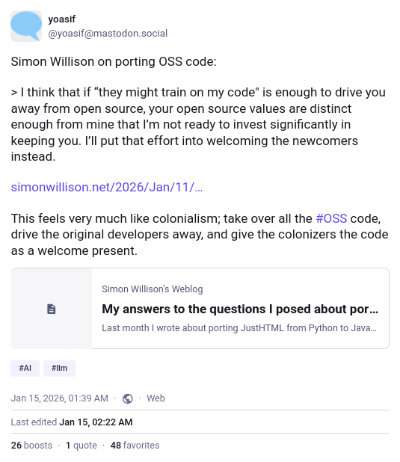
@yoasif 🔗 https://mastodon.social/users/yoasif/statuses/115895264796629089
–
Simon Willison on porting OSS code:> I think that if “they might train on my code” is enough to drive you away from open source, your open source values are distinct enough from mine that I’m not ready to invest significantly in keeping you. I’ll put that effort into welcoming the newcomers instead.
https://simonwillison.net/2026/Jan/11/answers/
This feels very much like colonialism; take over all the #OSS code, drive the original developers away, and give the colonizers the code as a welcome present.
Basically, some people are asking Code Generators to stop scanning their code into their system otherwise they will stop contributing to OSS and on the other side we have people like Simon who think that this is a bad reason to stop contributing code to OSS. I am not going to talk about the quality of code that that code generators create and why it is a bad idea to use these generators because I have talked about that in multiple other posts.
Looking at just the question of “Is it worth Contributing to Open Source with AI Scrapers using your work for training materials”, I think the answer is yes (for me at least) and everyone has the right to answer this in their own way.
For me Open Source is about learning how things work and solving specific problems that I want to fix, now this can be in existing software already published as OSS or new code that I write and then share publicly. I am sharing it so that people don’t have to reinvent the wheel and can build on top of existing solutions (which is what OSS is all about). Is it fair/right that companies are training their LLM’s on my code and then extrapolating/building on it without credit? Of-course not. I think that it is fair that I (or any developer) gets credit for the work they put in building something.
However, I learnt quite a lot looking at code that others had shared for free as OSS and I want to keep that culture alive and give that same option to new comers that I had. We are going to need a lot of coders in the near future to fix problems that were created by ‘vibe coders’ and LLM’s and the best way to create that experience is to have them look at existing code so that they can learn from it. Both the good parts and in certain cases learn what not to do 😉 .
So in summary I would have to say that yes it is worth it. Feel free to comment and share your thoughts on this.
– Suramya
There is an interesting disconnect in people about software engineering. They are unable to grasp that the industry/team exists to solve business problems, not to release changes as fast as possible (I mean we do want to release fast but not at the expense of solving actual problems) or to try out the latest in technology. This is why I have seen techies in companies get upset that they can’t upgrade the entire setup to use the latest and greatest (as of now) framework they just heard about. Business doesn’t care about any of that, they want the software to work reliably, have the features they want and be stable. If you have ever had to pitch a infra upgrade, addressing technical debt or system uplift (without new features) to senior management you know what I am talking about.
A good SLDC (Software Development Life Cycle) setup ensures that there is a solid code review process setup before a change is deployed into production. This allows a person (or persons) other than the developer to review the code and highlight any issues found. It also serves as a way to train junior programmers about best practices and more efficient ways to do things. I have come back from code reviews with pages of questions and better approaches to solving the problem I was addressing. Even now all my code still goes through code review. If a company doesn’t have a good code-review workflow then I would be very scared to use any products developed by them. In Git this review is initiated by creating a PR (Pull Request), once the changes are approved they are merged into the next release branch.
Programming is more than just writing code and pushing it to production. As I said earlier the goal is to solve business problems efficiently and without bugs. So when I see statements like in the screenshot below I get very scared because it shows just how unprepared/unknowledgeable some of the folks who are ‘vibe-coding’ or AI coding changes that are being pushed to production are.
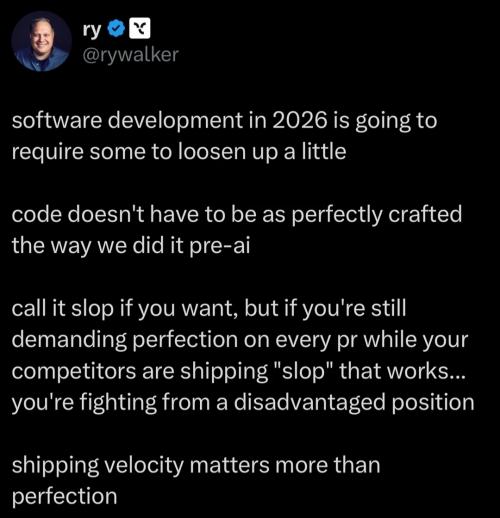
rye
@rywalkersoftware development in 2026 is going to require some to loosen up a little
code doesn’t have to be as perfectly crafted the way we did it pre-ai
call it slop if you want, but if you’re still demanding perfection on every pr while your competitors are shipping “slop” that works…
you’re fighting from a disadvantaged positionshipping velocity matters more than perfection
Even ‘Pre-AI’ no one has perfectly crafted code, which is why we have technical debt and temporary fixes that last years if not decades. That said, the main goal of the Code Review is to ensure that you are
a) Doing what you want to do correctly
b) You didn’t break any existing functionality
c) Didn’t introduce any new bugs
d) Are coding efficiently/following best practices.
Out of the four listed above A to C are critical. Most of the review process usually focuses on these three with the last one being given focus as and when time permits. There are times when you encounter ‘The Coding Evangelist’ (See: Types of Software Developers for explanation) who will make you miserable trying to perfect the code but that is usually a rare occurrence (at least in my experience over the past 27 years of coding).
But if you are optimizing for speed of production instead of legibility and maintainability that is a way to incur tech debt at scale. Which is a big problem for systems in production. People often fail to take into consideration the cost of “Keeping the Lights on”.
Sometimes people do argue in reviews about stupid stuff, one funny instance I remember is from a previous company where these two senior developers had an ongoing argument about how to format the code. Each one hated the other person’s preferred formatting and they had both actually created Macros in Emacs to change the formatting to their preferred style every time they edited the file. We could figure out who the last person to work on the file was by looking at the formatting.
Long story short, (good) Code reviews are absolutely required and essential for an organization to ensure that the code in production is as stable and bug free as possible. It doesn’t matter how quickly you are pushing code if the code doesn’t work the way it is supposed to or/and has bugs in it.
– Suramya
Powered by WordPress