Suramya's Blog : Welcome to my crazy life…

July 31, 2023

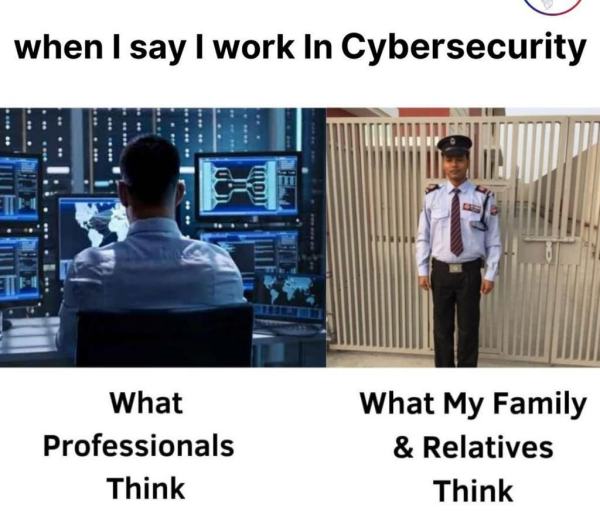
What people think I do when I say I work in Cybersecurity

Filed under: Humor,My Thoughts — Suramya @ 9:17 PM

It is great to have siblings because they make sure that you are grounded and don’t get too full of yourselves. My sister Surabhi sent me this image to ensure I know what they think of my specialization.

Picture of a guy with lots of monitors and the image of a security guard for what my family thinks I do
What Professionals think I do when I say I work in Cybersecurity and what my Family thinks I do

Well, in all fairness when Gaurang became a ships captain we told him he was a driver of a ship (instead of a bus). So, I can’t really complain…

– Suramya

July 27, 2023

GPS Data Could potentially be used to Detect Large Earthquakes in advance

Filed under: Emerging Tech,My Thoughts — Suramya @ 10:31 PM

Earthquakes are extremely devastating and because we don’t have a way to predict them in advance they end up taking a huge toll on lives. The existing systems for earthquake prediction are fraught with false positives to the point of being useless. However, that hasn’t stopped people from trying to predict them, and in a new paper researchers Quentin Bletery and Jean-Mathieu Nocquet claim to have found a unique way to predict them up to 2 hours in advance using GPS data.

They analyzed high-rate GPS time series before 90 different earthquakes that were magnitude 7 and above to find a precursor signal and they observed a subtle signal that rose from the noise about 2 hours before these major earthquakes occurred. This looks extremely promising and if validated can change how we approach disaster management of earthquakes. However, the study still needs to be validated and we don’t yet know if the precursor signal could ever be measured for individual events with the accuracy needed to provide a useful warning.

The existence of an observable precursory phase of slip on the fault before large earthquakes has been debated for decades. Although observations preceding several large earthquakes have been proposed as possible indicators of precursory slip, these observations do not directly precede earthquakes, are not seen before most events, and are also commonly observed without being followed by earthquakes. We conducted a global search for short-term precursory slip in GPS data. We summed the displacements measured by 3026 high-rate GPS time series—projected onto the directions expected from precursory slip at the hypocenter—during 48 hours before 90 (moment magnitude ≥7) earthquakes. Our approach reveals a ≈2-hour-long exponential acceleration of slip before the ruptures, suggesting that large earthquakes start with a precursory phase of slip, which improvements in measurement precision and density could more effectively detect and possibly monitor.

This is an area where Machine Learning might prove to be useful to extrapolate and predict but that being said we still need to validate and verify before implementing it or depending on it. The paper with their findings was published in Science (DOI: 10.1126/science.adg2565)

Source: Hacker News: Early Warning: GPS Data Could Detect Large Earthquakes Hours Before They Happen

– Suramya

July 26, 2023

New Double sided solar panels nearly double the power production per panel

Filed under: Emerging Tech,Science Related — Suramya @ 11:12 PM

Solar Panels have come a long way in the last few decades and their efficiency has been consistently increasing over the time as well. We have gone from an efficiency of ~10% on an average to more than 25% today. Now researchers from US Department of Energy’s National Renewable Energy Laboratory (NREL) have created a new double sided solar panel that generates electricity from both sides of the panel. Basically it uses reflected light on the back side of the panel to generate power. Even though the amount of power generated by the backside of the panel is only ~90% of the power generated by the front end adding them both together means that a single panel is generating almost double the power than traditional panels.

Bifacial photovoltaics (PV) harvest solar irradiance from both their front and rear surfaces, boosting energy conversion efficiency to maximize their electrical power production. For single-junction perovskite solar cells (PSCs), the performance of bifacial configurations is still far behind that of their state-of-the-art monofacial counterparts. Here, we report on highly efficient, bifacial, single-junction PSCs based on the p-i-n (or inverted) architecture. We used optical and electrical modeling to design a transparent conducting rear electrode for bifacial PSCs to enable optimized efficiency under a variety of albedo illumination conditions. The bifaciality of the PSCs was about 91%–93%. Under concurrent bifacial measurement conditions, we obtained equivalent, stabilized bifacial power output densities of 26.9, 28.5, and 30.1 mW/cm2 under albedos of 0.2, 0.3, and 0.5, respectively. We further showed that bifacial perovskite PV technology has the potential to outperform its monofacial counterparts with higher energy yields and lower levelized cost of energy (LCOE).

This is a significant breakthrough and the research was published in the journal Joule titled “Highly efficient bifacial single-junction perovskite solar cells”.

I love the fact that renewable energy is getting so much more push nowadays. I have been exploring putting solar at my place, but since I am in an apartment I don’t have much options available that would make financial sense. The panels I could put up would barely supply enough power making the whole thing not cost effective. Parents have put solar at our house in Delhi and my cousin has done the same at their farm where most of their power consumption is managed by their solar setup.

– Suramya

July 25, 2023

Suramya’s Blog is now (hopefully) its own Federated Instance on Fediverse

Filed under: Website Updates — Suramya @ 5:45 PM

Unless I have managed to mess up something really bad, this Blog should now be a part of the Fediverse and all posts here should get published to the Fediverse automatically. If all is well, then searching for @suramya@suramya.com on a Mastodon instance should allow you to add me there and all posts (with their full text) made here should get published there automatically.

Once the ActivityPub plugin is installed, each author’s page on your WordPress blog will become its own federated instance. In other words, if you have two authors, Jane and Bob, on your website, example.com, then your authors would have their own author pages at example.com/author/jane and example.com/author/bob. Each of those author pages would now be available to Mastodon users (and all other federated platform users) as a profile that can be followed. Let’s break that down further. Let’s say you have a friend on Mastodon who tells you to follow them and they give you their profile name @janelivesheresomeofthetime. You search for her name, see her profile, and click the follow button, right? From then on, everything Jane posts on her profile shows up in your Home feed. Okay, similarly, now that Jane has installed the ActivityPub plugin on her example.com site, her friends can also follow her on Mastodon by searching for @jane@example.com and clicking the Follow button on that profile.

– Suramya

June 29, 2023

There is no such thing as micro-cheating and these are not examples of it

Filed under: My Thoughts — Suramya @ 12:17 PM

I am constantly surprised at how insecure these some of the men are. The following screenshot came up in my Mastodon feed (unfortunately I didn’t save the link to the post, just the image and I can’t find it now) and I was flabbergasted. This is a screenshot from a ‘romance’ guide that is explaining how addressing a man by their name instead of calling them hey you is an example of Micro-cheating…


34 Ways Your Girlfriend Is Micro- Cheating (And Totally Getting Away With It) 29. Addressing a man by his name unexpectedly (e.g. “Hey, Doug” instead of just “Hey”), which breeds a strangely powerful sense of intimacy.

What on earth is wrong with people? Calling folks by their name is basic curtsy. I admit I am bad at it because I have a hard time remembering names but that is not something I am proud of and I try to go the extra mile to ensure that I memorize names.

A quick search gave me the site, and the examples they use in this ‘article’ are beyond idiotic. Search for the text from the example above and you will find it. I am not linking to it because I don’t want to send them more traffic. For example, #25 claims that “giggling“, yes you read that right is an example of Micro-cheating… Some more gems from the site:

9. Letting a guy she interacts with ever so briefly on the bus or in an elevator believe that he’s got a shot for a few precious seconds before getting on with her day.
Just because someone smiled at you doesn’t mean they are interested in dating you.

30. Addressing a man by his full name instead of the nickname he goes by (e.g. “Hello, Douglas”), which is secretly one of the most subtle but impactful ways to flirt.
I don’t like calling folks by their nicknames unless I know them well enough to use it (not talking about examples where Christian is shortened to Chris) and that doesn’t mean I am flirting with them.

34. Sending texts to a guy that are laced with more emojis than she typically uses when communicating with her besties.

These folks need to talk to a psychiatrist because they need help. They are being trained from a young age to only think about women a certain way and to expect every lady they meet to fall at their feet to fulfill their every desire. This is obviously not what happens in the real world and then these folks grow more & more militant and misogynistic causing huge problems for everyone around them. Some of them have actually killed people because they didn’t get what they thought was their right.

– Suramya

June 28, 2023

Please stop shoving ChatGPT Integration into products that don’t need it

I am getting really tired of folks shoving ChatGPT integration into everything whether it makes sense or not. The latest silliness is an electric bike with ChatGPT integration. I understand the desire to integrate GPS/Maps etc in a bike, although personally I would rather use an independent device which would get updates more frequently than the built in GPS where the maps might get updated a few times a year. Unless the maps are getting downloaded live using 3G/4G/whatever. I even understand the desire to integrate voice recognition in the setup so that the user can talk to it. But why on earth do I want/need to have ChatGPT shoved in there?

Based on ChatGPT’s well known tendency to hallucinate there is a good probability that it might decide that you should take a path that is not safe or even dump you into the ocean because it hallucinated that it was the way to go. This is the same thing we saw with Blockchain a few years ago, everything was suddenly on the Blockchain whether it needed to be or not. The sad part is that these folks are going to make a ton of money because of the hype behind ChatGPT and then bail leaving the consumers with a sub-par bike that hallucinates.

Source: Urtopia Unveils the World’s First Smart E-Bike with ChatGPT Integration at EUROBIKE 2023

– Suramya

June 27, 2023

Thoughts on Meta joining the Fediverse (Mastodon)

Filed under: My Thoughts,Tech Related — Suramya @ 4:29 PM

The past few weeks have been interesting over at Mastodon where some of the community has been screaming and loosing their minds about the possibility of Meta becoming part of the Fediverse. Bloonface summarized my feelings about it perfectly in the following Toot:


Let’s just say the blunt truth here: It’s not going to be Meta or Project 92 or whatever that kills fedi, it’s the fact that every time anyone suggests a way in which normal people can use it in the same way that normal people use social networks, the entire network shits the bed and starts screaming about keeping the outsiders out. But then also the same people heap judgment on people for still using Twitter when Twitter actually gives them what they want

People have reason not to trust Meta because of their behavior in the past, and we have extreme examples where Opensource protocols were subverted (XAMPP) and the opensource clients killed off. However, we also have the example of AOL which was a closed garden opening up their network and users to the Internet which introduced a ton of people to the Open Internet and while there were initial hiccups and adjustments required in the long run it was good for the internet to ingest the closed garden into an open network.

One of the biggest reasons for people sticking with Facebook/Whatsapp/whatever is the cost of switching and the Network effect. Basically, what that means is that people use a social network/site because their friends are already using it and it is difficult to get them to switch. I have tried getting my family and friends to switch to Signal from Whatsapp but since most folks are on Whatsapp it becomes a chicken and egg problem. We can’t move there because all the friends are here. Having Meta become a part of the Fediverse would allow me to move to a new network/server and still be able to connect with my friends / relatives on FaceBook. This interoperability lowers the switching costs allowing users the freedom to change servers without loosing the userbase/network they have build up on the old system/

Cory Doctorow has written a fantastic article about Facebook’s war on switching costs that goes into detail on how reducing the switching costs and increasing interoperability is a good idea.

Unfortunately, there are folks who think that only the chosen few should be allowed to use ‘their’ networks and are screaming their heads off about something that is not even a formal discussion yet. Meta has had a few exploratory calls with Mastodon server admins and that’s it. No one has ‘betrayed’ the users or sold out or whatever. I can’t remember how many folks have been referencing that post about ‘Geeks, MOPs, and sociopaths in subculture evolution’ that I wrote about a while ago (not linking to the original post because I don’t what to increase its visibility). It is the same standard whining for a certain part of the user group that always tries to gatekeep everything and it is annoying.

I would love to have everyone move to Mastodon so that I don’t have to log into Twitter to catch up with folks. Currently not everyone is on Mastodon which means that either I stop following their work or I log into Twitter to read what they are doing till they migrate. If Twitter federates then I wouldn’t have to do that, I could read their posts from the comfort of my own server. Same thing with Facebook, I don’t log in much there but that means that I miss a lot of updates from family who still use it actively.

However, the advantage of having an open federated network is that even if some of the admins have a hissy fit and block the Meta (or any other servers) nothing is preventing their users from deciding to move their accounts to a more sensibly managed server as they are not locked in.

– Suramya
June 26, 2023

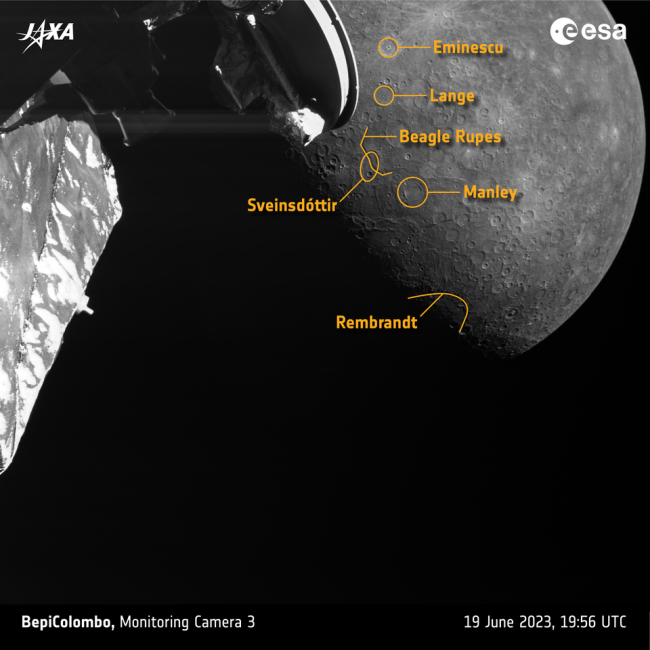
BepiColombo takes fabulous photos during its flyby of Mercury 236 km above the planet’s surface

Filed under: Astronomy / Space,Science Related — Suramya @ 9:10 PM

Mercury, the closest planet to the Sun has been a challenge to explore and examine because of its closeness to the Sun. This is the second craft to orbit the planet after NASA’s MESSENGER probe, which orbited the planet from 2011 to 2015. BepiColombo is a joint venture between European Space Agency (ESA) and the Japan Aerospace Exploration Agency (JAXA). The latest flyby was 3rd of the 6 planned flybys of the planet. The team has released a short video composed of 217 images taken during the flyby.


Photo taken by BepiColombo during its 3rd flyby of Venus

Pic Credit: European Space Agency/ Japan Aerospace Exploration Agency

The closest approach took place at 19:34 UTC (21:34 CEST) on 19 June 2023, about 236 km above the planet’s surface, on the night side of the planet.

Approaching on the nightside of the planet, a few features started to appear out of the shadows about 12 minutes following the closest approach, when BepiColombo was already about 1800 km from the surface. The planet’s surface became more optimally illuminated for imaging from about 20 minutes after close approach and onwards, corresponding to a distance of about 3500 km and beyond. In these closer images, a bounty of geological features are visible, including a newly named crater.

While not apparent in these flyby images, the nature of the dark material associated with Manley Crater and elsewhere will be explored further by BepiColombo from orbit. It will seek to measure just how much carbon it contains and what minerals are associated with it, in order to learn more about Mercury’s geological history.

The next Mercury flyby will happen in September 2024 but the next next long solar electric propulsion ‘thruster arc’ is planned to start early August until mid-September which will help BepiColombo in Braking against the gravitational pull of the Sun. During the lifetime of the project, the module will have completed 15,000 hours of solar electric propulsion operations which will allow it to perform 9 planetary flybys in total — one at Earth, two at Venus, and six at Mercury.

The more we explore our celestial neighbors, the more information we will have before we start working towards space colonization and building settlements. Although, I don’t think that Mercury will be a contender in the near future for a settlement, unless we find a rare mineral or something over there.

Source: Slashdot: New Video Shows a Flyby of the Planet Mercury – with AI-Assisted Music

– Suramya

June 21, 2023

India launches 2nd Gen satellite for the NavIC Navigation System

Filed under: Astronomy / Space,Science Related — Suramya @ 1:07 PM

GPS has become so ingrained in our life that it is hard to imagine a world before GPS. I remember having to use paper maps and asking folks for directions during our road trips and now I don’t need to worry about anything, just follow the map and you can find anything. Even during my mountaineering course back in 1999 we learnt how to navigate and how to figure out where you were using landmarks. Towards the end of the course the instructor showed us a GPS receiver (which was ridiculously expensive at that time) as something that was available but couldn’t be relied upon because it was too expensive and might not be available. Now we have watches with built in GPS so the technology has come a long way since then.

However, since GPS is a US controlled system they have the ability to disable it for any area if they want and that creates a major risk. In the Kargil war, US disabled GPS for the entire region making it difficult for them to figure out where they were and perform the attacks more safely. This highlighted the risk and strategic importance of the functionality for India and they started working on an indigenous replacement.

Other countries have also realized the same and implemented their own version of GPS, these include Russian GLONASS, European Galileo, Japanese QZSS (Covers Japan and surrounding areas), and Chinese BeiDou. India’s replacement is called NavIC, which means sailor in Hindi. It is an regional satellite navigation system that provides accurate real-time positioning and timing services and currently covers India and a region extending 1,500 km (930 mi) around it. The system went live in 2018 via seven satellites. These satellites only operated in the L-5 band and S-band frequencies which are not supported in civilian equipment so wasn’t available for civilian use. After the Galileo constellation was granted approval to use the L1 band India also requested access and was granted permission by the International Telecommunication Union to use the L1 and L2 frequency bands.

On 29th May 2023, ISRO successfully placed the NVS-01 navigation satellite into orbit. This second generation satellite supports the L1 band which means the device manufacturers such as GPS receivers and smartphones just need a software update to support navigation using NavIC instead of needed extra hardware which was the case with the previous generation of the system. ISRO is planning on launching a satellite every six months over the next few years to put 11 new satellites in orbit so that the system has redundancy.

NVS-01 is the first of the second-generation satellites envisaged for the Navigation with Indian Constellation (NavIC) services. NVS series of satellites will sustain and augment the NavIC with enhanced features. This series incorporates L1 band signals additionally to widen the services. For the first time, an indigenous atomic clock will be flown in NVS-01.

For now the system is concentrating on the Indian subcontinent and the area around it but as more satellites are launched they are planning on covering the entire globe and provide users with an alternative to GPS.

Source: EurAsian Times: Backstabbed During Pakistan War, India ‘Ditches’ US GPS For ‘Much More Accurate’ NavIC Navigation System

– Suramya

June 20, 2023

It is now possible to track someone using SMS Receipt Messages

Filed under: Computer Security,Interesting Sites,My Thoughts,Tech Related — Suramya @ 6:04 PM

With modern technology it is getting more and more easy to track someone. There are many apps, devices etc that allow a target to be tracked in near realtime by someone. This can be done using an App on your phone, find my phone functionality, family phone track etc etc. As someone who is worried about getting tracked they can disable GPS, get a new dumb phone that doesn’t support GPS etc which can mitigate the threat to a large extent. Unfortunately, now there is a new attack surface that allows an attacker to approximately locate a target with up to 96% accuracy.

Researchers have figured out how to deduce the location of an SMS recipient by analyzing timing measurements from typical receiver location. Basically they measure the time elapsed between sending a SMS and the receipt of the Delivery report and then use a ML model to predict the location area where the target could be located. The other advantage of this attack is that it doesn’t require any specialized equipment or access to restricted systems but can be executed via a simple smartphone.

Short Message Service (SMS) remains one of the most popular communication channels since its introduction in 2G cellular networks. In this paper, we demonstrate that merely receiving silent SMS messages regularly opens a stealthy side-channel that allows other regular network users to infer the whereabouts of the SMS recipient. The core idea is that receiving an SMS inevitably generates Delivery Reports whose reception bestows a timing attack vector at the sender. We conducted experiments across various countries, operators, and devices to show that an attacker can deduce the location of an SMS recipient by analyzing timing measurements from typical receiver locations. Our results show that, after training an ML model, the SMS sender can accurately determine multiple locations of the recipient. For example, our model achieves up to 96% accuracy for locations across different countries, and 86% for two locations within Belgium. Due to the way cellular networks are designed, it is difficult to prevent Delivery Reports from being returned to the originator making it challenging to thwart this covert attack without making fundamental changes to the network architecture.

The biggest problem with this method is that it doesn’t depend on any software or anything that needs to be installed on the target phone. You just need a phone that supports SMS, which is pretty much all phones in the market. There is an option to disable delivery reports which would mitigate the threat to an extent but is an opt-out setup rather than an opt-in. One way to reduce this vector would be for manufacturers to disable the delivery report by default and folks who need it can enable it from settings instead of the other way round which is the case right now.

Source: HackerNews: Freaky Leaky SMS: Extracting user locations by analyzing SMS timings
Full Paper: Freaky Leaky SMS: Extracting User Locations by Analyzing SMS Timings

– Suramya

« Newer PostsOlder Posts »

Powered by WordPress